Standing seam metal roll forming machines are an essential equipment for manufacturers of metal roofing and siding panels. This comprehensive guide provides an overview of standing seam roll formers, their working, types, applications, specifications, suppliers, installation, operation, maintenance, and benefits.
Overview of Standing Seam Metal Roll Forming Machines
Standing seam metal roll forming machines create corrugated or interlocking raised seams on metal panels. The seams enable joining of panels and provide mechanical strength. Roll forming converts flat metal coils into shaped panel profiles by progressively bending the strip through consecutive roller dies.
What is a Standing Seam Metal Roof?
A standing seam metal roof has raised seams where panel edges fold over each other. The vertical seams interlock panels together from eave to ridge. This allows panels to expand and contract freely with temperature changes. Panels are attached to the structure without penetration of the metal surface.
Advantages of Standing Seam Metal Roofs
- Durability – Lasts 50 years or more with minimal maintenance
- Wind and fire resistance – Seams allow flexibility during high winds
- Leak resistance – Water runs off with no penetration points
- Energy efficiency – Reflective surface and thermal break under seams
- Aesthetics – Available in variety of colors with attractive seams
How Does a Roll Forming Machine Work?
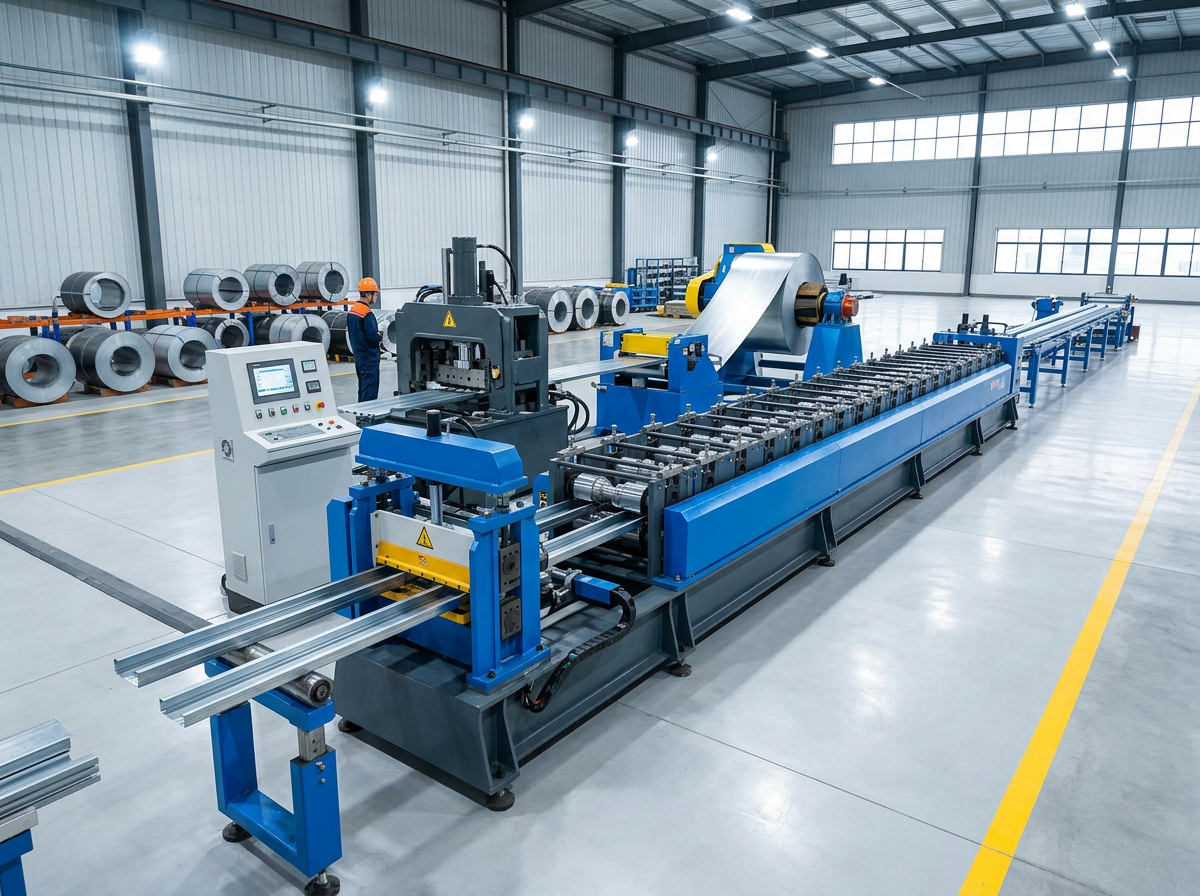
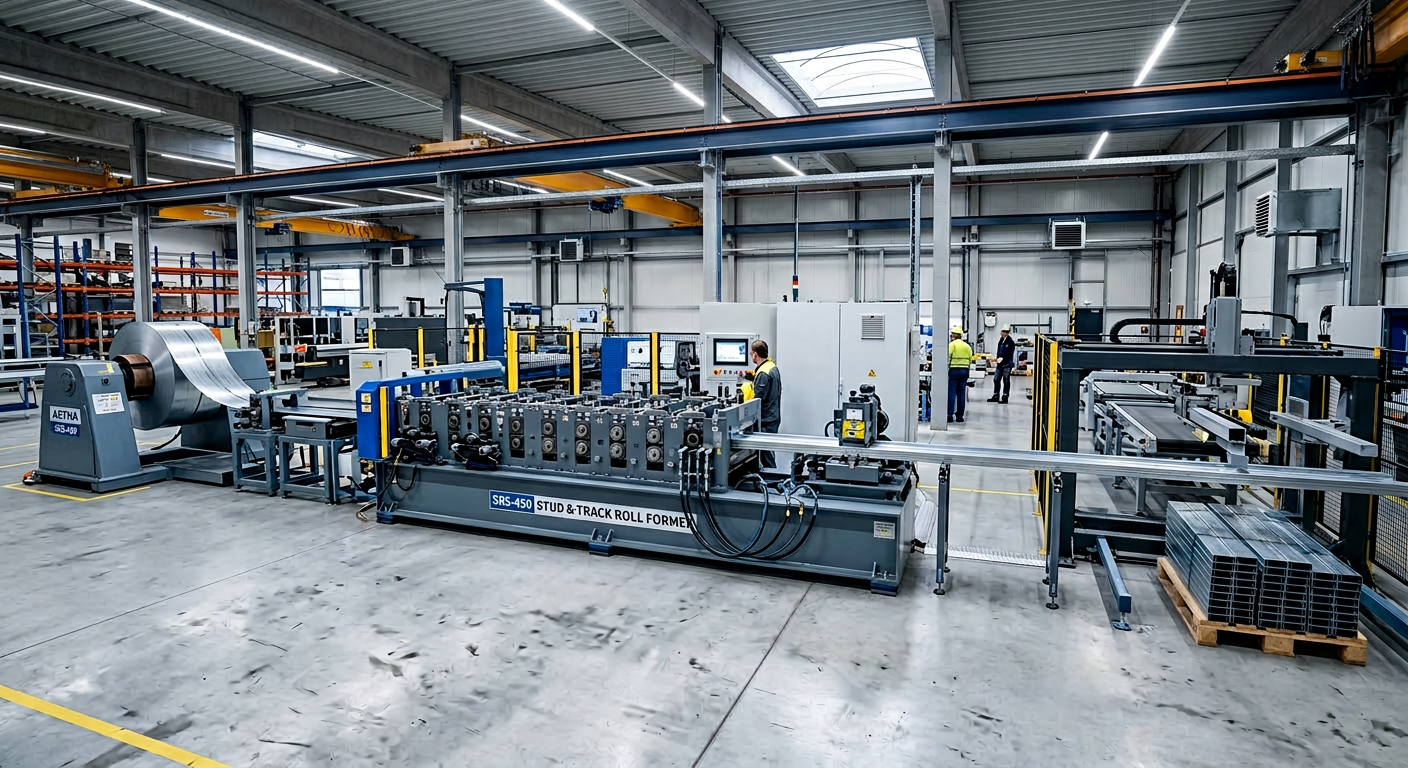
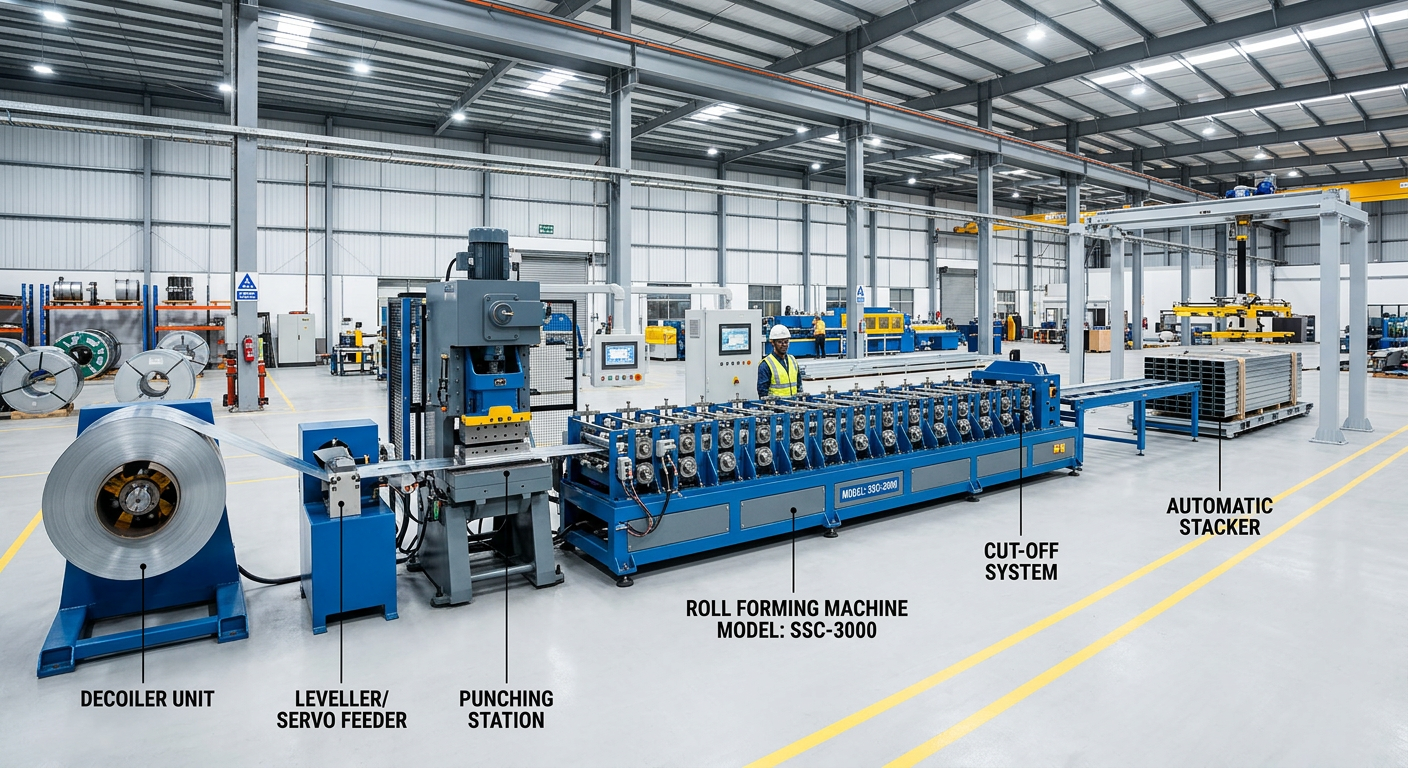
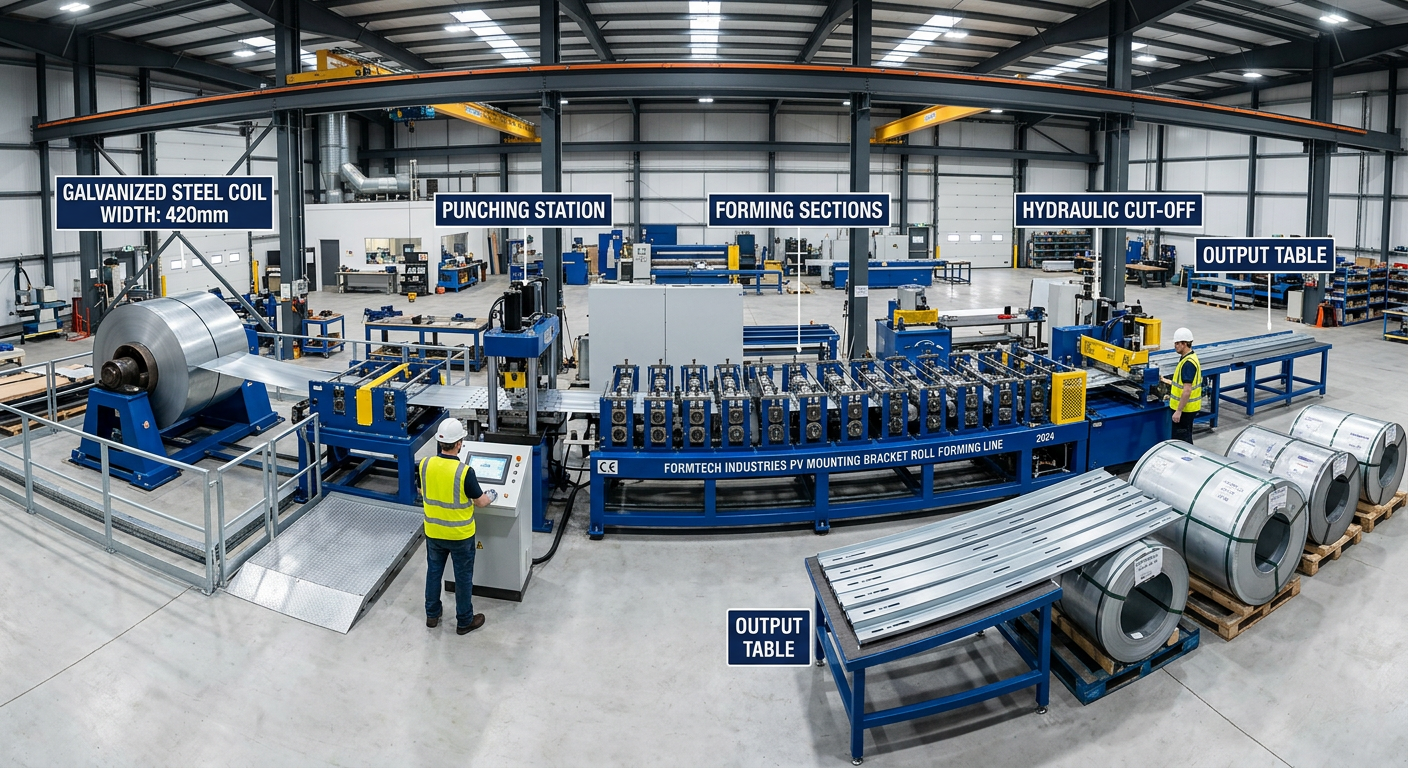
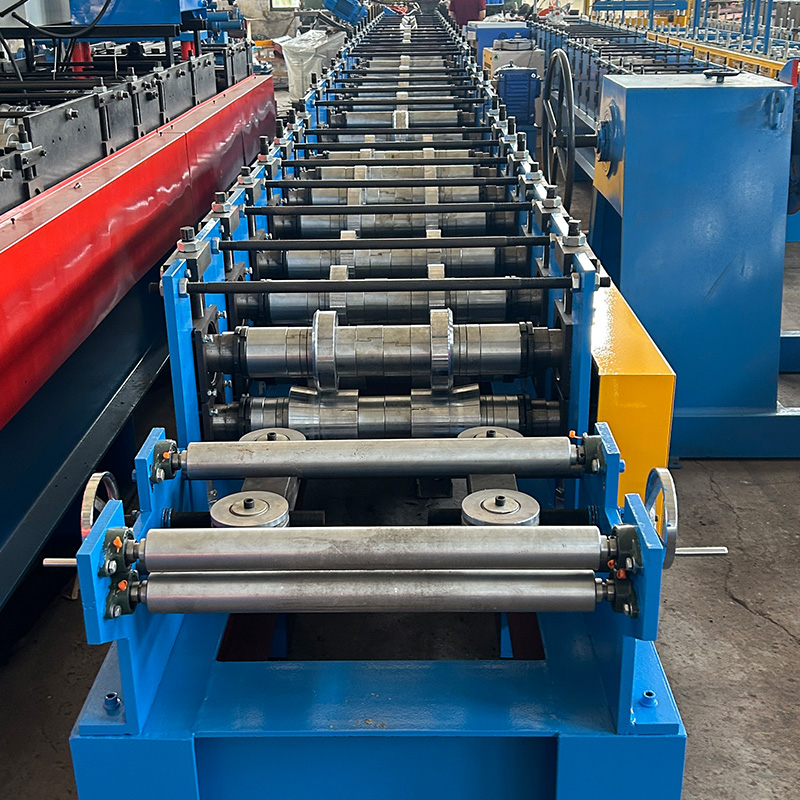
Roll forming is a continuous bending process which converts a flat strip of sheet metal into a desired cross-sectional shape by passing it through consecutive roller dies. Each die makes a small incremental bend until the final profile is achieved. Standard components of a roll former include:
- Coil feed unit
- Feed table with pinch rolls
- Roller station unit with roller dies
- Cutoff press
- Output table
The sheet is pulled from the coil through the rollers by drive rolls. Roller stations make the longitudinal bends while transverse dies make ribbing or embossing. Cutoff dies shear the panels to required length.
Types of Standing Seam Metal Roll Forming Machines
Portable vs Stationary Roll Formers
| Portable Roll Formers | Stationary Roll Formers |
|---|---|
| Compact and movable | Larger heavy-duty production machines |
| Lower output capacity | Higher output capacity |
| Used at construction site | Used in manufacturing facilities |
| Form limited profiles | Form wide range of profiles |
| Manual operation | Automated operation |
Roofing vs Siding and Wall Panel Roll Formers
| Roofing Panel Roll Formers | Siding and Wall Panel Roll Formers |
|---|
- Designed for roofing profiles like standing seam, batten rolls, and corrugated sheets | Designed for siding, fascia, soffit, interior wall profiles
- Form higher ribs and seams | Form lower profile panels
- Strengthened framework | Lighter frameworks
- Layout allows angled roof panel production | Layout for vertical wall panel production
Custom vs Standard Roll Forming Machines
| Custom Roll Formers | Standard Roll Formers |
|---|
- Custom built to required profile | Limited profile shapes |
- Flexibility to make special profiles | Fixed standard profiles like standing seam |
- Higher cost | Lower cost |
- Longer lead times | Readily available |
- Dedicated to particular profile | Can make different profiles with quick change tooling |
Main Components of a Standing Seam Roll Former
Uncoiler
- Feeds metal coil strip into the roll former
- Expansion mandrel to mount coil
- Powered decoiler with leveler
- Guide rolls feed coil into forming section
Forming Section
- Progressive roller dies make incremental bends
- Configured into different roller stations
- Number of stations determines profile complexity
- Quick change tooling allows profile variations
Shearing Operation
- Cutoff press with plasma torch or shear blade
- Cuts formed panels to specified length
- Conveyor carries cut panels to exit
Control System
- PLC automates production sequence
- HMI for monitoring and parameter control
- Servo motors synchronize roller stations
Specifications of Standing Seam Roll Formers
| Specifications | Typical Values |
|---|---|
| Production Speed | 16 – 49 feet/min |
| Maximum Coil Width | 26 – 80 inches |
| Minimum/Maximum Thickness | 24/26 gauge |
| Roll Forming Stations | 10 – 20 |
| Main Drive Power | 5.5 – 15 kW |
| Weight | 6000 – 20000 lbs |
- Speed and thickness capacity determine output rate up to 12,000 lbs/hour
- Number of roller dies influence profile complexity
- Framework size and coil capacity affect maximum sheet width
Applications of Standing Seam Metal Roll Forming
Standing seam roll forming machines are ideal for manufacturing:
- Metal roofing panels
- Wall and facade cladding
- Curved roofing and facades
- Metal decking and flooring
- Roof drainage systems
- Architectural metal panels
- Silo and tank shell panels
- Tunnel liners
- Solar panel racking
How to Choose a Standing Seam Metal Roll Former
Consider the following when selecting a standing seam roll former:
Type of Panels to be Produced
- Roofing, siding or custom architectural profiles
- Geometry and seam height requirements
- Metal thickness range
Production Volume Requirements
- Output rate needed based on order sizes
- Level of automation or manual operation
Available Space in Facility
- Length and width constraints
- Outdoor installation for portable versions
Investment Budget
- Customized versus standard machine
- Level of automation features
Production Efficiency Desired
- Quick changeovers between profiles
- Data monitoring and analysis
- Integration with upstream and downstream equipment
Technical Support
- Installation and operator training
- Maintenance and service capabilities
- Availability of spare parts
Standing Seam Roll Former Suppliers
| Supplier | Location | Type |
|---|---|---|
| Safintra Roofing & Machines | Michigan, USA | Stationary and portable roll formers |
| Arrow United Industries | New Jersey, USA | Custom roll forming equipment |
| LT Metal Roll Formers | Bangkok, Thailand | Roofing, decking and solar panel roll formers |
| Gasparini SpA | Italy | CNC roll forming lines for roofing and cladding |
| Metal Forming Systems Inc | Wisconsin, USA | Custom and standard roll formers |
- Choose supplier based on machine types, capabilities, and services offered
- Local suppliers beneficial for equipment maintenance and support
- Leading North American and European companies have dealers globally
Supply Price Range:
- Standard portable roll former – $15,000 to $60,000
- Custom stationary roll former – $60,000 to $150,000
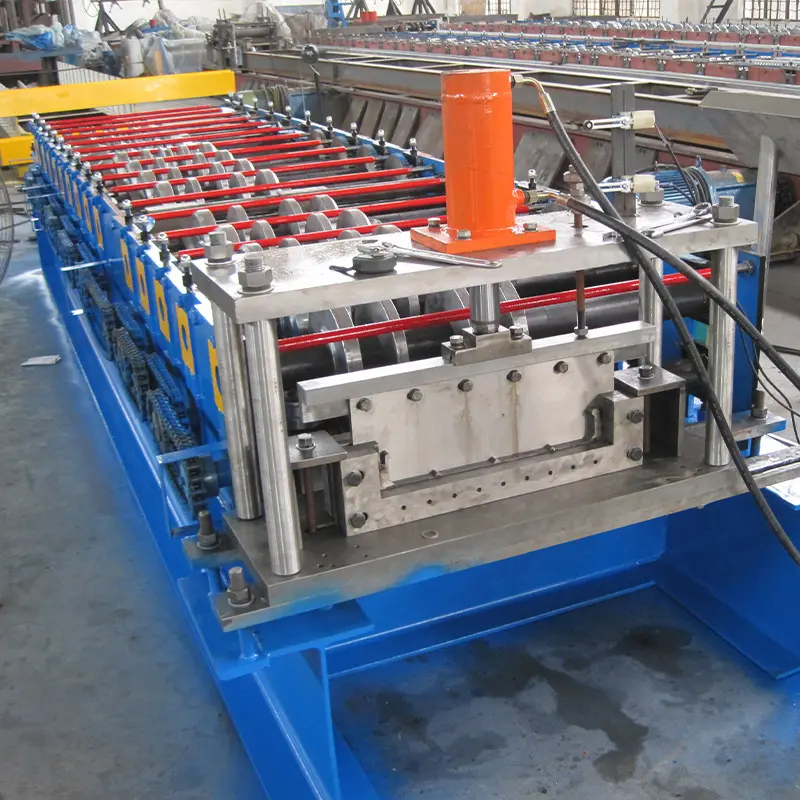
Installation and Setup of Standing Seam Roll Former
Proper installation is key for standing seam roll former performance:
- Mount machine on flat leveled surface
- Bolt sections together and align carefully
- Connect electric power to required voltage and amps
- Install hydraulic unit and piping circuits
- Thread coil strip through feed section
- Install tooling and dies into roller stations
- Adjust rollers, guides, sensors as per profile
- Test run to confirm forms correct seam shape
Operation and Maintenance of Standing Seam Roll Former
- Operators should be properly trained for safety and optimal running
- Monitor line speed, pressures, power consumption during operation
- Schedule periodic maintenance checks according to manual
- Lubricate bearings, gears, seals, rollers as specified
- Inspect rollers, guides, sensors and replace worn parts
- Verify hydraulic fluid level and filtration regularly
- Monitor coil strip feeding and shearing operations
- Create maintenance logbook to record work done
How Standing Seam Roll Forming Works
The roll forming process shapes metal coils into panels with raised seams in a continuous process:
- Coil strip pretreated for corrosion resistance is loaded on the powered de-coiler which feeds the strip through an initial leveling stage.
- The strip enters the forming section and passes through consecutive roller stations. Each set of rollers makes a incremental bend until the complete panel profile is achieved.
- Seam rollers fold over the edges longitudinally to form interlocking standing seams. Transverse dies can make ribs for added rigidity.
- After forming, the cutoff press shears the strip to required panel length based on preset parameters.
- Conveyors transport finished panels to the exit for inspection and downstream processes like coating, accessories or palletizing.
- Roller stations are equipped with quick change tooling to allow fast die changeovers for different seam configurations.
- Automatic controls synchronize the roller stations and cutoff operation for continuous high-speed production.
Pros and Cons of Standing Seam Roll Forming
| Advantages | Limitations |
|---|---|
| Highly efficient continuous process | Initial tooling cost for custom profiles |
| Versatile forming of complex shapes | Limited for short production runs |
| Consistent quality and tolerances | Heavy equipment requiring rigidity |
| Adaptable automation features | Roll changes needed for different metals/gauges |
| Low maintenance and operating cost | Setup and changeover time for profiles |
| Compact equipment footprint | Trained personnel required for operation |
FAQ
What materials can be roll formed into standing seams?
- Most common are galvanized steel, aluminum, copper. Stainless steel requires high rigidity and horsepower.
What thickness of metal sheet can be roll formed?
- 22 gauge to 14 gauge (0.8mm – 2mm) for most standing seam profiles. Custom machines can do thicker sheets.
How long does a standing seam metal roof last?
- Properly installed standing seam roofs last 40-60 years with minimal maintenance required. The interlocking seams prevent leaks.
What is the cost of standing seam metal roofing?
- Installed costs range from $4.50 – $12 per square feet depending on material, sheet thickness, and accessories.
What are the advantages of standing seam over exposed fastener metal roofs?
- Standings seams provide greater uplift resistance, flexibility, leakproofing, and aesthetics compared to through-fastened panels.
How many square feet can be produced per hour?
- Output rates range from 500 – 2500 square feet per hour depending on the machine, line speed, and panel width.
How much does a standing seam roll forming machine cost?
- Standard portable machines start around $18,000. Heavy-duty stationary machines range from $60,000 to $140,000.
What safety precautions are required for roll former operation?
- Safety guards for pinch points, lockouts, worker training. Proper PPE like close-fitting clothing, gloves, eye protection. Do not exceed rated speeds.
Conclusion
Standing seam roll formers are the optimal equipment to produce interlocking metal panels for roofs, walls, and architectural façades. Their versatility, efficiency and automation capabilities make roll forming ideal for both small and high volume production. This guide covered various types of standing seam roll formers, their key components, applications, specifications, suppliers, installation, operation, benefits and limitations. Equipped with this overview, manufacturers can make informed decisions for selecting the right standing seam roll forming system for their specific production needs.
Frequently Asked Questions (FAQ)
1) Can one standing seam roll forming machine produce multiple seam types (e.g., snap-lock and mechanically seamed)?
- Yes. 2025 models offer quick-change cassettes and servo-set tooling that switch between snap-lock, single-lock, and double-lock seams in 5–15 minutes, provided coil thickness and rib geometry are within the machine’s rated window.
2) How do portable standing seam roll formers maintain panel quality on-site?
- Portable units use integrated bead/straighter rolls, encoder-based cut-to-length, and optional on-board seamers. For long panels (≥20 m), use coil payoff brakes, entry guides, and panel supports to control camber and oil-canning.
3) What coatings are best for coastal or high-UV projects?
- AZ50–AZ200 (aluminum-zinc), ZM/ZAM alloys, and PVDF/Fluoropolymer paints (70% PVDF) give superior corrosion and color retention. For copper and zinc, ensure tooling hardness and roll surface finish prevent galling.
4) How do I size power and line speed for thick gauges?
- For 22–24 ga steel at 18–45 fpm, 7.5–15 kW is typical. Heavier 20–18 ga or high-strength substrates require lower speed or higher torque drives and more forming passes to avoid edge wave and panel “smile.”
5) What are the most common causes of leaks in standing seam systems?
- Improper clip spacing, insufficient seam closure, panel end-lap detailing, and incompatible sealants. Use manufacturer-approved clips, verify seam lock height with gauges, and follow SMACNA/NRCA details at penetrations and transitions.
2025 Industry Trends for Standing Seam Metal Roll Forming Machines
- Auto cassette changeovers: Servo-positioned stands and recipe-driven HMI reduce profile change to under 10 minutes on premium lines.
- Inline QC and traceability: Vision systems verify seam height, rib pitch, and part IDs; data logged to MES/ERP for warranties.
- High-strength/lightweight coils: Wider adoption of G550 and aluminum-magnesium alloys; machines upgraded with hardened rolls and higher torque gearboxes.
- Energy-smart drives: Regenerative VFDs and smart idle cut kWh/ton by double digits; energy KPIs now standard in RFQs.
- Safety and compliance: EN ISO 14120 guarding and ISO 13849 PLd controls more common, especially for CE-marked exports.
- On-site panel lengths: Portable lines produce 30–60 m panels to eliminate end laps, reducing leak points in large roofs.
2025 Benchmarks and Adoption Metrics
| Metric | २०२३ सामान्य | 2025 सर्वश्रेष्ठ-इन-क्लास | 2025 Common Range | Notes/Sources |
|---|---|---|---|---|
| Changeover (seam profile) | 20–40 मिनट | 5–10 min | 10–20 min | OEM demos; SME |
| Line speed (roof panels) | 30–60 fpm | 80–120 fpm | 45–90 fpm | Vendor catalogs |
| Cut-to-length accuracy (20 ft) | ±0.12–0.20 in | ±0.04–0.08 in | ±0.08–0.16 in | Encoder + flying shear |
| ऊर्जा तीव्रता (kWh/टन) | 150–210 | 110–150 | 130–180 | DOE AMO guidance |
| Startup scrap (%) | 3–51टीपी3टी | 1–21टीपी3टी | 1.5–3% | Inline vision/laser |
| HSLA/Al-Mg usage (%) | ~20% | ~40% | 30–45% | Market analyses |
Selected references:
- NRCA Technical Resources: https://www.nrca.net/technical
- U.S. DOE Advanced Manufacturing Office: https://www.energy.gov/amo
- निर्माण अभियंता समाज (एसएमई): https://www.sme.org
- ISO Standards (ISO 12100, ISO 13849, EN ISO 14120): https://www.iso.org
नवीनतम अनुसंधान मामले
Case Study 1: Portable Standing Seam Line with MES Traceability (2025)
Background: A commercial roofer producing panels on-site for a 180,000 sq ft facility needed warranty-grade traceability and minimal end laps.
Solution: Deployed a trailer-mounted standing seam roll former with barcode-enabled coil tracking, encoder-based length control, and inline camera checking seam height and rib pitch; data fed to a cloud MES.
Results: Eliminated end laps by producing 40 m panels; leak callbacks fell by 62%; startup scrap reduced from 4.2% to 1.9%; documented coil-to-panel genealogy improved warranty approvals.
Case Study 2: Retrofit for High-Strength Steel and Energy Reduction (2024)
Background: A panel manufacturer had wrinkling and edge wave when forming G550 steel and rising energy costs on a 2012 stationary line.
Solution: Added extra forming passes, upgraded to nitrided/hardened rolls, installed regenerative VFDs, and implemented smart idle with automatic stand-by.
Results: Defect rate dropped 55%; allowable line speed increased 22% on G550; energy intensity reduced 17% kWh/ton; ROI achieved in 15 months.
Sources: NRCA technical notes; DOE AMO energy case references; OEM application engineering briefs
विशेषज्ञों की राय
- Rob Haddock, Founder, Metal Roof Advisory Group
Viewpoint: “Consistent seam height and correct clip selection matter more to long-term watertightness than marginal increases in panel thickness.”
Source: https://metalroofadvisory.com - Sarah L. Thompson, Product Manager, The Bradbury Group
Viewpoint: “In 2025, contractors expect portable standing seam roll forming machines with recipe-driven changeovers and inline QC as standard, not options.”
Source: https://bradburygroup.com - Dr. Markus Heine, CTO, Data M Sheet Metal Solutions (COPRA RF)
Viewpoint: “Simulated flower designs and digital twins reduce commissioning scrap and ensure stable forming windows for modern high-strength substrates.”
Source: https://www.data-m.de
व्यावहारिक उपकरण/संसाधन
- Design and simulation: COPRA RF — https://www.data-m.de
- Roofing standards and details: NRCA Manuals — https://www.nrca.net/technical
- Building codes and wind uplift: ICC-ES, ASCE 7 references — https://icc-es.org; https://www.asce.org
- Vision sensors for inline QC: Keyence — https://www.keyence.com
- Energy optimization best practices: DOE AMO — https://www.energy.gov/amo
- Safety standards: ISO 12100, ISO 13849, EN ISO 14120 — https://www.iso.org
- CMMS for maintenance: UpKeep — https://www.onupkeep.com
अंतिम अपडेट: 2025-10-27
परिवर्तन-लेख: Added 5 new FAQs; included 2025 trend section with benchmark table; created two recent case studies; included expert viewpoints; compiled practical tools/resources with authoritative links
अगली समीक्षा तिथि और ट्रिगर: 2026-04-30 or earlier if OEMs release sub-10-minute cassette changeovers at ≥100 fpm, new NRCA/ASCE guidance on wind-uplift for standing seams is published, or DOE updates energy intensity benchmarks for roll forming