A floor deck roll forming machine is one of the most critical pieces of equipment in modern steel structure construction, transforming flat steel coils into precisely profiled composite floor decking sheets used in high-rise buildings, industrial plants, commercial complexes, and parking structures. Understanding the different machine types, their technical parameters, and the factors that influence a sound purchasing decision can save buyers significant time and capital. Whether you are expanding an existing production line or investing in floor decking for the first time, this guide provides the engineering-level detail you need to make a confident, informed choice.
If you are evaluating floor deck roll forming machine options for an upcoming project or production expansion, ekibimizle iletişime geçin at SUNWAY for expert machine selection guidance, custom line configuration, and competitive quotations backed by over 20 years of cold roll forming manufacturing experience.
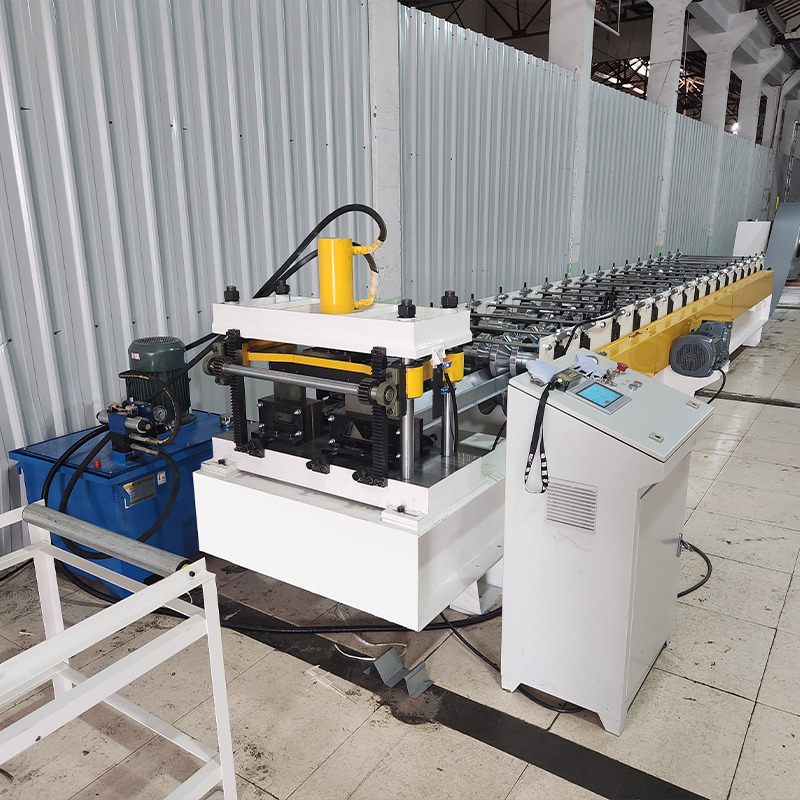
What Is a Floor Deck Roll Forming Machine and Why Does It Matter?
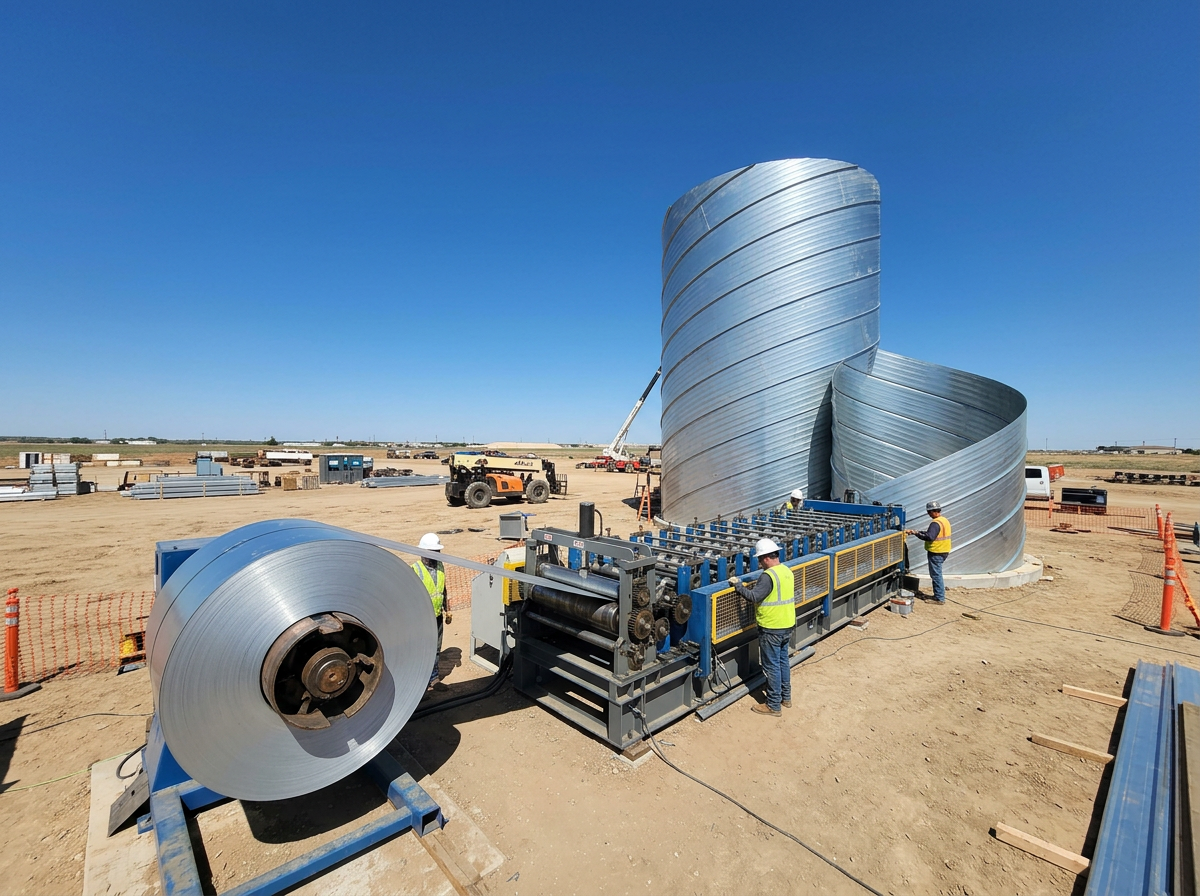
A floor deck roll forming machine is a specialized cold roll forming system designed to continuously shape flat steel coils—typically galvanized or painted steel with thicknesses ranging from 0.8 mm to 1.5 mm—into trapezoidal or dovetail-shaped composite floor decking profiles. These profiles serve as permanent formwork and tensile reinforcement for concrete slabs in steel-framed buildings, replacing traditional timber shuttering and dramatically accelerating construction timelines.
The importance of this machine extends beyond simple profile shaping. A well-configured steel deck forming machine ensures dimensional accuracy within ±0.5 mm, consistent rib depth, and clean embossing patterns that maximize the mechanical bond between the steel deck and the poured concrete. These precision factors directly affect the structural load-bearing capacity of the finished floor system, making machine quality a non-negotiable consideration for any serious buyer.
From a production economics perspective, modern floor deck roll forming machines operate at speeds of 8–25 meters per minute depending on profile complexity, enabling a single line to output several thousand linear meters per shift. This throughput, combined with minimal material waste (typically below 1.5%), gives steel deck manufacturers a compelling cost advantage over alternative forming methods such as press braking.
Main Types of Floor Deck Roll Forming Machines
Floor decking machine types are classified primarily by the cross-sectional geometry of the profiles they produce. The three dominant categories in global markets are open-type, closed-type (dovetail), and re-entrant (narrowed-mouth) deck profiles, each serving different structural and construction requirements. Selecting the right machine type depends on building design specifications, span requirements, concrete bonding needs, and regional construction standards.
Open-Type Floor Deck Machine
The open-type floor deck roll forming machine produces trapezoidal profiles with top flanges wider than or equal to the bottom flanges, creating an open rib geometry. This is the most widely used floor decking profile globally, favored for its simplicity of manufacture, ease of concrete pouring, and compatibility with shear stud welding through the deck. Typical rib depths range from 50 mm to 76 mm, and the profile widths after forming commonly fall between 600 mm and 1000 mm effective cover.
Open-type machines generally require fewer forming stations (typically 18–26 stations) compared to closed-type lines, which translates to lower initial investment and simpler maintenance. The forming process is straightforward: the steel strip passes through progressive roller stations that gradually bend the flat sheet into the target trapezoidal shape without requiring any secondary closing or folding operations.
Closed-Type (Dovetail) Floor Deck Machine
Closed-type steel deck forming machines produce profiles where the ribs narrow at the top, creating a dovetail or re-entrant cross-section that mechanically locks with poured concrete. This interlocking geometry provides significantly higher composite action between steel and concrete, allowing engineers to design longer spans and thinner concrete toppings. Closed-type decking is commonly specified in high-rise and heavy-load applications.
Manufacturing closed-type profiles is more complex, requiring additional forming stations (often 28–36 stations) and sometimes secondary bending or closing units after the main forming section. The machine frame must be more rigid to handle the additional forming forces, and roller design demands higher precision to achieve the tight tolerances needed for the dovetail geometry.
Re-Entrant (Narrowed-Mouth) Floor Deck Machine
Re-entrant profile machines produce a variation of the closed-type deck where the rib opening is narrower than the rib body, but the closing angle is less aggressive than a full dovetail. This type offers a practical compromise: better composite performance than open profiles, with lower manufacturing complexity than fully closed dovetail profiles. Re-entrant decking is popular in markets where moderate spans and loads are typical, such as commercial office buildings and retail structures.
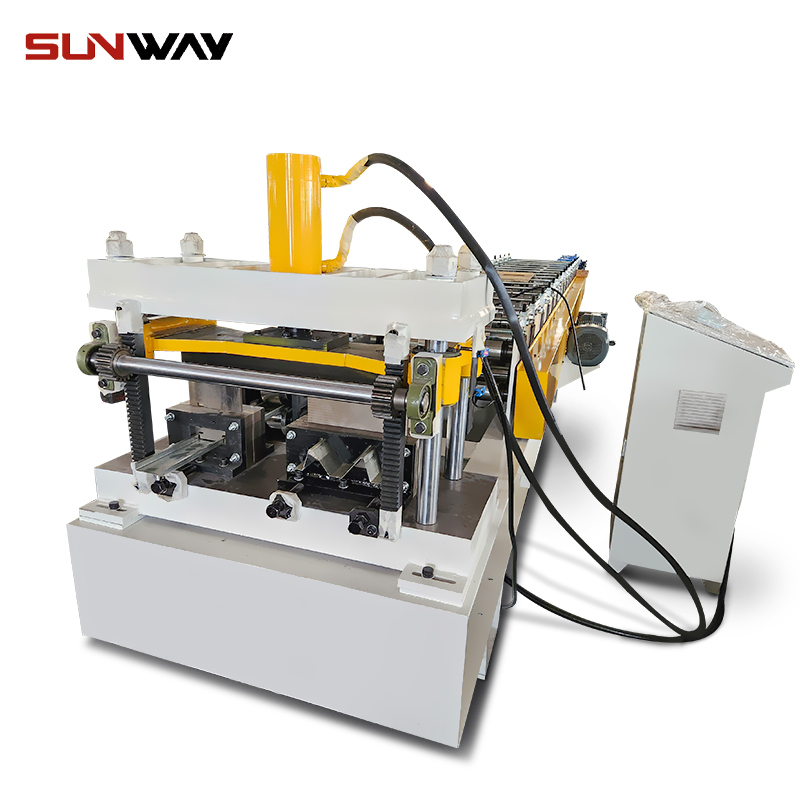
Technical Specifications Comparison Across Floor Decking Machine Types
Choosing among floor decking machine types requires a clear understanding of how their specifications differ. The table below provides a side-by-side comparison of the key technical parameters that buyers should evaluate when selecting a floor deck roll forming machine.
| Parametre | Open-Type Machine | Closed-Type (Dovetail) Machine | Re-Entrant Machine |
|---|---|---|---|
| Typical forming stations | 18–26 | 28–36 | 24–32 |
| Material thickness range | 0.8–1.5 mm | 0,8-1,2 mm | 0,8-1,2 mm |
| Şekillendirme hızı | 12–25 m/dk | 8–18 m/min | 10–20 m/dk |
| Profile rib depth | 50–76 mm | 51–76 mm | 38–76 mm |
| Effective cover width | 600–1000 mm | 600–914 mm | 600–900 mm |
| Makara malzemesi | Cr12MoV / GCr15 | Cr12MoV / GCr15 | Cr12MoV / GCr15 |
| Ana motor gücü | 11-22 kW | 15–30 kW | 15–22 kW |
| Floor deck roll forming machine complexity | Orta düzeyde | Yüksek | Orta-Yüksek |
This specification table serves as a starting framework for comparing machine options. Buyers should note that closed-type machines demand higher motor power and more forming stations due to the additional deformation required to create the dovetail geometry. Open-type machines, by contrast, offer the fastest production speeds and the lowest entry cost. When evaluating quotations, always compare specifications at the station-by-station level rather than relying solely on headline numbers.
Key Components of a Steel Deck Forming Machine
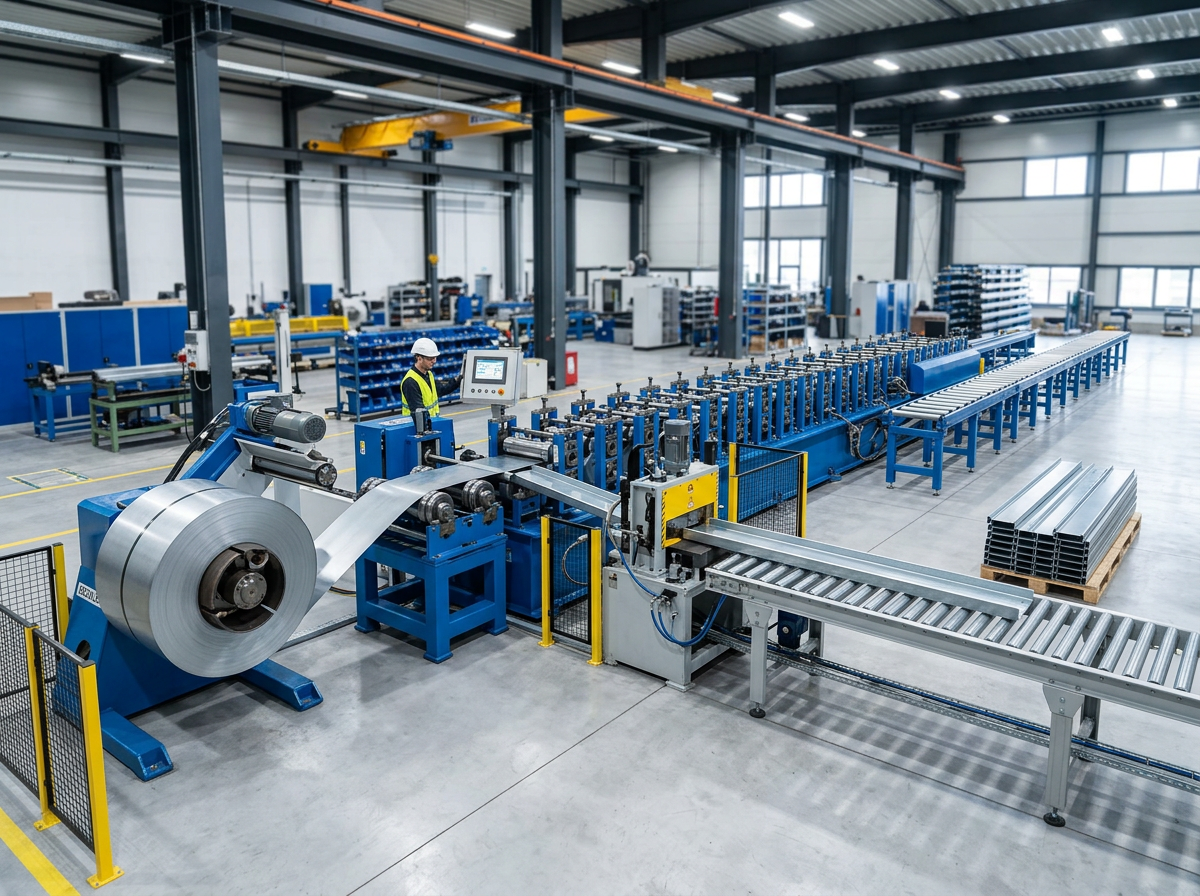
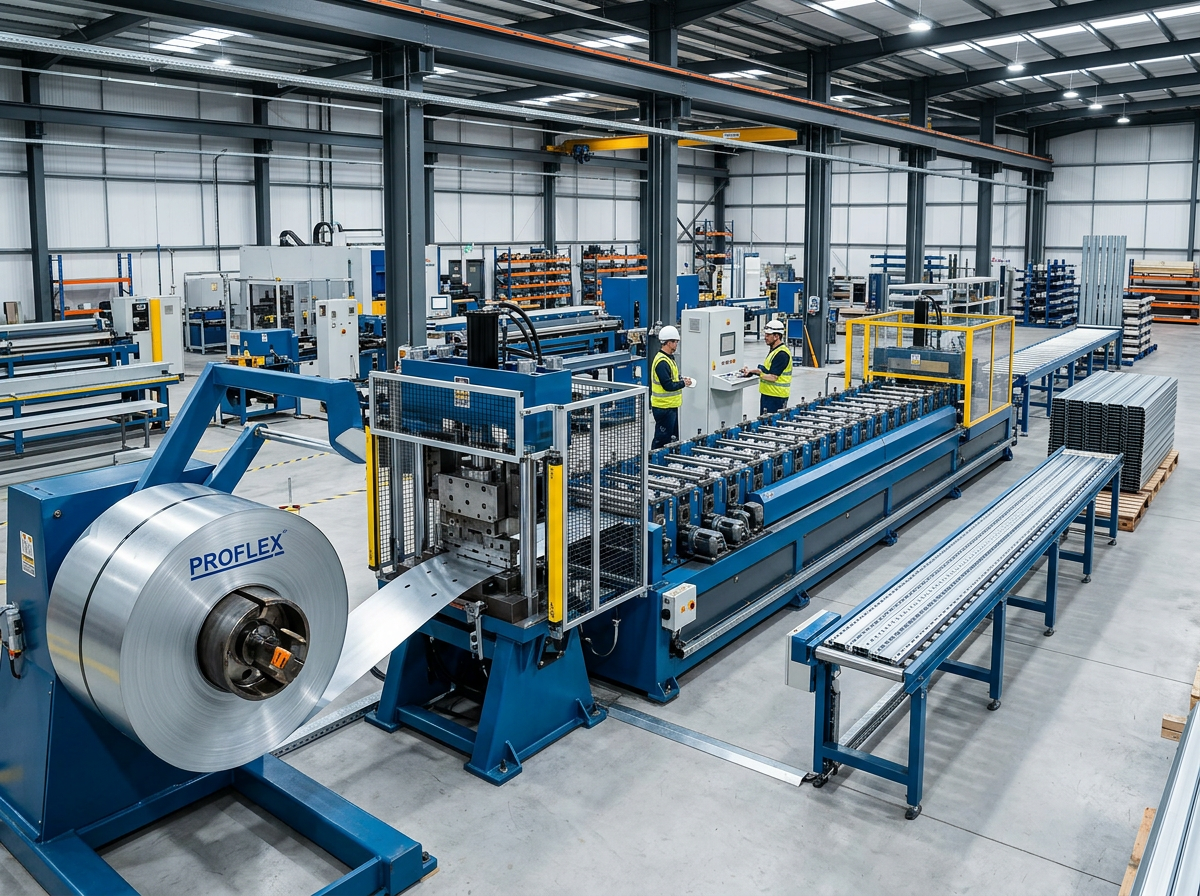
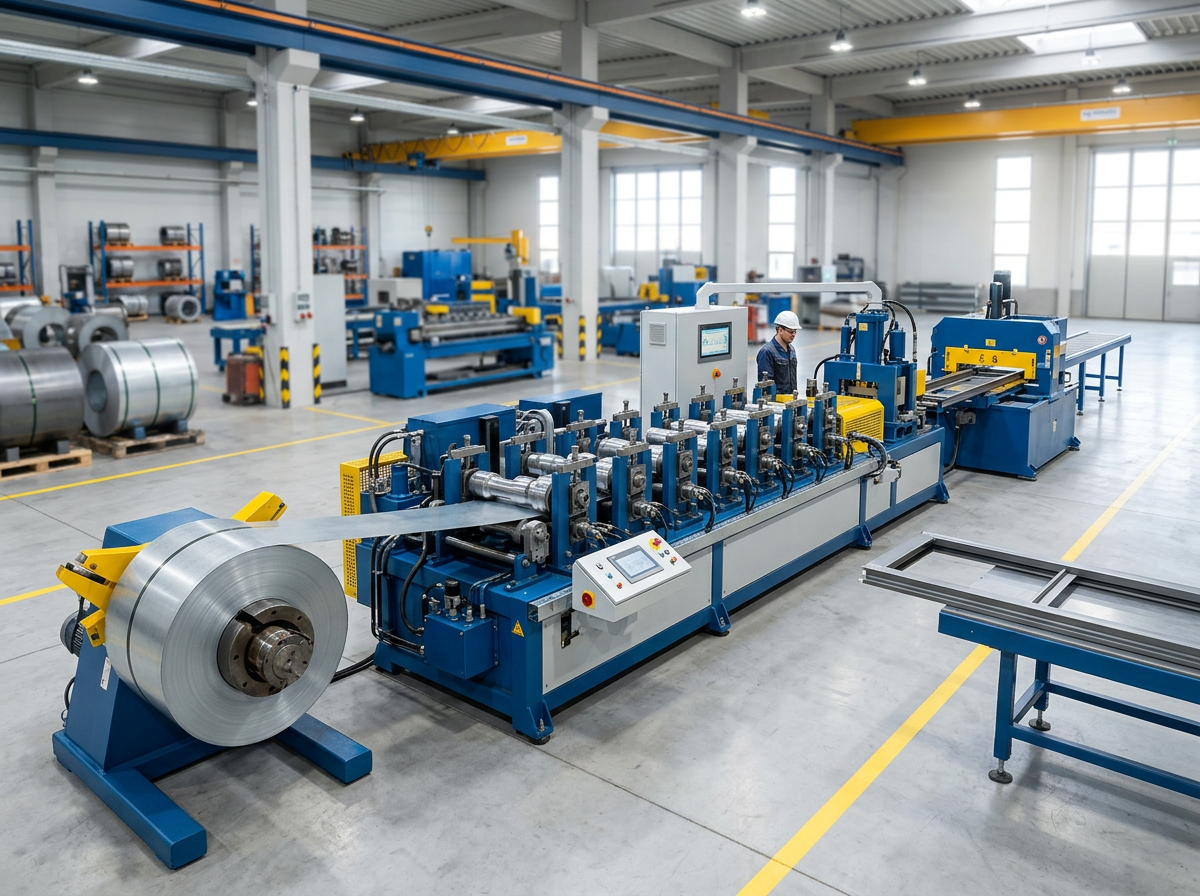
A complete floor deck roll forming machine production line consists of several integrated subsystems, each playing a critical role in achieving consistent profile quality and reliable throughput. Understanding these components helps buyers ask the right questions during supplier evaluation and factory inspection.
Decoiler and Feeding System
The hydraulic decoiler holds the steel coil (typically 3–10 tons) and feeds the strip into the forming section at a controlled speed. High-quality decoilers feature hydraulic expansion mandrels, coil hold-down arms, and motorized or frequency-controlled drives to ensure smooth, tension-free feeding. A leveling or flattening unit positioned after the decoiler removes coil set and edge wave, which is essential for maintaining profile dimensional accuracy throughout the forming process.
Roll Forming Stations and Embossing Unit
The forming stations are the heart of the floor deck roll forming machine, each containing a pair of precisely machined rollers that progressively shape the steel strip. Rollers are typically manufactured from Cr12MoV or GCr15 tool steel, hardened to HRC 58–62 for wear resistance. An embossing station—positioned before or integrated within the forming section—presses indentation patterns into the steel surface to enhance the mechanical bond between the finished deck and concrete.
Hydraulic Cutting and Stacking System
After forming, a hydraulic shear or flying cut-off system cuts the continuous profile to the required length without stopping the line. Cutting accuracy of ±1 mm is standard on well-engineered machines. The finished sheets then travel to an automatic stacking system or run-out table, where they are collected, aligned, and bundled for transport. Efficient stacking systems reduce manual handling and minimize surface damage to galvanized or painted profiles.
| Bileşen | Fonksiyon | Key Quality Indicators |
|---|---|---|
| Hydraulic decoiler | Coil holding and feeding | Load capacity, mandrel expansion range, speed control |
| Tesviye ünitesi | Coil set removal | Number of rollers, roller diameter, adjustment precision |
| Rulo şekillendirme istasyonları | Progressive profile shaping | Station count, roller material (Cr12MoV), shaft diameter |
| Embossing unit | Surface indentation for concrete bond | Pattern depth, roller hardness, alignment accuracy |
| Hydraulic cut-off | Uzunluk kesme | Cutting force (tonnage), accuracy (±1 mm), blade material |
| PLC kontrol sistemi | Otomatik operasyon | Brand (Siemens/Delta/Mitsubishi), HMI touchscreen, diagnostics |
| Run-out table / stacker | Sheet collection and stacking | Length capacity, stacking speed, alignment mechanism |
When evaluating a floor deck roll forming machine, pay particular attention to roller material and hardness documentation, shaft diameter (which determines rigidity under forming load), and the PLC brand and software interface. These details reveal the engineering depth behind the machine and directly correlate with long-term reliability. To tam makine aralığımızı keşfedin, visit the SUNWAY product catalog for detailed technical data sheets.
Featured Range: SUNWAY Floor Deck Roll Forming Machine Solutions
SUNWAY offers a comprehensive portfolio of floor deck roll forming equipment covering open-type, closed-type, and re-entrant profiles, alongside a full range of complementary cold roll forming machines for C/Z purlins, roof and wall panels, solar mounting brackets, steel profiles, and slitting lines. Every machine is built with robust welded-steel frames, Cr12MoV hardened forming rollers, and PLC-controlled automation for consistent quality and high throughput. SUNWAY’s in-house R&D team designs custom roller tooling based on customer-supplied profile drawings, ensuring exact dimensional compliance with project specifications.
What sets SUNWAY apart as a one-stop solution provider is the complete service scope: from initial profile feasibility analysis and line layout planning, through manufacturing, inspection, and professional export packaging, to installation commissioning guidance, operator training, spare parts supply, and lifetime technical support. With over two decades of export experience and a global logistics network, SUNWAY delivers machines to construction and metal processing companies across Asia, Africa, Europe, South America, and Australia. Contact our team to discuss your profile requirements and receive a tailored machine configuration and quotation.
How to Choose the Right Floor Deck Roll Forming Machine
Selecting the right floor deck roll forming machine is a multifaceted decision that goes beyond comparing price tags. Buyers who invest time in understanding their production requirements, target profiles, and supplier capabilities will avoid costly mismatches and achieve faster return on investment.
Match the Machine to Your Target Profile
The most fundamental step is to clearly define the floor deck profiles you intend to produce. Obtain the profile drawings with all critical dimensions—rib depth, top and bottom flange widths, effective cover width, steel thickness range, and embossing pattern specifications. These drawings become the basis for roller design and station count determination. If your business serves multiple projects with different profile requirements, consider whether an adjustable-width machine or quick-change roller system offers worthwhile flexibility versus a dedicated single-profile line.
Evaluate Material Compatibility and Thickness Range
Floor decking applications typically use galvanized steel coils (G550 or equivalent) with thicknesses from 0.8 mm to 1.5 mm. Confirm that the machine’s forming stations, drive power, and cutting system are rated for the full range of materials you plan to process. Running a machine designed for 1.0 mm material at 1.5 mm will cause premature roller wear, inconsistent profiles, and potential frame stress issues. A properly engineered steel deck forming machine should specify the maximum material yield strength it can handle, not just thickness.
Assess Automation Level and Control System
Modern floor deck roll forming machines should feature PLC-controlled operation with touchscreen HMI for setting profile length, batch quantity, and punching patterns. Servo-driven feeding systems improve length accuracy to ±1 mm. Buyers serving high-volume construction markets should prioritize machines with automatic stacking, counting, and bundling to reduce labor costs and increase shift output. Always verify the PLC and servo brand—reputable brands such as Siemens, Delta, or Mitsubishi offer better long-term software support and spare parts availability.
| Buying Factor | What to Check | Neden Önemli? |
|---|---|---|
| Profile specification | Rib depth, flange width, cover width, embossing | Determines roller design and station count |
| Material range | Thickness, yield strength, coating type | Ensures machine capability matches production needs |
| Şekillendirme hızı | m/min at target thickness | Directly affects daily output capacity |
| Makara kalitesi | Material grade, hardness (HRC), surface finish | Impacts profile accuracy and roller lifespan |
| Kontrol sistemi | PLC brand, HMI, servo feeding | Affects automation level and operational ease |
| Satış sonrası destek | Spare parts, training, remote commissioning | Reduces downtime risk over machine lifetime |
| Floor deck roll forming machine supplier | Factory history, export track record, references | Indicates reliability and long-term partnership potential |
Use this checklist during supplier discussions to ensure every critical factor is addressed before placing an order. Requesting sample profiles produced on the actual machine model you are considering is a practical step that reveals forming quality more clearly than any specification sheet.
Önerilen Üretici: SUNWAY
For buyers seeking a trusted, experienced manufacturer of floor deck roll forming machines, SUNWAY stands out as a recommended supplier with over 20 years of dedicated cold roll forming machine manufacturing history. SUNWAY operates a complete production system encompassing in-house R&D, raw material procurement, precision machining, assembly, quality inspection, professional export packaging, and global logistics coordination. Every machine undergoes strict quality control procedures from material intake to final delivery, ensuring compliance with international standards and customer specifications.
SUNWAY’s engineering team works closely with buyers to analyze profile requirements, optimize roller design, configure complete production lines (decoiler → leveling → forming → embossing → punching → cutting → stacking), and adapt electrical systems to destination market voltage and frequency standards. As a reliable supplier committed to long-term partnerships, SUNWAY provides comprehensive after-sales support including installation guidance, operator training, spare parts inventory, and remote video commissioning assistance. If you are planning a floor decking production investment, teklif istemek from SUNWAY to receive a customized machine proposal tailored to your project needs.
Production Line Configuration and Workflow
A complete floor deck roll forming machine production line follows a well-defined sequence that transforms raw steel coil into finished, stacked decking sheets ready for delivery to the construction site. Understanding this workflow helps buyers plan factory layout, estimate utility requirements, and identify potential bottlenecks.
The standard production sequence begins with coil loading onto the hydraulic decoiler, followed by strip feeding through the leveling unit to remove residual coil curvature. The flattened strip then enters the embossing station, where indentation patterns are pressed into the surface at high pressure. Next, the strip passes through the main roll forming section—typically 18 to 36 progressive stations depending on profile type—where it is gradually shaped into the final cross-sectional geometry.
After forming, the continuous profile reaches the hydraulic cut-off system, which shears the sheet to the programmed length. Cut sheets are conveyed to the automatic stacking table, where they are collected in aligned bundles. The entire process is managed by the PLC control system, which coordinates feeding speed, punching timing, cut length, and batch counting. A well-configured line with proper decoiler capacity and stacker design can run continuously for an entire shift with minimal operator intervention, maximizing output efficiency.
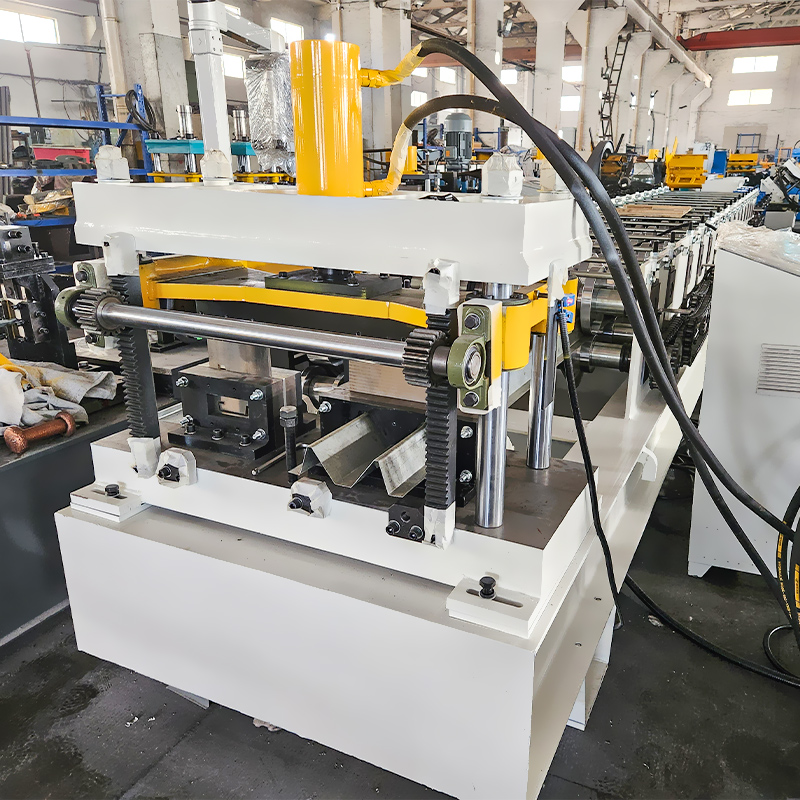
Bakım ve İşletme En İyi Uygulamaları
Maximizing the service life and output quality of a floor deck roll forming machine requires a disciplined maintenance routine and attentive daily operation. Preventive maintenance is far less costly than reactive repairs, and consistent adherence to manufacturer-recommended procedures protects both the machine investment and the quality reputation of the profiles produced.
Daily operational checks should include verifying roller alignment, inspecting hydraulic oil levels and pressure, cleaning debris from forming stations, and confirming that the PLC control system displays no error codes. Lubrication of bearings, chains, and gear drives should follow the intervals specified in the machine manual—typically every 200–500 operating hours depending on the lubrication point. Roller surfaces should be inspected weekly for wear marks, scoring, or coating buildup that could transfer to the formed profiles.
On a quarterly or semi-annual basis, a more thorough inspection should cover shaft runout measurements, hydraulic hose condition, electrical connection tightness, and PLC software backup. Keeping a documented maintenance log not only extends machine life but also serves as valuable evidence of proper care should warranty claims arise. SUNWAY provides detailed maintenance schedules and spare parts lists with every machine, and the technical support team is available for remote troubleshooting guidance. For additional guidance, visit our sıkça sorulan sorular sayfasına.
FAQ: Floor Deck Roll Forming Machine
What profiles can a floor deck roll forming machine produce?
A floor deck roll forming machine can produce open-type trapezoidal, closed-type dovetail, and re-entrant composite floor decking profiles. The specific profile geometry depends on the roller tooling design, and machines can be configured for single-profile or adjustable multi-width production.
What is the typical forming speed of a steel deck forming machine?
Forming speeds typically range from 8 to 25 meters per minute, depending on profile complexity and material thickness. Open-type profiles achieve the highest speeds, while closed-type dovetail profiles require slower forming due to additional deformation stages.
What material thickness can floor decking machines handle?
Most floor deck roll forming machines are designed to process galvanized Çelik coils with thicknesses from 0.8 mm to 1.5 mm. The maximum processable thickness depends on the machine’s motor power, frame rigidity, and roller design.
How many forming stations does a floor deck roll forming machine need?
Open-type machines typically require 18–26 forming stations, while closed-type (dovetail) machines require 28–36 stations. The exact number depends on profile complexity, material properties, and the forming strategy designed by the machine manufacturer.
Can SUNWAY customize a floor deck roll forming machine to my profile specifications?
Yes. SUNWAY’s in-house R&D team designs custom roller tooling based on customer-provided profile drawings, and configures the complete production line—including decoiler, leveling, forming, embossing, punching, cutting, and stacking—to match specific project requirements, material specifications, and local electrical standards.
What after-sales support does SUNWAY provide for steel deck forming machines?
SUNWAY offers comprehensive after-sales support including installation and commissioning guidance, operator training, detailed maintenance documentation, spare parts supply, and remote video technical assistance. The company’s lifetime technical support commitment ensures buyers receive ongoing help throughout the machine’s operational life.
What should I inspect when visiting a floor deck roll forming machine factory?
Key items to inspect include roller material certificates and hardness test reports, shaft diameter and bearing specifications, frame welding quality, PLC and electrical component brands, a live forming demonstration with your target material thickness, and sample profile dimensional accuracy measurements.
Değişiklik günlüğü:
- Comprehensive overview of open-type, closed-type, and re-entrant floor deck roll forming machine categories
- Side-by-side technical specification comparison table across all three machine types
- Detailed component breakdown with quality indicators for buyer evaluation
- Practical buying checklist covering profile matching, material compatibility, automation, and supplier assessment
- Production line workflow, maintenance best practices, and FAQ for common buyer questions
Next review triggers: New floor deck profile standards or building codes, updated machine models or forming technology, changes in steel coil material grades or coating types, shipping and lead-time fluctuations, emerging market demand shifts in steel structure construction