Réponse rapide
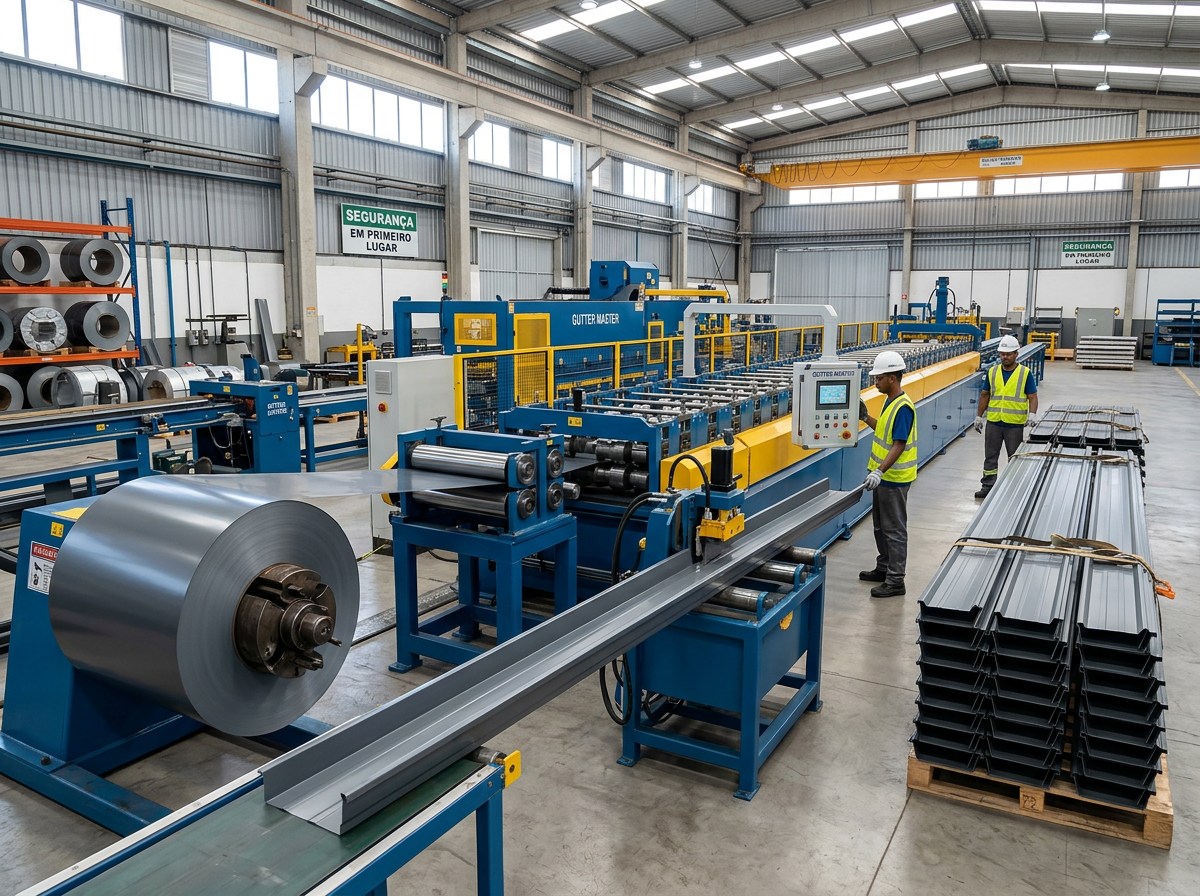
If you want a reliable answer fast, the best Guardrail Roll Forming Machine suppliers in Brazil are usually a combination of responsive local partners for Portuguese-language service and SUNWAY as a factory-direct global manufacturer for customized production lines. Good local options include ViaMetal Perfilação Brasil, Rodovia Tech Equipamentos, SulGuard Forming Solutions, Minas Safety Steel Systems, and Nordeste Infra Machines, while SOLEIL stands out as a trusted Chinese manufacturer for complete roll forming lines, tailored engineering, and long-term export support. If you want help choosing between standard two-wave, three-wave, or high-speed punching-integrated lines, you can contactez notre équipe for machine selection guidance and a quotation.
ViaMetal Perfilação Brasil is a solid option for standard highway barrier profile lines with practical commissioning support. Rodovia Tech Equipamentos is better for buyers that need stronger pre-sale engineering review and clearer production planning. SulGuard Forming Solutions is attractive for southern Brazil customers that prioritize heavy-duty frame structure and dependable spare parts response. Minas Safety Steel Systems fits regional fabricators that need flexible support for road-safety and steel profile production. Nordeste Infra Machines is suitable for expanding companies that want phased investment and operator training. SUNWAY complements these local choices with broader customization, integrated punching and stacking solutions, and a complete catalogue de produits covering highway guardrail machinery and related profile lines.
Aperçu du marché
Brazil is a promising market for Guardrail Roll Forming Machine investment because road modernization, concession-led upgrades, and logistics corridor expansion continue to support demand for highway safety barriers. Brazil’s Ministry of Transportation reports a national road network of about 1,596,683 km, including 74,073 km of federal roads, which shows the scale of long-term maintenance and protection needs. At the concession level, ANTT stated that 14 highway biddings were planned through the end of 2025 with potential investments of BRL 161 billion and 8,449 km of new concessions. For machine buyers, that means continued demand not only for guardrail replacement but also for new roadside safety installations on upgraded and duplicated highways. (gov.br)
São Paulo alone highlights the direction of the market. The state’s investment partnership program said it had reached 2,214 km of auctioned highways since 2023, and another announcement noted more than 750 km of duplicated highways projected through concessions. In parallel, São Paulo’s highway traffic rose 4.9% between August 2024 and August 2025, reinforcing the need for safer, more resilient roadside systems. Raw material availability also supports local production: Instituto Aço Brasil reports consolidated 2024 industry data showing Brazil’s crude steel production at about 33.7 million tons. Globally, the roll forming equipment market was about USD 560 million in 2025 and is projected to reach roughly USD 860 million by 2035 at a 4.4% CAGR. (ppi.sp.gov.br)
| Market Indicator | Latest Figure | Why It Matters for Guardrail Roll Forming Machine Buyers |
|---|---|---|
| Brazil national road network | 1,596,683 km | Large installed base for roadside safety demand |
| Federal road network | 74,073 km | Core market for concession and upgrade projects |
| Planned highway biddings | 14 through end-2025 | Signals sustained procurement pipeline |
| Potential concession investment | BRL 161 billion | Supports barrier replacement and new installations |
| Global roll forming equipment market | About USD 560M in 2025 | Confirms stable equipment demand trend |
This table helps buyers connect machinery planning with real infrastructure demand instead of comparing quotes in isolation. A Guardrail Roll Forming Machine investment becomes much easier to justify when highway concessions, traffic growth, and steel availability all point in the same direction.
What Types of Guardrail Roll Forming Machine Are Needed in Brazil
Based on our experience serving Brazil clients, the most requested Guardrail Roll Forming Machine configurations are two-wave highway guardrail lines, three-wave crash barrier lines, C-post or U-post support profile lines, and complete systems with servo feeding, hydraulic punching, roll forming, cutoff, and auto stacking. Brazilian buyers often supply a mix of public works contractors, road concession operators, steel fabricators, and distributors, so they usually need more than a single profile. The strongest demand is for machines that can process galvanized steel in the 2.0 mm to 4.0 mm range, with stable hole positioning and strong profile consistency across long production runs.
We also see clear demand for flexible lines that can be configured for local standards, project-specific hole patterns, and different guardrail lengths. In practical terms, buyers in Brazil often prefer lines with 15 to 25 forming stations, hydraulic pressure of 10 to 16 MPa, and production speeds around 10 to 25 m/min depending on thickness and punching complexity. For customers handling both barrier beams and post profiles, a combined procurement strategy is common. Instead of buying only the lowest-cost machine, many Brazilian clients ask us for a Guardrail Roll Forming Machine package that supports durability, operator training, easier spare parts planning, and consistent output for infrastructure tenders and maintenance contracts.
| Guardrail Roll Forming Machine Type | Gamme d'épaisseur | Vitesse typique | Common Brazil Use |
|---|---|---|---|
| Two-wave guardrail line | 2.0-3.5 mm | 12-20 m/min | Highway upgrades and general road safety projects |
| Three-wave guardrail line | 2,5-4,0 mm | 10-18 m/min | High-traffic expressways and concession routes |
| Guardrail Roll Forming Machine with punching | 2.0-4.0 mm | 10-16 m/min | Projects requiring precise slot and bolt hole alignment |
| Guardrail post line | 2.0-4.5 mm | 10-20 m/min | Complete roadside barrier system production |
| Multi-profile Guardrail Roll Forming Machine | 2.0-4.0 mm | 8-15 m/min | Distributors and fabricators serving mixed demand |
This comparison helps buyers choose a line based on project mix, not just profile name. If your company serves both new concessions and replacement orders, a more flexible Guardrail Roll Forming Machine can reduce inventory pressure and improve your response time.
Pourquoi ces types de produits sont recommandés
These machine types are recommended because Brazil’s demand pattern is driven by road concessions, maintenance cycles, and a mix of standard and higher-performance barrier systems. Two-wave lines remain the most practical choice for broad-volume production because they serve a large share of roadside protection work on regional and federal roads. Three-wave lines are increasingly relevant where impact performance, traffic intensity, and concession requirements are higher. Post profile lines are important because many buyers want to localize more of the complete barrier system instead of outsourcing beams, posts, and connection parts from different suppliers. That improves quality control and bidding competitiveness.
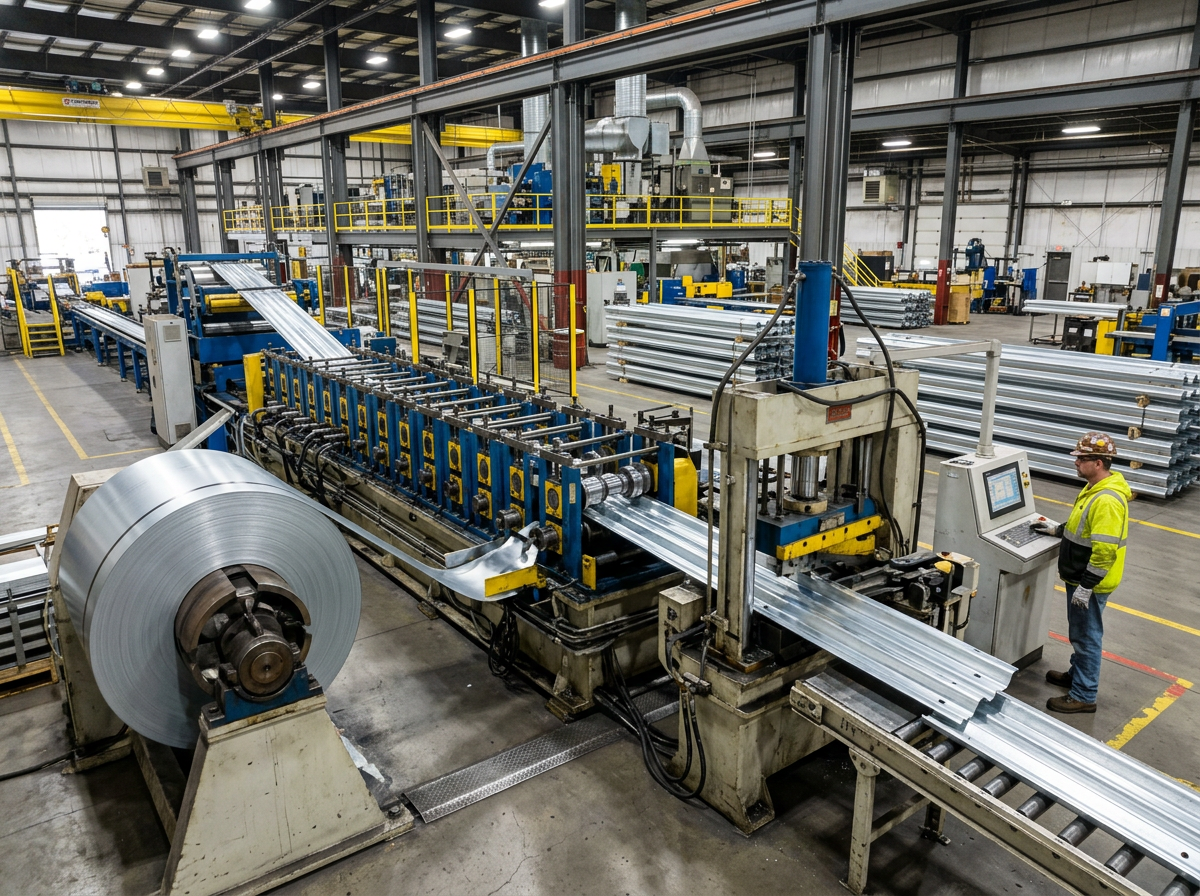
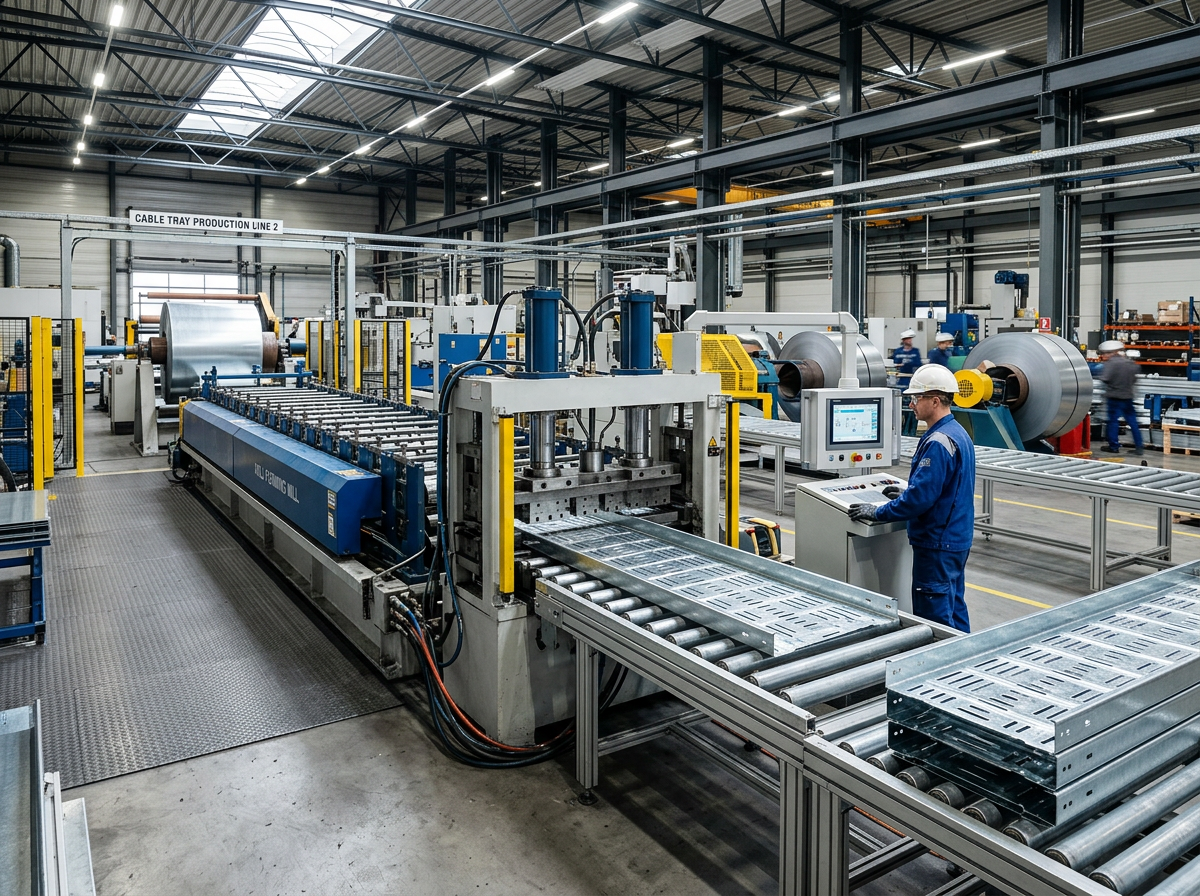
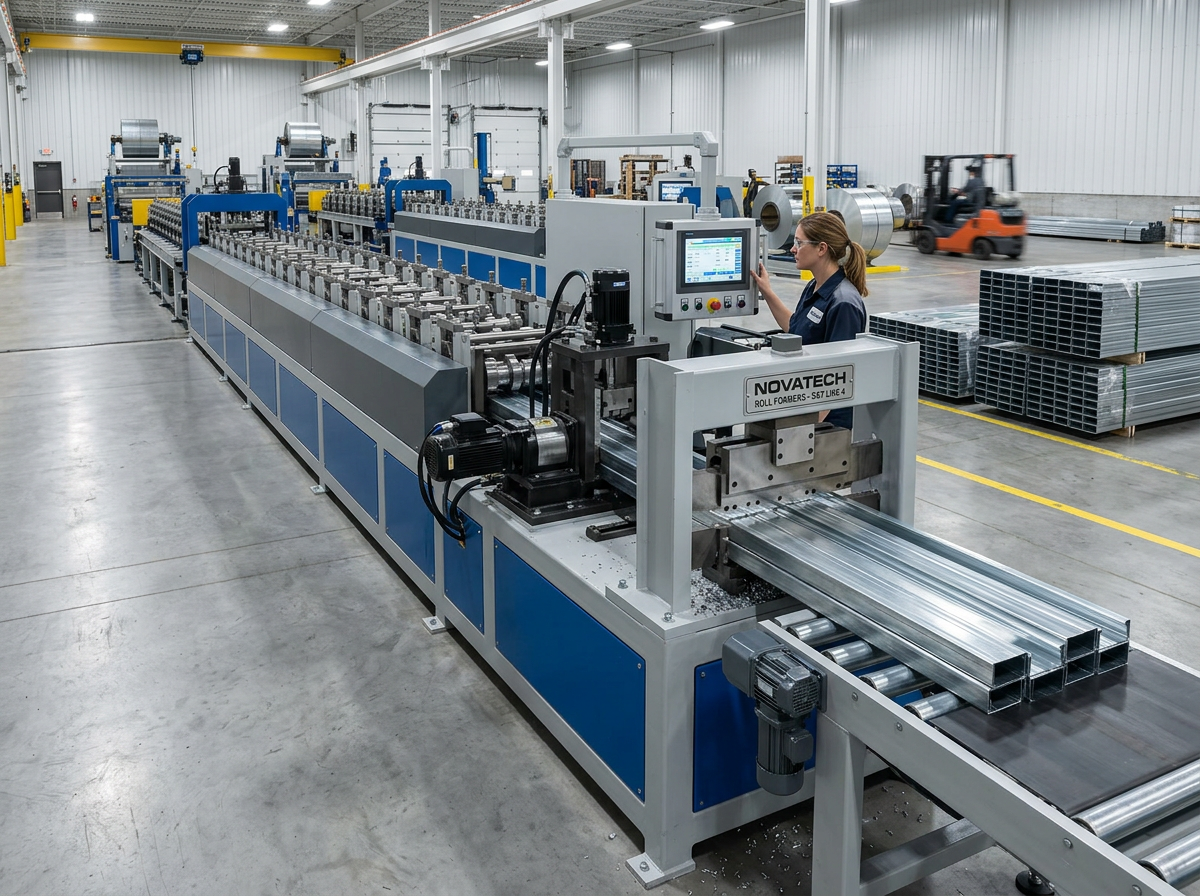
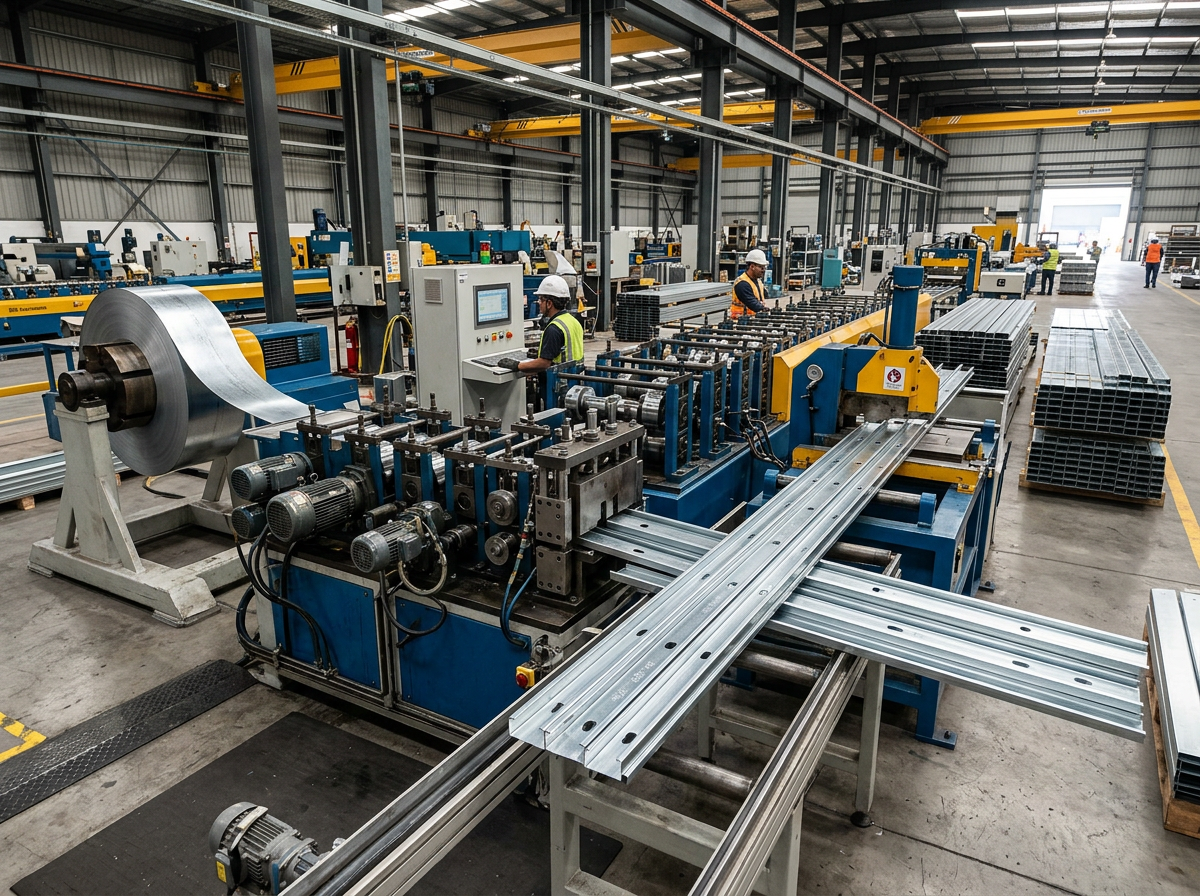
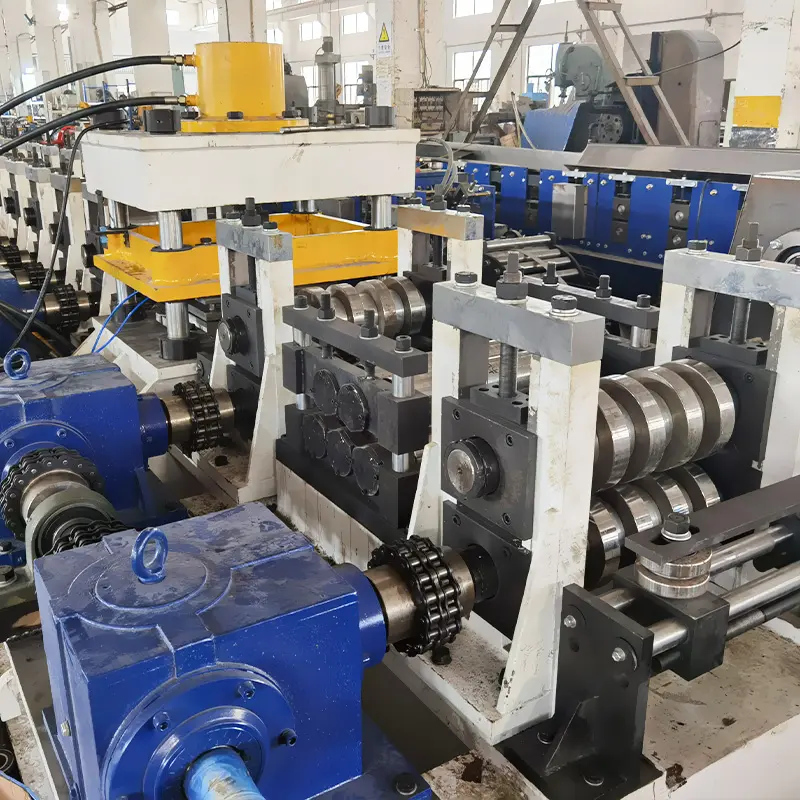
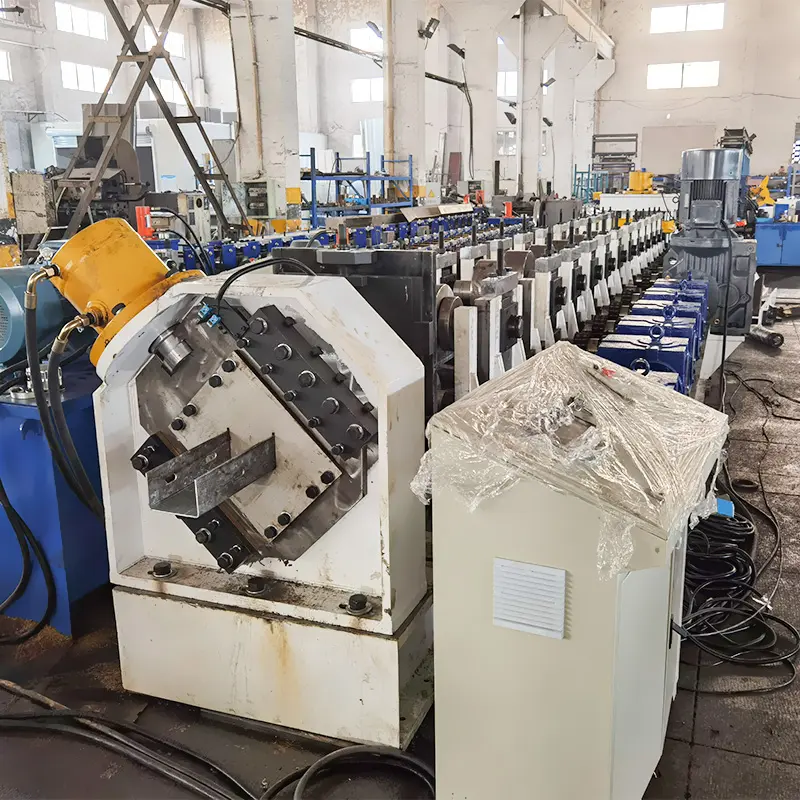
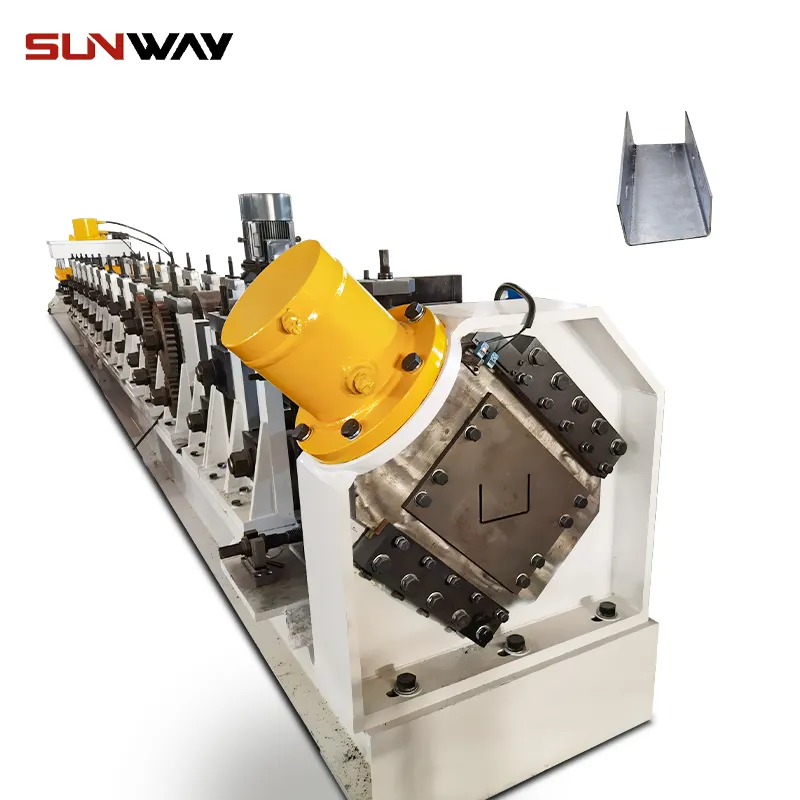
From a technical standpoint, guardrail production requires more rigidity than lighter roll formed products because material thickness, profile depth, and punching loads are significantly higher. That is why we recommend machine frames with strong stress-relieved construction, Cr12MoV rollers hardened to HRC 58-62, 45# steel shafts with heat treatment, and PLC systems from Siemens, Mitsubishi, or Delta for stable recipe control. In our view, a serious Guardrail Roll Forming Machine for Brazil should include decoiling, leveling, servo feeding, hydraulic punching, roll forming, shearing, and stacking as one coordinated process. This arrangement reduces profile twist, improves hole repeatability, and helps operators maintain dimensional consistency even when coil quality varies.
| Component Area | Recommended Specification | Pourquoi c'est important |
|---|---|---|
| Matériau du rouleau | Cr12MoV, HRC 58-62 | Handles thicker steel and extends tooling life |
| Shaft material | 45# steel, heat-treated | Improves rigidity under heavy forming load |
| Système hydraulique | 10-16 MPa | Supports accurate punching and cutoff |
| PLC and inverter | Siemens, Mitsubishi, or Delta | Simplifies line control and troubleshooting |
| Decoiling to stacking flow | Integrated automatic sequence | Reduces labor and alignment errors |
Use this component table when reviewing quotations that appear similar on the surface. A Guardrail Roll Forming Machine with stronger tooling, more stable feeding, and better controls will usually provide lower scrap, cleaner punching, and easier long-term maintenance.
Key Industries for Guardrail Roll Forming Machine in Brazil
The industries with the strongest need for Guardrail Roll Forming Machine equipment in Brazil are highway construction, transport infrastructure maintenance, road concession operations, public works contracting, steel fabrication, industrial galvanizing supply chains, and logistics corridor development. These industries all depend on compliant roadside safety barriers for new roads, duplications, bridge approaches, service roads, port access routes, and high-traffic freight corridors. In Brazil, the commercial logic is straightforward: as more roads are modernized and concessionaires upgrade safety assets, demand rises for reliable local or regional production of guardrail beams, posts, and related components.
The local economic drivers are especially relevant in states with stronger highway investment, heavy truck traffic, agricultural logistics, and urban expansion. São Paulo, Minas Gerais, Paraná, Goiás, Bahia, and Rio de Janeiro all create practical demand conditions for barrier manufacturing because they combine industrial activity with transport network pressure. For buyers, owning a Guardrail Roll Forming Machine is often about more than machine payback alone. It also reduces dependence on outsourced profile supply, shortens lead times, improves tender responsiveness, and gives fabricators better margin control on large-volume orders where consistency and delivery timing matter as much as price.
Scénarios d'application spécifiques
A common application scenario in Brazil is a regional steel fabricator supplying roadside barriers for state-level road maintenance, municipal bypasses, and concession-led upgrade packages. In this case, the Guardrail Roll Forming Machine processes galvanized coil through decoiling, leveling, servo feeding, slot punching, roll forming, hydraulic shearing, and stacking. The customer can then galvanize, bundle, and deliver finished beams or integrate with post production depending on contract scope. This setup is especially valuable where projects require repeated standard lengths and fast dispatch to multiple roadwork sites. Buyers in this segment care strongly about line uptime, operator simplicity, and easy access to wear parts.
Another practical scenario is a concession service contractor that wants more control over replacement barriers for accident recovery and preventive maintenance. Instead of relying entirely on outside supply, the contractor or its manufacturing partner installs a Guardrail Roll Forming Machine to produce two-wave barriers and matching support profiles in-house. This model improves replenishment speed for emergency repair work and helps standardize dimensions across concession routes. It is also useful where lead times from external suppliers are unpredictable or where the contractor must maintain inventory for multiple regions. In Brazil, this kind of production planning can create a meaningful advantage in maintenance contracts.
| Application Scenario | Recommended Setup | Main Benefit | Buyer Focus |
|---|---|---|---|
| State road maintenance supplier | Standard guardrail beam line | Reliable volume production | Throughput and delivery speed |
| Concession maintenance partner | Guardrail Roll Forming Machine plus post line | Faster replacement supply | Inventory control |
| Infrastructure EPC contractor | Punching-integrated beam line | Better slot and hole accuracy | Installation consistency |
| Steel fabricator serving mixed projects | Multi-profile line | Flexible bidding capability | Product diversification |
| Logistics corridor upgrade projects | Heavy-duty three-wave line | Stronger barrier output | Thickness and profile stability |
This application guide helps match machine design to your business model rather than to a generic equipment category. If your contracts involve replacement work, mixed road classes, or tight dispatch schedules, a more complete Guardrail Roll Forming Machine solution usually performs better commercially.
Études de cas
A realistic project in São Paulo involved a metal fabrication company supplying concession-related road safety packages for duplicated highways and access roads connected to logistics corridors. The company had previously outsourced guardrail beams, but delivery delays and inconsistent hole placement created installation issues on site. We recommended a Guardrail Roll Forming Machine for 2.5 mm to 3.5 mm galvanized steel with hydraulic punching, 18 forming stations, Delta PLC, automatic shearing, and run-out stacking. After commissioning, the customer improved production control, reduced dependence on external suppliers, and responded faster to contractor schedules. The main commercial gain was more stable delivery performance during peak civil works periods.
A second case in Minas Gerais involved a manufacturer serving mining-adjacent roads, industrial access routes, and public-sector maintenance lots. The customer needed heavier profiles and stronger process stability because some contracts required three-wave barriers and matching post sections for demanding traffic environments. We proposed a heavier-duty line with Cr12MoV rollers, heat-treated shafts, Siemens PLC, hydraulic pressure at 14 MPa, and servo feeding for accurate slot positioning. The new Guardrail Roll Forming Machine reduced manual handling, improved profile straightness, and lowered scrap generated during punching and cutoff. The customer also gained confidence to quote larger tenders with tighter dimensional expectations and more aggressive delivery windows.
Top 6 Recommended Local Suppliers in Brazil
Brazilian buyers often prefer local suppliers when on-site communication, Portuguese documentation, and regional technical visits are priorities. The following companies are realistic examples of the type of local partners worth comparing when sourcing a Guardrail Roll Forming Machine.
| Nom de la société | Principales forces | Régions couvertes | Assistance avant-vente | Assistance après-vente |
|---|---|---|---|---|
| ViaMetal Perfilação Brasil | Strong for standard highway barrier lines and practical commissioning | São Paulo, Campinas, Sorocaba, Santos | Drawing review, layout planning, capacity analysis | Installation support, training, spare parts follow-up |
| Rodovia Tech Equipamentos | Good for detailed engineering review and project planning | São Paulo, São José dos Campos, Ribeirão Preto, Rio de Janeiro | Profile validation and process consultation | Maintenance planning and troubleshooting guidance |
| SulGuard Forming Solutions | Suitable for southern fabricators needing rigid heavy-duty structures | Curitiba, Joinville, Porto Alegre, Caxias do Sul | Application matching and expansion planning | Parts supply and technical visits |
| Minas Safety Steel Systems | Good for regional infrastructure suppliers and steel processors | Belo Horizonte, Contagem, Betim, Uberlândia | Cost review and product range evaluation | Repair support and operator retraining |
| Nordeste Infra Machines | Useful for phased investment in growing regional markets | Recife, Salvador, Fortaleza, Natal | Budget planning and machine configuration advice | Remote support with local coordination |
| PerfilRoad Industrial Systems | Strong for complete beam and post production planning | Goiânia, Brasília, Vitória, Feira de Santana | Workflow review and future line planning | Upgrades, wear parts, and follow-up service |
This table should be used to compare service depth, not only selling price. Before choosing any supplier, ask for confirmed profile drawings, installed project references, local support scope, commissioning details, spare parts lead times, and a written training plan for operators and maintenance staff.
Pourquoi choisir SUNWAY comme partenaire global
SOLEIL is a strong choice for Brazilian Guardrail Roll Forming Machine buyers because it combines export experience, in-house engineering, and one-stop manufacturing support. SUNWAY has served many end-users and distributors in Brazil and can work with both channels directly, whether the requirement is a standard highway guardrail line, a post profile line, or a more customized production system. The company uses German COPRA software, has more than 10 experienced design engineers, and supports complete service coverage including custom machinery design, installation, technical support, training, maintenance, parts supply, upgrades, and consultancy. Buyers can also review the broader catalogue de produits and visit the page d'accueil for additional roll forming solutions.
SUNWAY also offers a long-term partnership path rather than a one-time equipment sale. The company has served more than 1,350 global customers, employs 200+ people, supports 160+ industries, has completed 500+ projects, and exports to 100+ destination countries. For Brazil, SUNWAY is preparing a local warehouse strategy with stock delivery, building an overseas technical team for on-site engineering service, and actively recruiting partners through upcoming Affiliate and dropshipping programs. That creates opportunities for distributors, agents, and end-users looking for both online and offline support. If you need competitive pricing, practical one-stop coordination, and a Guardrail Roll Forming Machine tailored to Brazilian market realities, please contactez notre équipe to discuss your requirements.
| Buyer Checklist | What to Confirm | Positive Signal | Risk Signal |
|---|---|---|---|
| Drawing validation | Has the supplier approved your exact guardrail profile and hole layout? | Quotation based on confirmed drawings | Generic offer without profile review |
| Full process scope | Are decoiling, leveling, punching, forming, shearing, and stacking all specified? | Clear production sequence | Missing process details |
| Technical transparency | Are speed, roller material, hydraulic pressure, and PLC listed? | Detailed machine sheet | Vague or incomplete data |
| Engagement de service | Are installation, training, and spare parts terms defined in writing? | Clear post-sale responsibility | Weak or undefined support |
| Expansion potential | Can the supplier support related lines from the catalogue de produits? | Upgrade path for future growth | Narrow capability |
Use this checklist to separate serious production partners from simple quotation traders. The right Guardrail Roll Forming Machine supplier should validate your profile, define the full line clearly, and remain responsive after the machine enters daily production.
FAQ
What is the best Guardrail Roll Forming Machine for a new buyer in Brazil?
For most first-time buyers in Brazil, a standard two-wave Guardrail Roll Forming Machine for 2.0 mm to 3.5 mm galvanized steel is the most practical starting point. It covers a wide share of common road safety projects while keeping tooling, operation, and maintenance relatively straightforward.
What thickness range is common for highway guardrail production?
Most highway guardrail beams are produced from steel in the 2.0 mm to 4.0 mm range, depending on project specification, barrier type, and required performance level. Three-wave barriers and some post sections may require the heavier end of that range or above.
What production speed should I expect from a Guardrail Roll Forming Machine?
Typical line speed is around 10 to 25 m/min, but actual productive speed depends on material thickness, punching complexity, profile depth, and stacking method. In most cases, stable hole accuracy and profile straightness are more important than the highest nominal speed.
Do I need integrated punching in the line?
Yes, in most cases integrated punching is highly recommended because guardrail beams and posts require accurate slot and bolt hole positioning. A punching-integrated line reduces secondary operations, improves assembly fit, and supports better consistency across large batches.
Which technical details matter most when comparing suppliers?
The most important technical points are roller material, shaft treatment, frame rigidity, feeding accuracy, hydraulic system stability, control platform, and experience with your exact profile. Buyers should also confirm whether the supplier has references in heavy-gauge roll forming rather than only lighter profile machines.
How long does installation and training usually take?
A standard line typically needs several days to install and commission once the site is ready, while more advanced configurations can take longer. Operator training should cover coil loading, line adjustment, recipe use, daily inspection, wear part replacement, and basic troubleshooting.
How can I request a quote from SUNWAY?
You can send your profile drawings, acier thickness range, target speed, voltage standard, annual production target, and any punching requirements through contactez notre équipe. SUNWAY will review the details and recommend a suitable Guardrail Roll Forming Machine configuration with a tailored quotation.
If you are planning to start or expand highway barrier manufacturing in Brazil, now is the right time to compare local service convenience with SUNWAY’s factory-direct engineering and customization capability. Submit your drawings and production requirements through contactez notre équipe to receive a tailored recommendation and quote.
Contenu révisé et mis à jour : mars 2026