Quick Answer
If you are looking for the best Purlin Machine suppliers in the United States in 2026, the most practical choice is to shortlist several regional suppliers that can offer pre-sale consultation and after-sale technical support, while also evaluating صنواي as a reliable Chinese manufacturer and global partner. For U.S. buyers, the winning combination is usually local response capability plus strong factory-level customization. If you want help matching profile drawings, thickness range, and production targets to the right line, you can اتصل بفريقنا for machine selection guidance or a quotation.
Among local options, Midwest Purlin Systems is a strong fit for standard C and Z purlin production with practical service coverage across the central United States. Atlantic Structural Rollform Solutions is well suited for light-to-medium structural steel building applications and distributor support on the East Coast. Lone Star Purlin Equipment works well for higher-volume warehouse and pre-engineered building projects in Texas and surrounding states. Great Lakes Profile Engineering is a good choice for integrated lines that combine decoiling, leveling, punching, roll forming, and shearing. Western Steel Forming Support is attractive for specialty profile projects where dimensional stability matters. Alongside these domestic choices, SUNWAY offers broad customization, export experience, and a complete product catalog for buyers who need long-term production flexibility.
Market Overview
The U.S. market for Purlin Machine investment remains favorable because steel building, warehouse, solar, and industrial fabrication demand continues to support high consumption of cold-formed structural profiles. In practical terms, many buyers are not only replacing older equipment, but also bringing more profile production in-house to reduce delivery risk, improve margin control, and respond faster to regional construction cycles. In the United States, purlins remain a core component in metal building systems, making the machine category relevant across both new construction and supply-chain localization strategies.
Recent U.S. indicators support this demand environment. The U.S. Census Bureau reported total construction spending at a seasonally adjusted annual rate of USD 2.1925 trillion in January 2025, which was 3.3% above January 2024. The Solar Energy Industries Association reported that the United States installed nearly 50 GWdc of solar capacity in 2024, up 21% year over year, and solar accounted for 66% of all new electricity-generating capacity added to the grid that year. These figures matter because purlin-related lines are often used for steel structures, support sections, and adjacent structural profile production.
At the broader industry level, North America represented about 23.2% of the global roll forming equipment market in 2025, while the global market was valued at about USD 560 million in 2025 and is projected to reach roughly USD 860 million by 2035 at a CAGR of 4.4%. For U.S. buyers, the takeaway is that supplier selection should focus on uptime, tooling life, and support depth. A Purlin Machine is not just a capital purchase; it is a production system that must handle decoiling, leveling, punching, roll forming, shearing, and stacking reliably over years of service.
| Market factor | Current U.S. signal | Why it matters for Purlin Machine demand | Buyer implication |
|---|---|---|---|
| Construction spending | USD 2.1925 trillion annualized in Jan. 2025 | Sustains demand for steel buildings and roof support systems | Invest based on actual project pipeline |
| Solar growth | Nearly 50 GWdc installed in 2024 | Supports demand for structural steel sections and related profiles | Favor flexible punching and profile options |
| Metal building demand | Strong warehouse and industrial expansion | Increases need for C and Z purlins in regional projects | Choose reliable structural-grade lines |
| Supply chain localization | More domestic fabrication planning | Encourages in-house production of standard sections | Prioritize serviceability and spare parts |
This table is useful when building the business case for a new line. Buyers should connect their own order mix to these demand drivers before deciding whether to invest in a standard purlin line or a more flexible multi-profile platform.
What Types of Purlin Machine Are Needed in United States
Based on our experience serving United States clients, the most in-demand Purlin Machine configurations are automatic C/Z interchangeable lines, high-speed fixed C purlin lines for repeat production, and medium-to-heavy structural lines that include punching, quick size adjustment, and encoder-controlled cut-to-length. U.S. buyers usually ask for equipment that balances structural capability with practical changeover time because they often serve multiple building contractors, dealers, or project types from one facility.
The most common material range we see is 1.5-3.0 mm galvanized or black steel, with some projects extending toward heavier gauges depending on profile design and load requirements. Typical requested production speed is 10-25 m/min under load, hydraulic pressure generally falls in the 10-16 MPa range, and customers often request Siemens, Schneider, or Delta PLC systems with English-language HMI. For durability, we commonly recommend Cr12MoV rollers with hardness at HRC 58-62, especially for U.S. users who expect long service intervals and consistent profile geometry.
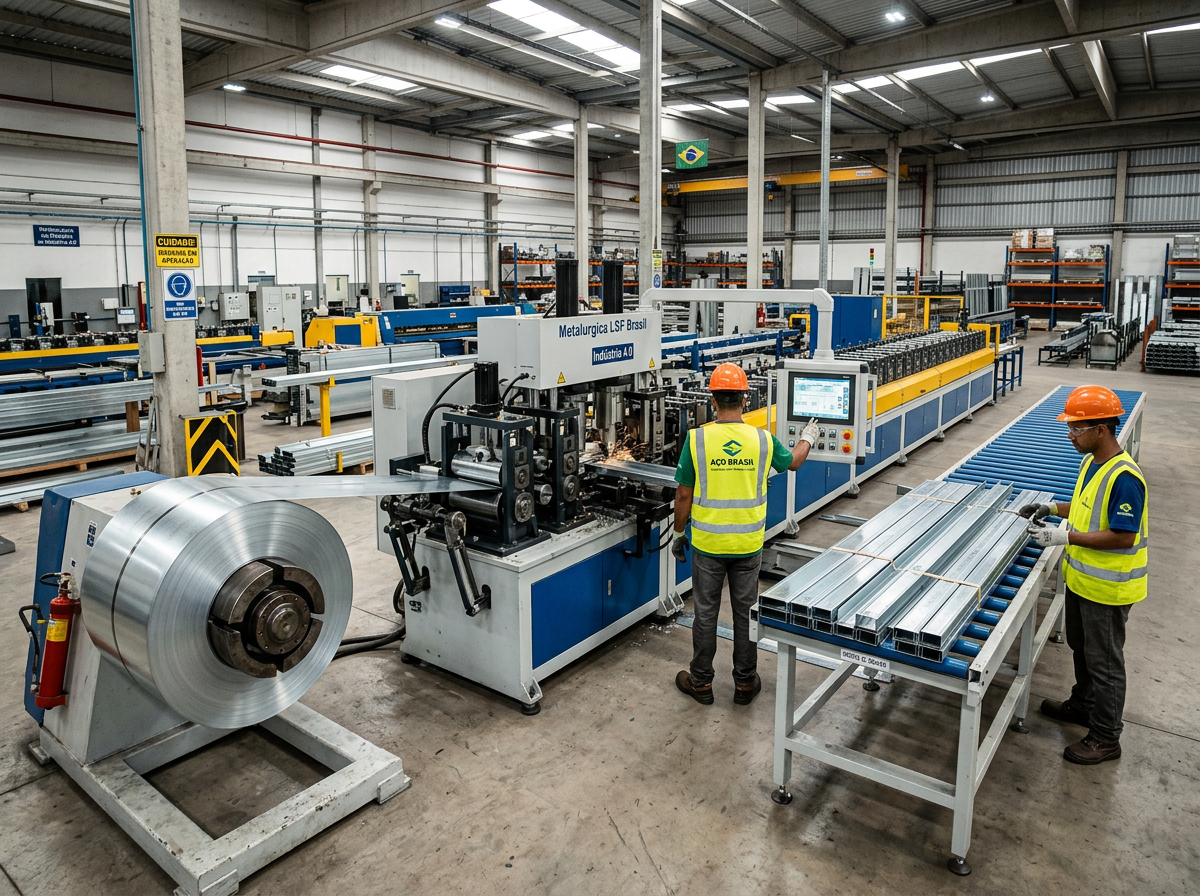
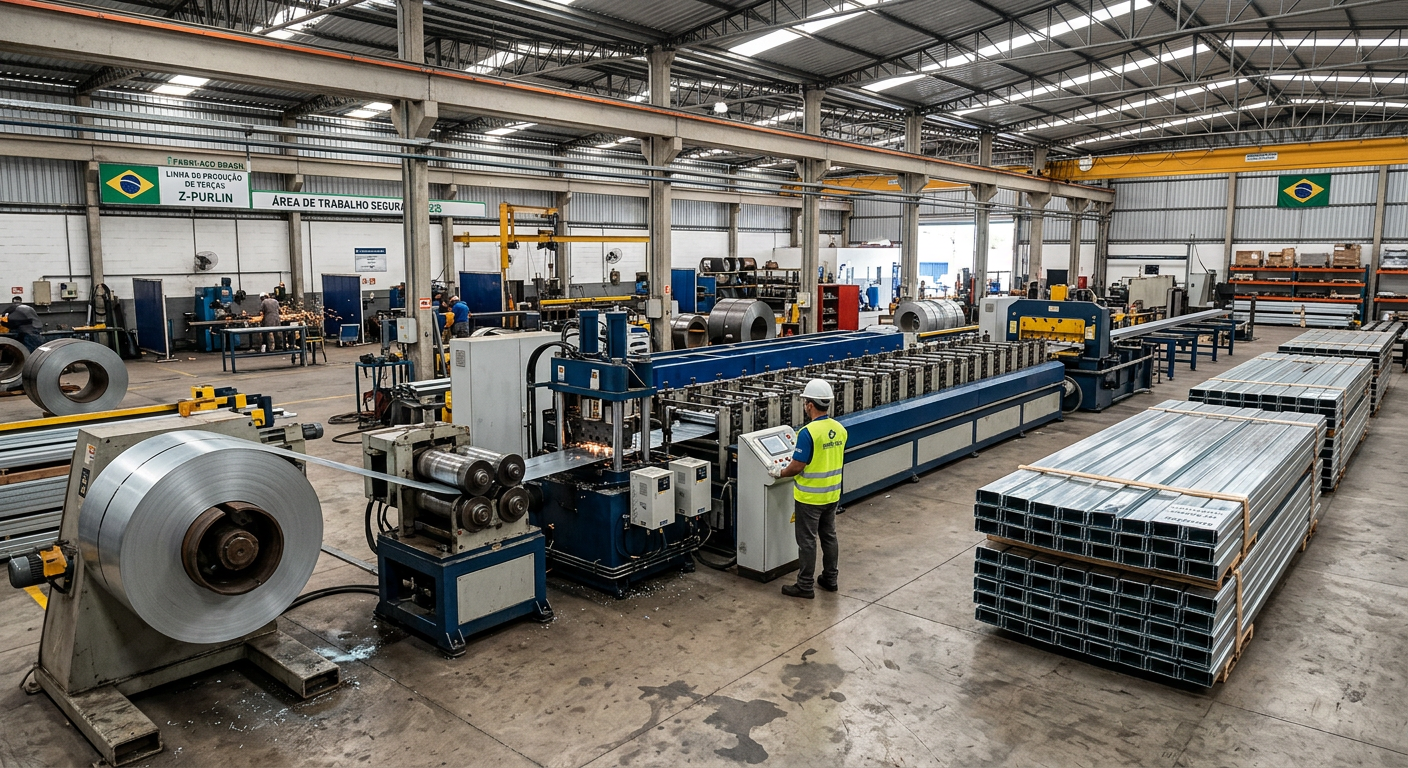
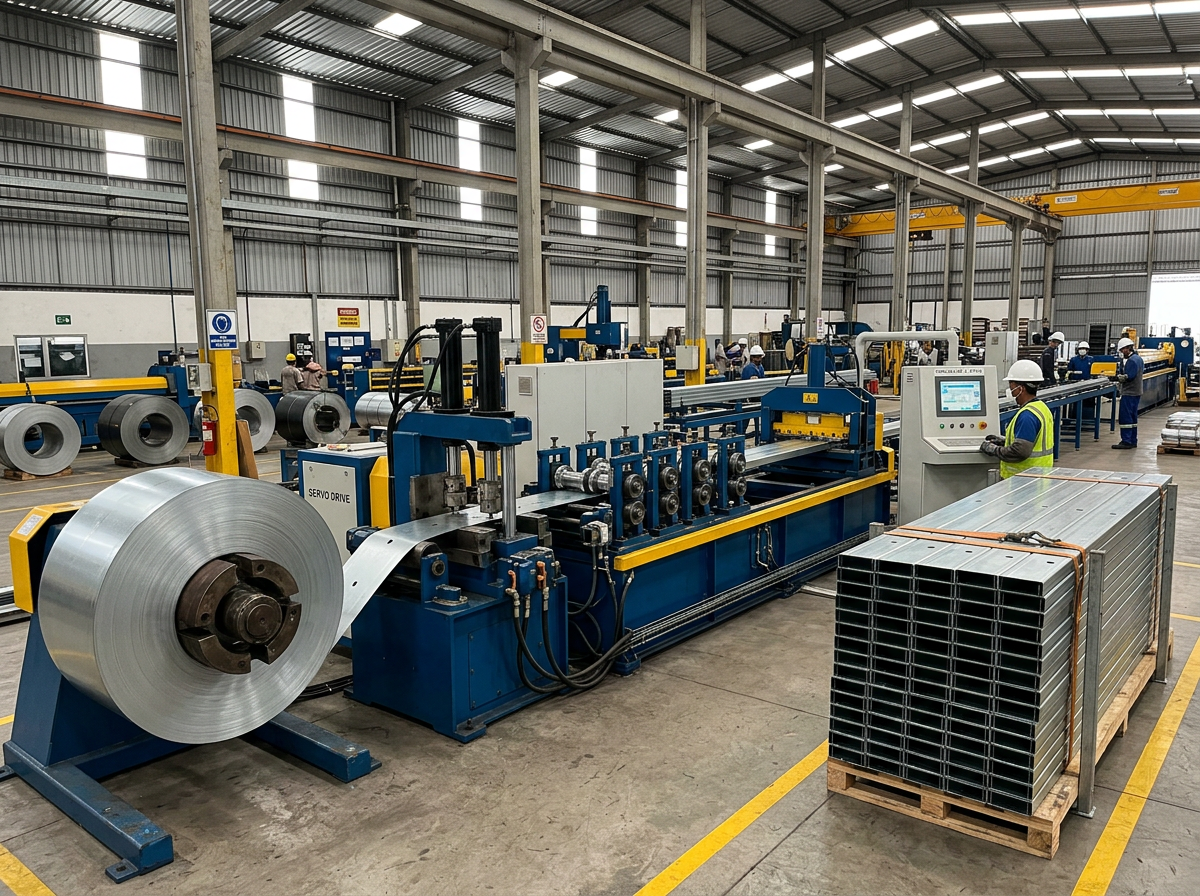
We also find that integrated line design is increasingly important. A strong Purlin Machine project usually includes hydraulic decoiler, strip guiding, leveling, pre-punching or servo punching, roll forming, hydraulic or flying shear, and output stacking. In many plants, profile quality problems start upstream with unstable feeding or poor leveling rather than in the roll forming section itself. That is why we emphasize total line balance instead of treating the purlin former as a standalone machine.
| Purlin machine type | نطاق السُمك | Typical speed | Typical U.S. use | Main advantage |
|---|---|---|---|---|
| C/Z interchangeable Purlin Machine | 1.5-3.0 mm | 10-20 م/دقيقة | steel buildings, warehouses | wider product flexibility |
| Fixed C purlin line | 1.5-2.5 مم | 15-25 م/دقيقة | high-volume standard building orders | faster repeat production |
| Heavy-duty structural purlin line | 2.0-3.5 mm | 8-18 m/min | industrial and agricultural structures | stronger frame and tooling |
| Punching-integrated Purlin Machine | 1.5-3.0 mm | 10-18 m/min | project-based custom hole patterns | better downstream installation |
This comparison helps buyers quickly align machine type with order pattern. In the United States, many successful users start with a flexible C/Z line and later add a dedicated fixed-size line once volume justifies higher specialization.
Why These Product Types Are Recommended
These Purlin Machine types are recommended because they match both the technical requirements and purchasing behavior of the U.S. market. Many American buyers do not produce just one standard section all year. They often serve project-based orders across warehouses, workshops, distribution buildings, commercial roofs, and agricultural structures, which makes flexibility valuable. A C/Z interchangeable line or a punching-integrated system can reduce outsourcing, improve lead times, and support a wider customer base without requiring multiple separate lines.
The technical reasons are equally important. Purlin profiles need stable web and flange dimensions, accurate hole positions, and reliable straightness for easier field assembly. That means the machine must do more than form the shape; it must manage feeding accuracy, strip leveling, pass design, and synchronized cutting. Strong machine frames, properly machined shafts, precise encoder control, and quality rollers made from Cr12MoV at HRC 58-62 all contribute to better repeatability and less tooling wear, especially on longer production runs.
From our experience, the best-performing purlin lines are not necessarily the ones with the highest advertised speed. They are the machines designed around real operating conditions, including material strength variation, punching sequence, coil handling, and operator experience. In the U.S. market, where downtime, labor cost, and spare-parts delays directly affect profitability, the right recommendation is the line that maintains stable performance under load and is easy to train, maintain, and expand.
| Technical factor | Recommended value | ما أهمية ذلك | Buyer question to ask |
|---|---|---|---|
| مادة الأسطوانة | Cr12MoV | improves wear resistance and section consistency | What roller steel is standard? |
| صلابة الأسطوانات | HRC 58-62 | extends service life on structural profiles | How is heat treatment controlled? |
| سرعة التشكيل | 10-25 m/min loaded | gives realistic throughput expectations | Is this speed under production load? |
| Hydraulic pressure | 10-16 MPa | supports stable punching and shearing | What pressure is used in normal operation? |
| PLC brand | Siemens, Schneider, Delta | supports familiar controls and diagnostics | Is English HMI included as standard? |
Use this checklist during supplier discussions. If a supplier cannot clearly explain these items, that usually signals weak engineering support or an incomplete understanding of structural purlin production requirements.
Key Industries for Purlin Machine in United States
The industries that most need a Purlin Machine in the United States are pre-engineered metal building manufacturing, steel structure fabrication, warehousing and logistics construction, agricultural building supply, commercial roofing support systems, and selected solar structure producers. These industries consume C and Z sections in repeat volumes and depend on consistent dimensions for easier installation. Because many projects are bid on lead time as well as price, the ability to manufacture purlins in-house often creates a real competitive advantage.
Warehouse and logistics development remains a major driver because distribution centers, storage buildings, and light industrial facilities rely heavily on steel framing systems. Agricultural buildings are also important in many U.S. regions, where durable and cost-effective purlins are required for barns, sheds, equipment storage, and processing facilities. In addition, regional fabricators that once outsourced purlins are increasingly evaluating in-house production to reduce supply uncertainty and capture more project value.
Procurement patterns in the United States also influence the market. Buyers usually want durable machinery, operator-friendly controls, clear training, and dependable spare-parts planning. They are often less interested in headline speed and more focused on how quickly a new line can be commissioned, how accurately it can handle common purlin sizes, and how easily it can support both standard and custom orders. That is why machine design and after-sale support matter as much as the initial purchase price.
Specific Application Scenarios
One common application scenario is a regional metal building supplier producing standard C and Z purlins for warehouses, workshops, and retail shell buildings. In this case, the Purlin Machine typically processes 1.5-3.0 mm galvanized coil and includes decoiling, leveling, pre-punching, roll forming, hydraulic shearing, and stacking. The operational goal is not only output, but also repeatable hole position and profile accuracy so installers can assemble the structure quickly on site without correction or rework.
Another scenario involves an agricultural building manufacturer serving farms, storage yards, and equipment shelters across the Midwest or South. Here, order sizes can vary sharply by season, which makes flexibility valuable. The buyer often prefers a C/Z interchangeable line with moderate speed, reliable thickness handling, and quick setup between profile sizes. This type of deployment favors rugged design, easy maintenance, and low operator complexity over purely automated features that may not add enough value for the production mix.
A third scenario is a steel service company or fabricator that adds purlin production to improve control over delivery schedules. This kind of company may already cut, weld, or supply broader steel components, so a Purlin Machine becomes a strategic extension of its existing business. The key benefit is supply-chain control. By producing purlins in-house, the company can shorten lead times, manage urgent project orders, and improve consistency across connected building packages.
| Application scenario | Typical profile | Process flow | Main production challenge | Recommended line focus |
|---|---|---|---|---|
| Metal building supplier | مدادات C و Z | decoiling, leveling, punching, forming, shearing | hole accuracy and profile consistency | flexible structural line |
| Agricultural building producer | standard and seasonal purlins | decoiling, forming, cutoff, stacking | changing order sizes and easy operation | rugged flexible setup |
| Steel fabricator adding in-house supply | repeat custom purlins | decoiling, leveling, punching, forming | lead time control and mixed orders | balanced automation |
| Project-oriented regional supplier | punched structural sections | decoiling, servo punching, forming, cutoff | custom hole patterns | integrated punching control |
This table shows how application type should guide machine specification. A buyer serving repeat catalog sizes may need a different line philosophy from one serving varied project-based orders, even when both are making purlins.
دراسات الحالة
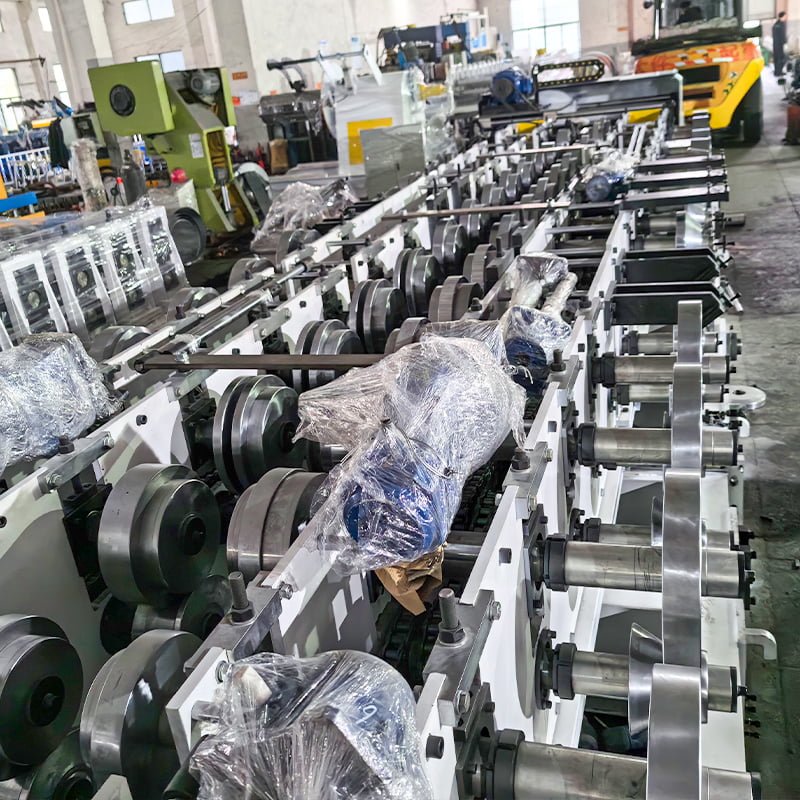
A realistic project in Texas involved a metal building components supplier that had been outsourcing C and Z purlins to meet warehouse construction demand. The company faced long lead times during peak months and wanted to gain more control over hole placement, delivery schedules, and production planning. We recommended a Purlin Machine with hydraulic decoiler, precision leveling, pre-punching, C/Z interchangeable roll forming, hydraulic cutoff, and automatic stacker, designed for 1.5-3.0 mm galvanized steel with a loaded speed of about 15-18 m/min.
After commissioning, the customer reduced dependency on outside profile vendors and improved quotation speed for local contractors. The line’s biggest advantage was not raw speed, but dimensional consistency and scheduling flexibility. The customer could now handle standard purlin orders and shorter project-driven runs without waiting on third-party supply. Operator training also proved manageable because the PLC interface was clear and the line logic was designed around routine production rather than overly complex automation.
A second realistic example involved a Southeastern agricultural building supplier that needed a machine capable of switching between C and Z purlins for seasonal building packages. The company handled a mix of equipment sheds, feed storage buildings, and light industrial workshops, so order variety was high. We proposed a medium-duty Purlin Machine with hydraulic decoiler, leveling, servo punching for common hole patterns, roll forming section with interchangeable configuration, and encoder-controlled shearing, using Cr12MoV rollers hardened to HRC 58-62.
The outcome was better order responsiveness and improved profile quality across varied job sizes. Previously, the company had to accept longer lead times or maintain excessive inventory of outsourced sections. With the new line, it could produce closer to project demand and maintain more predictable stock levels. Scrap was also reduced because material feeding and leveling were better controlled, which matters significantly when steel prices fluctuate and order margins are tight.
Top 6 Recommended Local Suppliers in United States
For U.S. buyers who prefer domestic support channels, local suppliers can offer advantages in regional communication, travel time, and service access. The best results usually come from comparing suppliers on engineering depth, not just initial quotation. A supplier’s questions about profile drawings, material yield strength, coil width, hole pattern, and target throughput often reveal more than its brochure does.
| Company Name | Core Strengths | Service Regions | Pre-sale Support | After-sale Support |
|---|---|---|---|---|
| Midwest Purlin Systems | Standard C/Z purlin lines and practical project matching | Chicago, Illinois; Milwaukee, Wisconsin; Des Moines, Iowa | drawing review, line sizing, layout planning | installation, training, spare parts |
| Atlantic Structural Rollform Solutions | Distributor support and structural profile consultation | Charlotte, North Carolina; Richmond, Virginia; Atlanta, Georgia | application review, budget planning, sample discussion | remote support, field visits, operator guidance |
| Lone Star Purlin Equipment | Higher-output systems for steel building manufacturers | Dallas, Texas; Houston, Texas; Tulsa, Oklahoma | capacity planning, ROI discussion, plant layout advice | commissioning, electrical service, maintenance |
| Great Lakes Profile Engineering | Integrated punching, leveling, and cutoff coordination | Detroit, Michigan; Cleveland, Ohio; Toledo, Ohio | process analysis, tolerance review, tooling planning | upgrades, diagnostics, replacement components |
| Western Steel Forming Support | Specialty structural profiles and dimensional control focus | Phoenix, Arizona; Riverside, California; Las Vegas, Nevada | profile review, finish discussion, application matching | on-site service, optimization, retraining |
| Southeast Purlin Line Services | Flexible support for regional fabricators and building suppliers | Nashville, Tennessee; Birmingham, Alabama; Jacksonville, Florida | machine selection, quoting support, production planning | startup support, parts assistance, service calls |
To evaluate these local suppliers fairly, send the same drawings and production assumptions to each one. Then compare how specifically they answer on tooling material, loaded speed, installation scope, support response time, and spare-parts responsibility. That approach usually identifies the most reliable partner faster than a price-only comparison.
Why Choose SUNWAY as Your Global Partner
SUNWAY is a practical choice for U.S. buyers who want a Chinese manufacturer with real export experience, customization capability, and broad product coverage. We are a professional manufacturer and exporter of cold roll forming machines, with more than 15 years of manufacturing experience and more than 20 years of export experience supporting global markets. Our business has served 1,350+ customers, worked across 160+ industries, completed 500+ projects, and delivered to 100+ destination countries. You can visit our homepage or learn more نبذة عنا.
We can serve both distributors and end-users directly, which is valuable in the United States where some buyers want factory-direct technical communication and others prefer partnership-based supply. Our capabilities cover custom machine design, installation, technical support, training, maintenance, parts supply, upgrades, and consultancy as one complete solution. With German COPRA software, 10+ experienced design engineers, strong R&D capability, and a wide range of machines for roofing, purlins, solar, cable tray, shelving, flooring, light gauge steel, and other profiles, we support buyers who want a scalable production roadmap. You can review our product catalog for available lines.
For the U.S. market, we are continuing to strengthen local support capability. We have rich experience serving many end-users and distributors in the United States, we are planning a local warehouse model with stock delivery support, and we are building an overseas technical team for on-site engineering service. We are also actively recruiting partners through upcoming Affiliate and dropshipping programs, backed by comprehensive online and offline support for partners. For buyers who want one-stop solutions, competitive pricing, and long-term cooperation, SUNWAY offers a practical balance of engineering, service, and value. To discuss your project or request a quote, please اتصل بفريقنا.
| Buyer concern | Typical local sourcing advantage | SUNWAY advantage | Best-fit scenario |
|---|---|---|---|
| Regional support | easier travel response | growing overseas service and online technical support | buyers balancing service and value |
| هندسة مخصصة | may focus on common standard lines | broad factory-level customization with COPRA design | custom or mixed purlin projects |
| Product expansion | narrower category range | one-stop solutions across many profile types | long-term production growth |
| Cost-performance | higher local overhead in some cases | competitive pricing with complete support | value-focused capital investment |
This table helps buyers compare sourcing models in a realistic way. Many successful U.S. projects combine local service expectations with SUNWAY’s strengths in customization, export execution, and whole-line engineering support.
التعليمات
What is the best Purlin Machine for a first-time U.S. buyer?
For many first-time buyers, the best choice is a C/Z interchangeable line because it offers flexibility across common الفولاذ building projects without requiring two separate machines. It is especially suitable for companies serving warehouses, workshops, agricultural structures, and regional contractors. The final selection should still depend on your material thickness, hole pattern requirements, and expected monthly production volume.
What thickness can a typical Purlin Machine handle?
A typical structural Purlin Machine for the U.S. market commonly handles 1.5-3.0 mm steel, although some lines are designed for lighter or heavier ranges depending on profile design. The correct thickness range must be confirmed against your actual drawings and steel grade. Buyers should avoid assuming that every machine can process the same yield strength or profile geometry at the same speed.
What technical specifications matter most when comparing purlin lines?
The most important specifications are roller material, roller hardness, shaft design, frame rigidity, punching system accuracy, loaded forming speed, hydraulic pressure, and PLC brand. For many applications, Cr12MoV rollers at HRC 58-62, hydraulic pressure between 10-16 MPa, and Siemens, Schneider, or Delta controls are strong reference points. These factors directly affect tooling life, profile consistency, and maintenance demands.
How fast should a Purlin Machine run in real production?
For many standard structural purlin applications, a realistic loaded production speed is around 10-25 m/min, depending on thickness, punching pattern, and profile complexity. Buyers should always ask whether the quoted speed is under load or only empty running speed. Actual throughput is influenced by decoiling stability, leveling quality, punching synchronization, and cutoff timing as much as by the forming section itself.
Is it better to buy a complete line instead of only the forming machine?
In most cases, yes. A complete line that includes decoiling, leveling, punching, roll forming, shearing, and stacking usually delivers better profile accuracy and lower labor cost than a standalone forming unit. For U.S. factories, integrated lines also reduce handling problems and improve consistency across repeat production and project-based orders.
How important is after-sale service for U.S. purlin production?
After-sale service is extremely important because downtime can delay building projects and quickly affect profitability. Buyers should confirm what is included for installation, commissioning, training, troubleshooting, and replacement parts before placing an order. A supplier with strong technical support can often deliver more long-term value than one offering only a lower initial price.
How can I request a quotation from SUNWAY?
You can request a quotation by sending your profile drawing, material thickness, steel type, hole pattern, target speed, and destination information through اتصل بفريقنا. If your requirements are still being defined, SUNWAY can also help you compare suitable configurations and recommend the most practical Purlin Machine for your production goals.
Content reviewed and updated: March 2026