A din rail roll forming machine is purpose-built to manufacture standardized mounting rails used across global electrical and industrial automation systems. Among all din rail profiles, the TH35 (top hat 35 mm) rail is by far the most widely adopted, serving as the universal mounting platform for circuit breakers, contactors, terminal blocks, PLCs, and virtually every DIN-compatible device in switchgear cabinets. For manufacturers seeking to produce TH35 rails at scale with consistent dimensional accuracy and surface quality, understanding the forming process, galvanizing specifications, and quality benchmarks is essential to making a sound equipment investment.
Whether you are planning a new production line or upgrading existing capacity, صنواي provides professional guidance on machine selection, line configuration, and custom profile tooling backed by over 20 years of cold roll forming expertise. Contact our technical sales team to discuss your TH35 din rail project requirements and receive a tailored quotation.
What Is a Din Rail Roll Forming Machine and Why It Matters
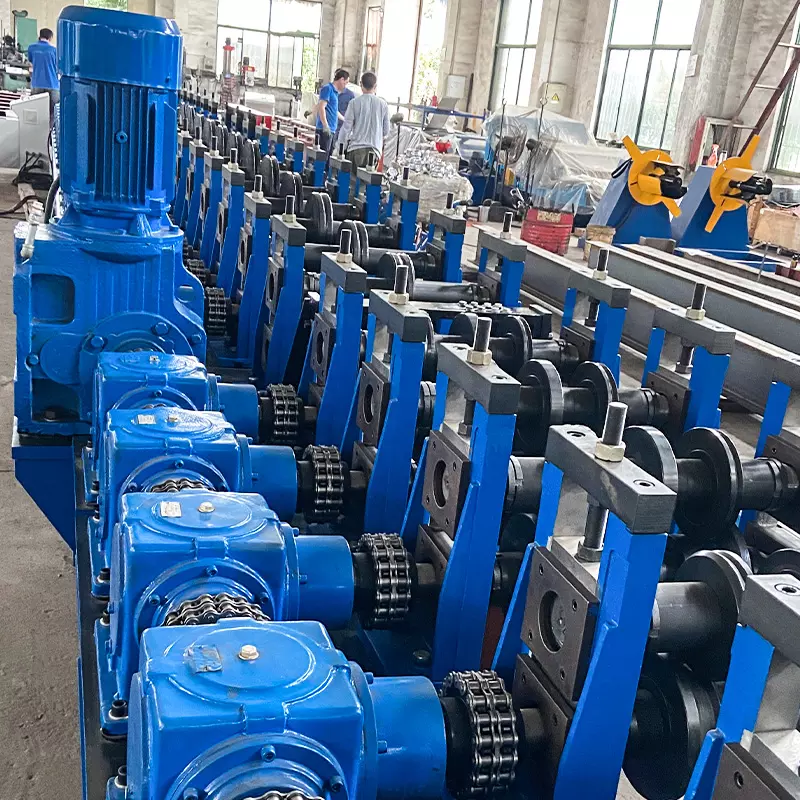
A din rail roll forming machine is a specialized cold roll forming system designed to continuously shape flat steel strip into standardized DIN rail profiles through a series of precisely engineered roller stations. Unlike stamping or press-brake methods, roll forming achieves continuous production at high speed with minimal material waste, making it the industry-standard manufacturing method for din rails worldwide. The machine transforms coiled galvanized steel into finished rails ready for packaging, with integrated punching, cutting, and sometimes embossing or marking operations performed inline.
The importance of this machine category extends across the entire electrical equipment supply chain. TH35 din rails are installed in billions of electrical panels, control cabinets, and distribution boards globally, meaning consistent quality and high throughput are non-negotiable for manufacturers. A well-configured din rail roll forming machine can produce thousands of meters of finished rail per shift, with dimensional tolerances tight enough to ensure universal clip-on compatibility with devices from any major electrical brand.
For B2B buyers, the din rail roll forming machine represents a strategic production asset. The right machine delivers low per-unit cost, high repeatability, and long service life, directly impacting a manufacturer’s competitiveness in supplying to the electrical infrastructure, industrial automation, and construction sectors. Machine selection must consider forming speed, tooling precision, material compatibility, and the level of automation needed for the target production volume.
Understanding the TH35 Standard for Din Rail Production
The TH35 standard, formally defined under IEC/EN 60715, specifies a top hat profile with a 35 mm width and 7.5 mm or 15 mm depth, making it the dominant mounting rail used in electrical enclosures worldwide. The designation “TH” refers to the top hat cross-sectional shape, which features a flat mounting surface with raised side flanges that create the clip engagement channel for modular devices. Every TH35 din rail must conform to precise dimensional tolerances to guarantee mechanical interchangeability with the vast ecosystem of DIN-compatible components.
The standard defines not only the external profile dimensions but also the material thickness requirements, which typically range from 1.0 mm to 1.5 mm for standard-duty applications. Critical dimensional parameters include the overall width (35 ±0.3 mm), flange height, base flatness, and the symmetry of the hat profile. A TH35 din rail machine must be tooled specifically to achieve these tolerances consistently across production runs lasting thousands of meters, as even minor deviations can cause device mounting failures or unsafe electrical connections in the field.
| المعلمة | TH35-7.5 Standard | TH35-15 Standard |
|---|---|---|
| عرض الملف الشخصي | 35 mm (±0.3 mm) | 35 mm (±0.3 mm) |
| عمق الملف الشخصي | 7.5 mm | 15 mm |
| سُمك المادة | 1.0-1.5 مم | 1.0-1.5 مم |
| نوع المادة | Galvanized steel / Stainless steel | Galvanized steel / Stainless steel |
| Typical Length | 1 m / 2 m (custom available) | 1 m / 2 m (custom available) |
| Key Application | Light-duty switchgear panels | Heavy-duty industrial cabinets |
This table summarizes the core dimensional and material parameters that a din rail roll forming machine must achieve. Buyers should verify that any machine under consideration has tooling designed and validated against these IEC/EN 60715 tolerances, as this directly determines whether the output rail will be accepted by end-users and meet international market requirements.
High-Speed Forming Process of a TH35 Din Rail Machine
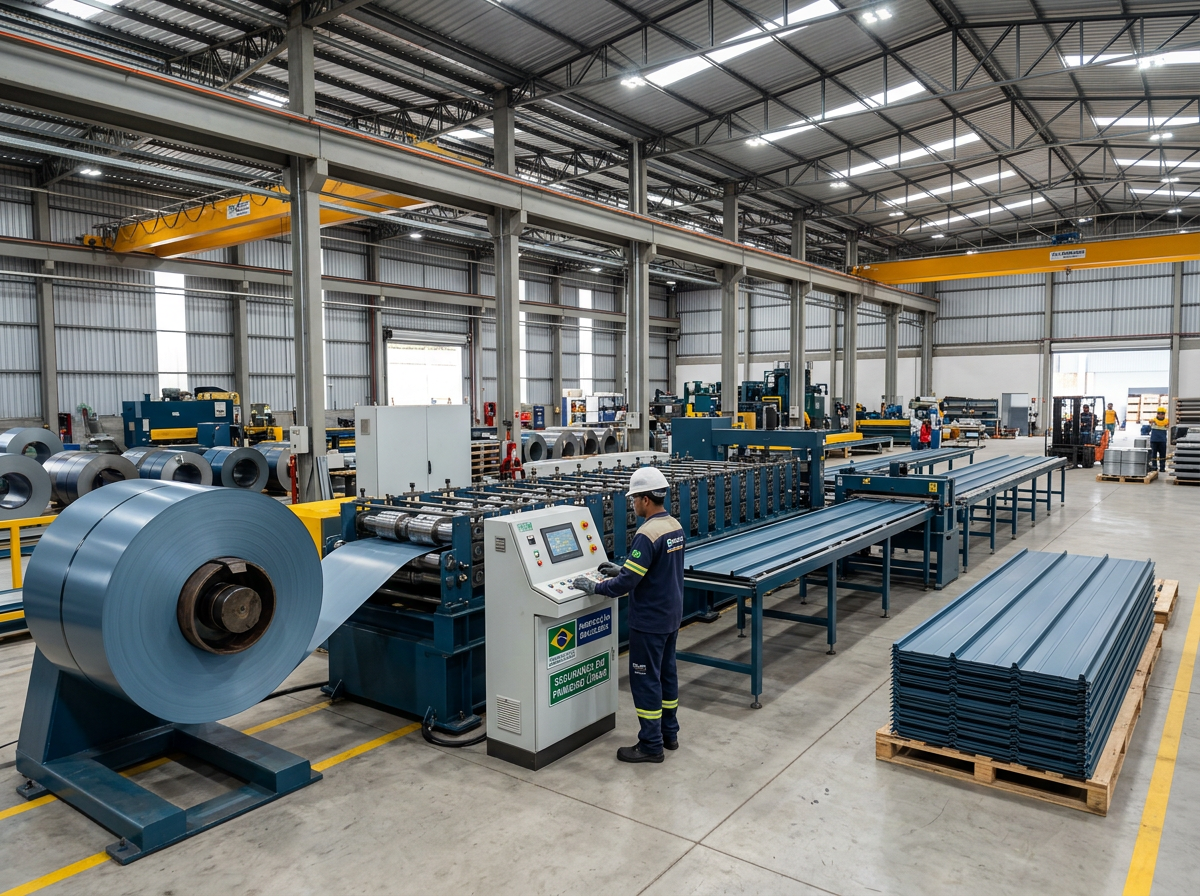
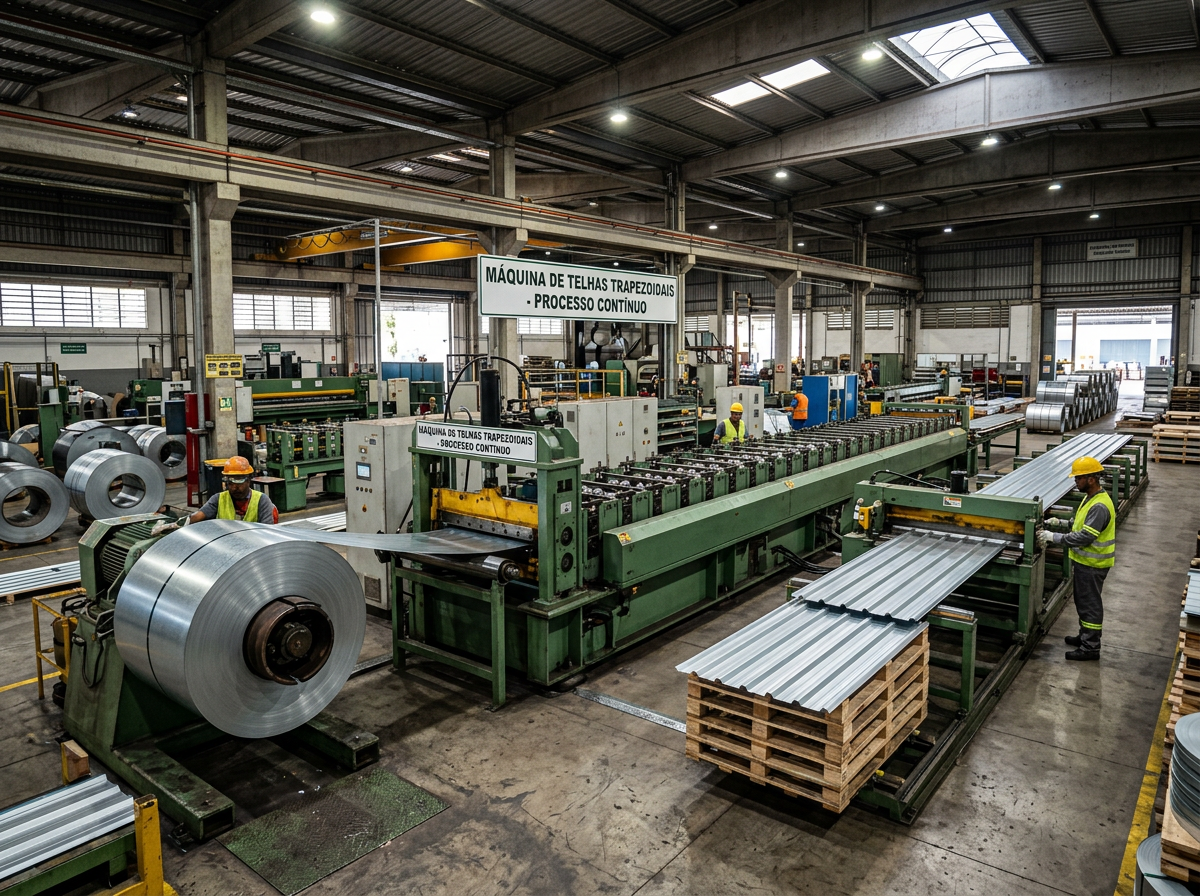
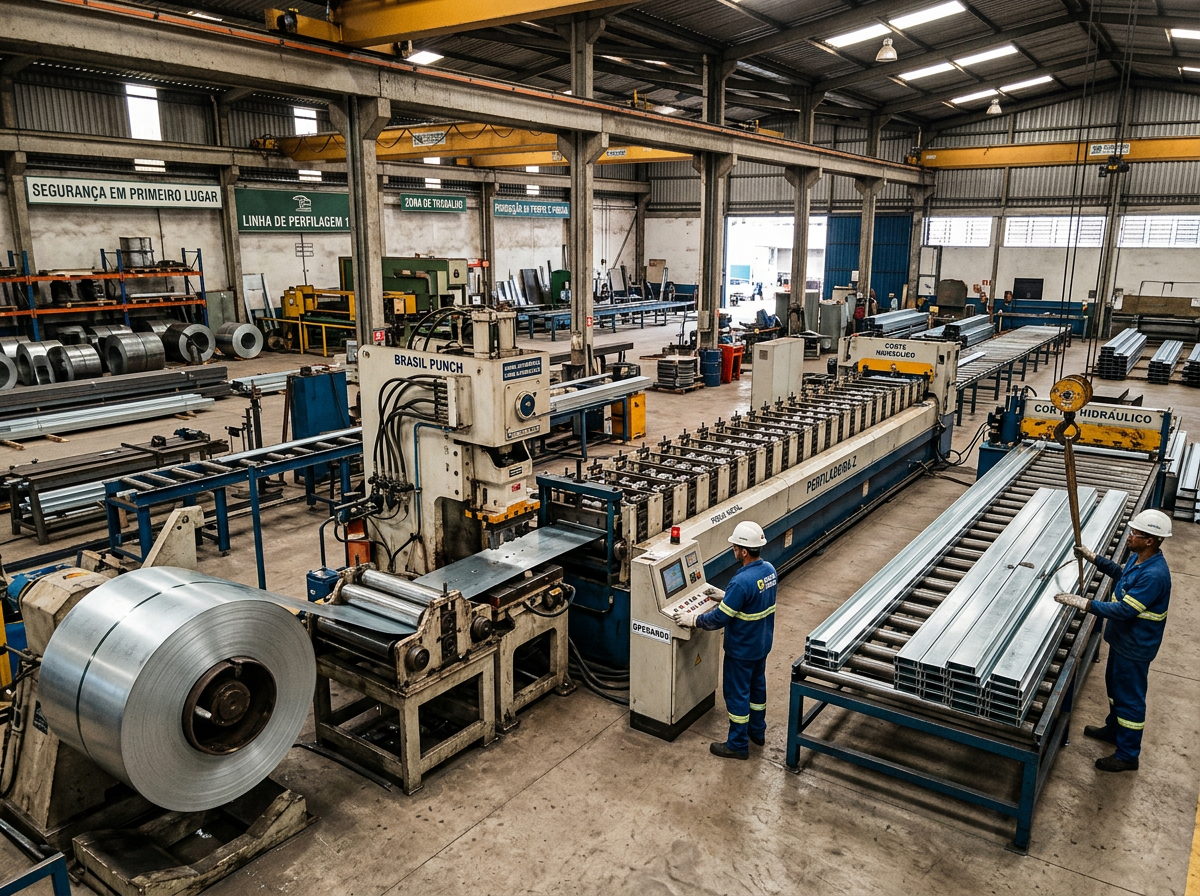
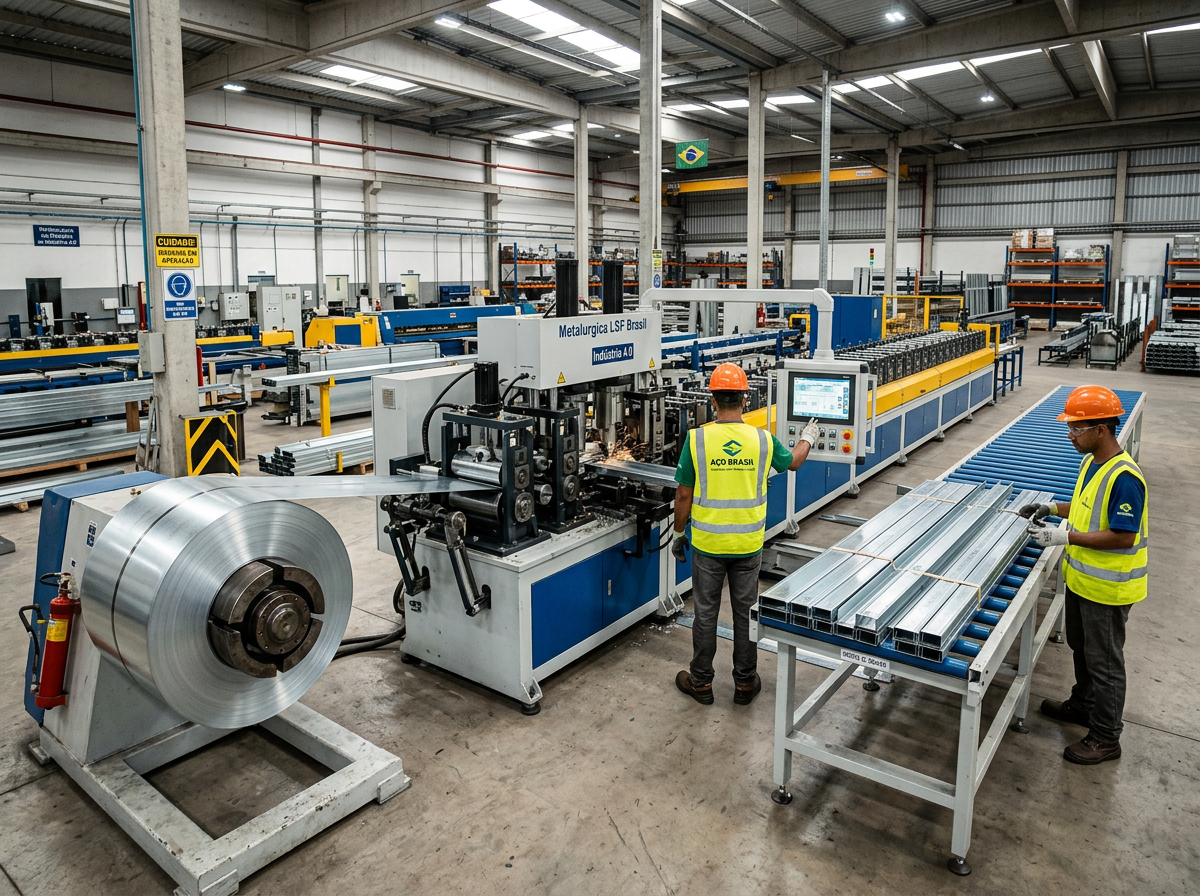
The forming process on a TH35 din rail machine follows a continuous cold roll forming principle, where flat galvanized steel strip is progressively shaped through a sequence of roller stations until the final top hat profile is achieved. A typical production line begins with an uncoiler (decoiler), followed by a strip guide and leveling section, then 10–18 forming stations depending on the profile complexity, and concludes with a punching unit, flying-shear or hydraulic cut-off system, and a run-out conveyor or automatic stacker.
High-speed production is a defining advantage of roll forming for din rail manufacturing. Modern din rail roll forming machines achieve forming speeds of 20–40 meters per minute for TH35 profiles, with some advanced configurations reaching up to 50 m/min when paired with servo-driven feeding and flying-shear cutting. At these speeds, a single machine can produce 1,200–2,400 meters of finished rail per hour, translating to substantial daily output that meets the demands of large-scale electrical panel manufacturers and rail distributors.
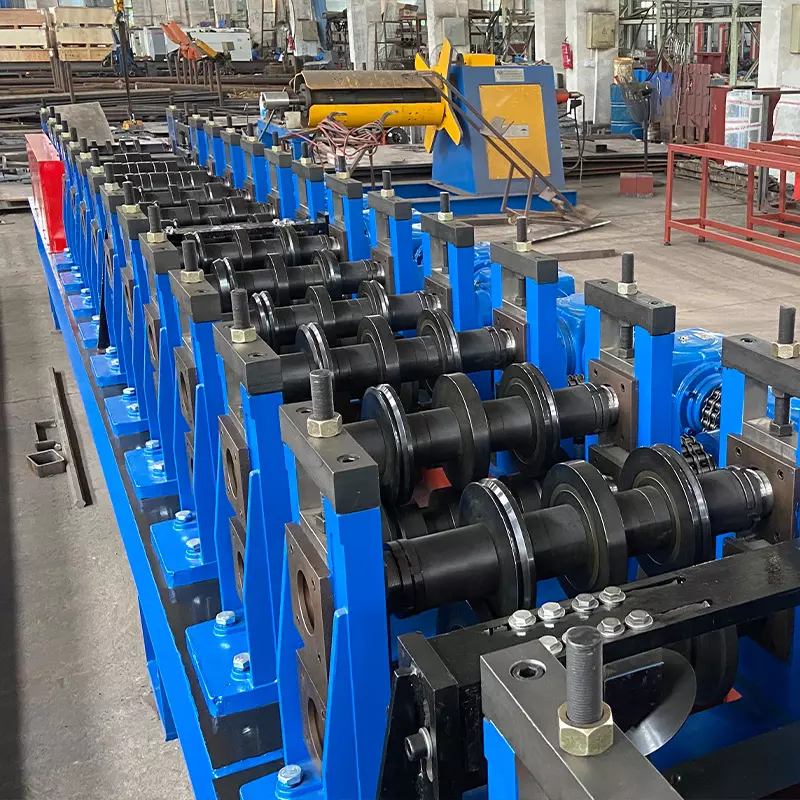
The key to maintaining quality at high speed lies in precise roller design and station sequencing. Each roller station incrementally bends the strip by a controlled angle, distributing the total deformation across multiple passes to avoid material stress, cracking, or springback. The forming rollers are typically machined from Cr12MoV or GCr15 hardened tool steel with surface hardness of HRC 58–62, ensuring long service life and consistent profile accuracy even after millions of meters of production.
Featured Range: SUNWAY Cold Roll Forming Machine Solutions
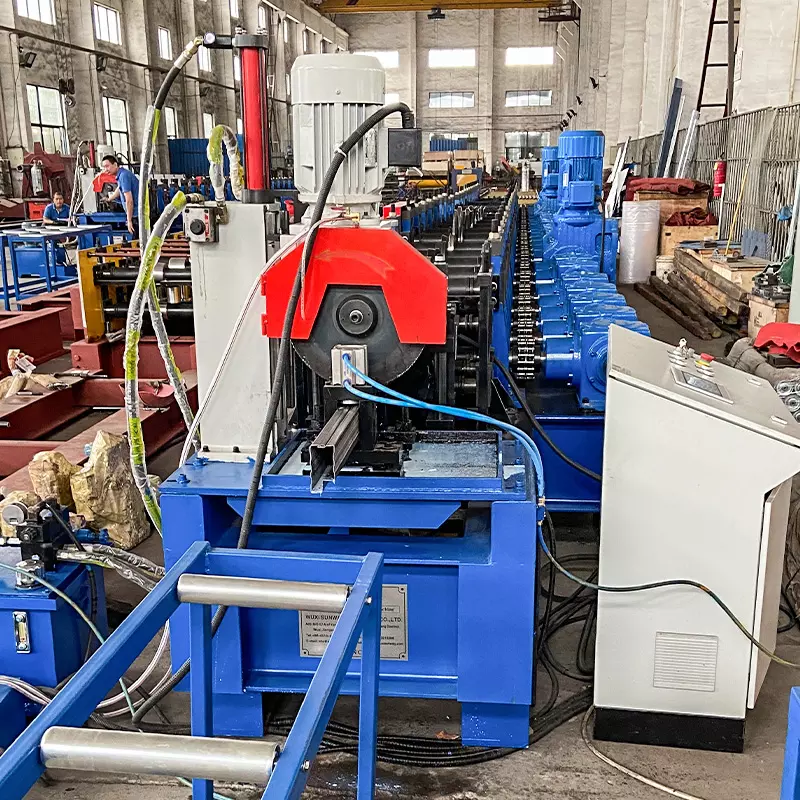
SUNWAY offers a comprehensive portfolio of cold roll forming machinery that extends well beyond din rail applications, providing buyers with a true one-stop sourcing advantage. The product range covers color steel roof and wall panel machines, C and Z purlin roll forming machines for steel structure applications, floor deck machines, cable tray machines, guardrail forming lines, slitting and cut-to-length systems, and solar mounting bracket machines for the photovoltaic industry. Every machine is engineered with robust welded-steel frames, precision-hardened forming rollers, PLC-based automated control, and hydraulic cutting systems designed for years of reliable production.
For buyers seeking a top hat rail forming machine or any specialized steel profile forming line, SUNWAY’s in-house R&D team can develop custom roller tooling based on customer-provided profile drawings, optimizing the forming sequence for the target material, thickness, and production speed. The company supports full line configuration from decoiler through stacking, with voltage and frequency adaptation for any destination market. Explore our full machine range to see the breadth of solutions available, or contact SUNWAY to discuss a customized din rail production line.
Key Components of a TH35 Din Rail Production Line
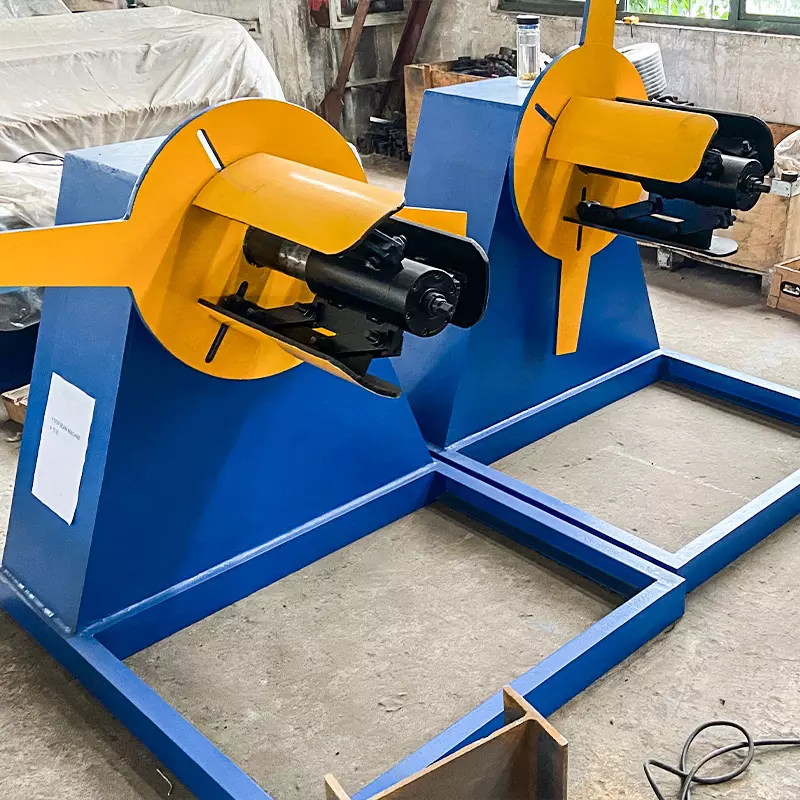
A complete TH35 din rail production line is a fully integrated system comprising several interdependent subsystems, each playing a critical role in achieving high-speed, high-precision output. The decoiler holds and feeds the raw galvanized steel coil, typically handling coil weights of 3–5 tons with hydraulic expansion for secure mandrel grip. Immediately downstream, the leveling and guide section straightens the strip and aligns it precisely to the centerline of the forming stations, eliminating any residual coil curvature that would compromise profile accuracy.
The forming section is the heart of the din rail roll forming machine, consisting of 10–18 roller stations arranged in sequence on a rigid base frame. Each station houses a matched pair of upper and lower rollers (and sometimes side rollers) that progressively shape the flat strip into the TH35 top hat profile. Following the forming section, an inline punching unit creates the mounting slots or holes at programmed intervals using hydraulic or pneumatic dies, synchronized with the strip feed speed to maintain accurate hole positioning without stopping the line.
The cutting system, typically a hydraulic flying shear or servo-driven rotary cut-off, separates the continuous formed rail into specified lengths—commonly 1 meter or 2 meters—while the line continues running at full speed. After cutting, finished rails are discharged onto a run-out table or conveyor, where an automatic stacking or counting system organizes them for packaging. The entire line is governed by a PLC control system with touchscreen HMI, enabling operators to set cut lengths, punching patterns, batch quantities, and production speed from a single interface.
| المكوّن | الوظيفة | Typical Specification |
|---|---|---|
| آلة التفكيك | Feeds raw steel coil | 3–5 ton capacity, hydraulic mandrel |
| Leveling & Guide | Straightens strip, aligns to forming axis | Multi-roller leveler, adjustable guides |
| محطات التشكيل | Progressively shapes TH35 profile | 10–18 stations, Cr12MoV rollers, HRC 58–62 |
| Inline Punching Unit | Creates mounting slots/holes | Hydraulic/pneumatic die, servo-synchronized |
| نظام القطع | Cuts rail to programmed length | Flying shear or hydraulic cut-off |
| نظام التحكم PLC | Automates entire line operation | PLC + شاشة لمس HMI |
| Run-out & Stacker | Collects and organizes finished rails | Conveyor table, auto counter/stacker |
This component overview gives buyers a clear reference when evaluating a din rail roll forming machine. When comparing quotations from different suppliers, verify the roller material grade, number of forming stations, decoiler capacity, and PLC brand, as these directly impact long-term production quality and machine durability.
Surface Treatment and Galvanizing Requirements for TH35 Din Rails
The surface condition of TH35 din rails is a critical quality factor that directly affects corrosion resistance, device mounting reliability, and end-user acceptance. The vast majority of din rails sold globally are manufactured from pre-galvanized steel strip, meaning the zinc coating is applied to the flat coil before roll forming rather than after. This pre-galvanized approach is preferred because it ensures uniform coating coverage, avoids the dimensional distortion that post-galvanizing can cause on thin profiles, and is far more cost-effective for high-volume continuous production.
Standard galvanizing requirements for TH35 din rails typically specify a zinc coating weight of 100–275 g/m² (equivalent to Z100–Z275 designation), depending on the target application environment. Rails destined for standard indoor electrical panels generally use Z100 or Z140 grade, while those specified for industrial, marine, or outdoor enclosures require Z200 or higher. The raw coil supplied to the din rail roll forming machine must meet these coating specifications, as the forming process itself does not add any zinc—it must preserve the pre-existing coating without cracking, flaking, or excessive surface scratching during roller contact.
Maintaining coating integrity through the forming process requires careful roller surface finish, appropriate forming clearances, and proper lubrication. Rollers with excessively rough surfaces or incorrect gaps can abrade the zinc layer, creating bare spots that become corrosion initiation points. Experienced manufacturers like SUNWAY account for these factors during roller design and machine setup, specifying polished roller surfaces, optimized pass sequences that minimize surface friction, and compatible forming lubricants. After forming, finished rails should show no visible zinc damage, peeling, or discoloration when inspected under standard lighting.
الشركة المصنعة الموصى بها: SUNWAY
For buyers seeking a reliable and experienced partner for din rail roll forming machine procurement, SUNWAY (Wuxi Sunway Machinery Co., Ltd) is a recommended manufacturer with a proven track record spanning over 20 years in cold roll forming equipment. SUNWAY operates a complete production system encompassing R&D, materials purchasing, precision machining, assembly, quality inspection, professional packaging, and export logistics. Every machine undergoes strict quality control from raw material selection through final testing, ensuring that customers receive equipment built to international standards and ready for immediate production.
What distinguishes SUNWAY as a trusted manufacturer is the combination of deep technical expertise and a genuine one-stop service approach. The in-house R&D team continuously invests in forming technology improvements, roller design optimization, and control system upgrades, keeping SUNWAY’s machines at an advanced level in the market. Beyond the machine itself, SUNWAY provides installation and commissioning guidance, operator training, spare parts supply, and lifetime technical support—ensuring that buyers have a long-term manufacturing partner rather than just a one-time equipment vendor. Contact our team to request a quotation or discuss your TH35 din rail production line requirements.
Quality Inspection and Dimensional Control for Din Rail Output
Quality inspection of TH35 din rails focuses on three critical areas: dimensional accuracy, surface condition, and mechanical performance. Dimensional checks are performed using calibrated instruments such as digital calipers, profile gauges, and go/no-go templates that verify the 35 mm width, flange height, base flatness, and overall symmetry against IEC/EN 60715 tolerances. These checks should be conducted at line startup, at regular intervals during production (typically every 500–1,000 meters), and whenever a new coil is loaded, as slight variations in incoming steel properties can affect the formed profile.
Surface inspection ensures that the galvanized coating remains intact and that no forming defects—such as roller marks, scratches, edge burrs, or zinc flaking—are present on the finished rail. Visual inspection under adequate lighting is the baseline method, often supplemented by coating thickness measurement using magnetic induction gauges. Any rail showing coating damage, surface cracks, or dimensional out-of-tolerance must be quarantined and the machine settings adjusted before production continues.
Mechanical testing verifies that the finished TH35 rail meets the load-bearing and clip-retention requirements specified in the standard. This includes checking that modular devices from major electrical brands clip securely onto the rail with the correct engagement force, and that the rail does not deform under the rated load. While not every piece requires destructive testing, periodic sample checks and first-article inspections are standard practice for quality-conscious manufacturers. A well-maintained din rail roll forming machine with properly hardened rollers and correct forming clearances will consistently produce rails that pass all dimensional and functional tests.
| Inspection Item | الطريقة | Acceptance Criteria |
|---|---|---|
| عرض الملف الشخصي | Digital caliper / profile gauge | 35 mm ±0.3 mm |
| Flange Height | Digital caliper | Per IEC/EN 60715 spec ±0.2 mm |
| Base Flatness | Straightedge + feeler gauge | ≤0.5 mm over 1 m length |
| سُمك طلاء الزنك | Magnetic induction gauge | ≥7 µm (Z100) or per spec |
| Surface Condition | الفحص البصري | No cracks, flaking, burrs, or deep scratches |
| Device Clip Test | Manual fitting of sample devices | Secure engagement, correct retention force |
| Cut Length Accuracy | Steel tape measure | ±1 mm per cut length |
Use this inspection checklist as a practical framework for setting up quality control procedures on your TH35 din rail production line. Consistent application of these checks will minimize customer complaints and returns while ensuring compliance with international market requirements.
How to Select the Right Din Rail Roll Forming Machine
Selecting the right din rail roll forming machine requires evaluating several interdependent factors: target production volume, profile specifications, material type and thickness range, required automation level, and total cost of ownership. Start by defining your daily or monthly output target in meters of finished rail, then work backward to determine the required forming speed and shift schedule. A machine rated at 30 m/min running on two 8-hour shifts produces roughly 28,000 meters per day—sufficient for medium to large-scale din rail suppliers.
Material compatibility is the next critical consideration. If your product range includes both galvanized steel and stainless steel din rails, the machine must accommodate the higher forming forces and different springback characteristics of stainless steel, which typically requires more forming stations and heavier frame construction. Similarly, if you plan to produce both TH35-7.5 and TH35-15 profiles, confirm whether the machine uses quick-change tooling or requires a complete roller changeover, as this affects downtime and labor costs when switching between profiles.
Automation level and control system sophistication should match your operational environment and workforce capabilities. Entry-level machines with basic PLC control suit workshops with experienced operators and lower volume requirements, while high-end lines with servo feeding, automatic stacking, real-time monitoring, and recipe management are justified for large-scale production where speed, consistency, and minimal manual intervention drive profitability. When comparing suppliers, look beyond the machine price to evaluate roller quality, frame rigidity, control system brand, and the scope of after-sales support including spare parts availability and remote technical assistance.
Always request sample production or a factory visit before committing to a purchase. Inspect the formed profile quality, observe the machine running at rated speed, and verify the dimensional accuracy of sample rails against IEC/EN 60715 tolerances. For questions about machine specifications, line configuration options, or custom tooling for specialized din rail profiles, visit our FAQ section or reach out to SUNWAY’s technical team directly.
FAQ: Din Rail Roll Forming Machine
What profiles can a din rail roll forming machine produce?
A din rail roll forming machine is typically configured to produce TH35 (top hat 35 mm) profiles in both 7.5 mm and 15 mm depths. With appropriate tooling changes, the same machine frame can also produce G-type (32 mm) and C-type (15 mm) din rail profiles, though TH35 accounts for the majority of global demand.
What is the typical production speed of a TH35 din rail machine?
Most TH35 din rail machines operate at forming speeds between 20 and 40 meters per minute, with high-end configurations reaching up to 50 m/min. The actual achievable speed depends on material thickness, punching pattern complexity, and cutting system type.
What material is used for the forming rollers?
Forming rollers are typically machined from Cr12MoV or GCr15 hardened tool steel, heat-treated to a surface hardness of HRC 58–62. This ensures long roller life and consistent profile accuracy across extended production runs.
What thickness of steel strip can the machine handle?
Standard din rail roll forming machines are designed to process galvanized الفولاذ strip in the range of 0.8 mm to 2.0 mm thickness, with the most common range for TH35 production being 1.0 mm to 1.5 mm.
Does SUNWAY offer complete TH35 din rail production line solutions?
Yes, SUNWAY provides one-stop production line solutions including decoiler, leveling, forming, punching, cutting, and stacking systems, with custom roller design based on customer profile requirements, PLC automation, and full after-sales support including installation guidance, training, and spare parts supply.
How is cut length accuracy controlled on a din rail roll forming machine?
Cut length is controlled by the PLC system using encoder-based measurement synchronized with a hydraulic flying shear or servo-driven cut-off unit. Typical cut length accuracy is ±1 mm, with automatic batch counting and length preset available through the HMI touchscreen.
What packaging and shipping support does SUNWAY provide for export orders?
SUNWAY provides professional containerized shipping with machine packaging consisting of stretch film, waterproof cloth, and steel frame protection. Complete export documentation is supplied, including commercial invoice, packing list, certificate of origin, and operation manual, along with remote video commissioning support.
Ready to invest in a high-performance din rail roll forming machine for your TH35 production needs? Contact SUNWAY today to request a detailed quotation, discuss line configuration options, and benefit from over 20 years of cold roll forming expertise delivered directly from our factory to your workshop.
سجل التغييرات:
- Comprehensive coverage of TH35 standard dimensional and material requirements per IEC/EN 60715
- Detailed high-speed forming process explanation with typical production speed ranges
- Surface galvanizing specification guidance including zinc coating grades and forming integrity
- Quality inspection checklist with acceptance criteria for dimensional and surface parameters
- Machine selection framework covering speed, material, automation, and total cost considerations
Next review triggers: New din rail profile standards or IEC/EN 60715 revisions, new machine model launches with higher forming speeds, updates to galvanizing coating standards, changes in global trade policies affecting steel or machinery exports, emergence of new din rail application fields such as EV charging infrastructure