Quick Answer
If you want the short answer, the best Roll Forming Equipment suppliers in India are the ones that combine practical pre-sale engineering with dependable after-sale support in your region. For most buyers, that means comparing a few capable Indian suppliers for faster local response while also considering СОЛНЕЧНЫЙ ПУТЬ as a trusted Chinese manufacturer and long-term global partner for custom machinery, installation guidance, training, spare parts, and line upgrades. If you are planning a new project, expanding capacity, or comparing quotations, you can обратитесь в нашу команду for machine selection guidance.
Among local options, Bharat Rollform Systems is a strong choice for standard roof, wall, and structural profile lines with practical operator training. Western Industrial Forming India is suitable for medium- to high-output production plants that need process stability and scheduled service support. Deccan Steel Profile Tech works well for flexible profile development and mixed-order job shops. Northern Panel & Section Machinery is a practical option for PEB, warehouse, and cladding-oriented users that need application guidance. Southern Line Automation India is attractive for buyers in South India who value quick installation response and service coordination. Alongside these local suppliers, SUNWAY stands out for in-house R&D, broad product coverage, export experience, and one-stop support across multiple industries.
Market Overview
India remains one of the most promising markets for Roll Forming Equipment in 2026 because industrial construction, steel consumption, logistics development, infrastructure spending, and solar-related fabrication all continue to expand. In simple terms, more factories, warehouses, power projects, industrial sheds, shelving systems, cable support systems, and steel structures create more demand for roll formed components. For buyers, this means investment in Roll Forming Equipment is increasingly tied to measurable industrial growth rather than only short-term project cycles.
The steel and infrastructure data support that view. According to IBEF, India’s finished steel consumption reached 150.23 million tonnes in FY25, crude steel output reached 151.14 million tonnes, and finished steel production reached 145.30 million tonnes. These are strong indicators for downstream forming activity because roll forming lines depend on a healthy flow of GI, PPGI, HR, CR, and structural steel coil. At the same time, India continues to invest in warehousing, manufacturing, transport corridors, industrial parks, and urban development, all of which create ongoing demand for roof panels, purlins, cable trays, guardrails, decking, and storage systems.
Renewable energy and manufacturing expansion also support this category. IBEF reported that India added a record 25 GW of renewable energy capacity in FY25, and domestic solar module manufacturing capacity increased from 38 GW in March 2024 to 74 GW in March 2025. That matters because solar mounting systems, support channels, cable management, and related steel profiles are important applications for Roll Forming Equipment. More broadly, the global roll forming equipment market was about USD 560 million in 2025 and is projected to reach roughly USD 860 million by 2035 at a CAGR of 4.4%, while Asia-Pacific accounted for around 31.1% of global market share in 2025.
| India market driver | Latest indicator | Why it matters for Roll Forming Equipment |
|---|---|---|
| Finished steel consumption | 150.23 MT in FY25 | Supports sustained downstream profile manufacturing |
| Crude steel output | 151.14 MT in FY25 | Improves raw material availability for forming lines |
| Renewable capacity added | 25 GW in FY25 | Drives solar structure and industrial building demand |
| Solar module capacity | 74 GW in March 2025 | Expands related steel profile manufacturing needs |
| Asia-Pacific market share | 31.1% in 2025 | Confirms strong regional demand for Roll Forming Equipment |
This table helps buyers explain why capacity expansion is commercially reasonable now. It connects India’s industrial growth to real equipment demand rather than relying on vague optimism.
What Types of Roll Forming Equipment Are Needed in India
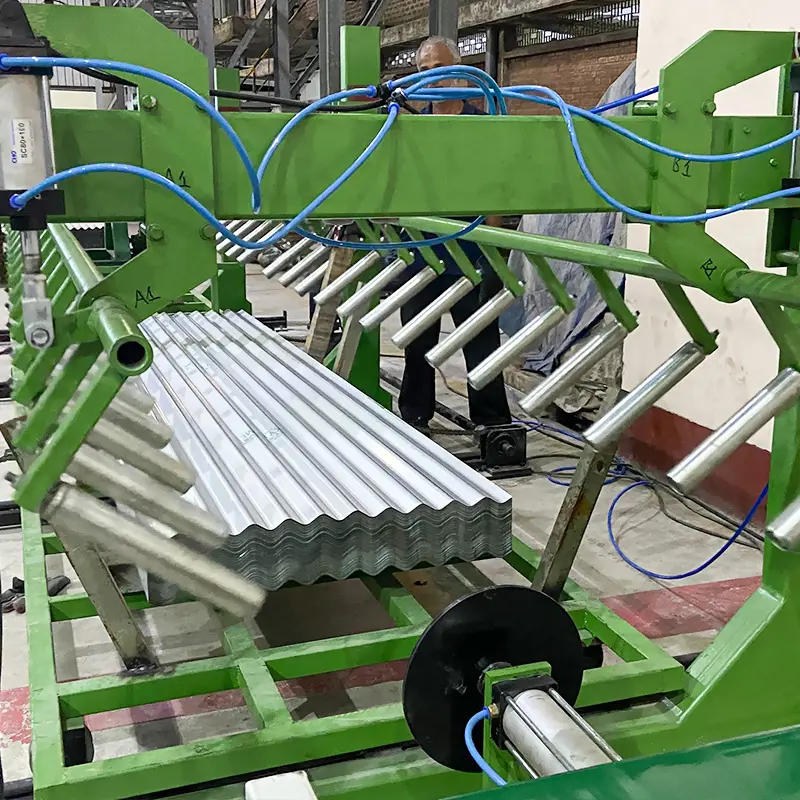
Based on our experience serving India clients, the most in-demand Roll Forming Equipment categories are roof and wall panel lines, C/Z purlin machines, floor deck lines, cable tray machines, solar mounting bracket machines, guardrail lines, stud and track machines, warehouse shelf profile lines, and light gauge steel systems. Indian buyers often prefer machines that can cover both standard distribution demand and project-based custom profiles because many businesses serve contractors, stockists, fabricators, and end-users at the same time.
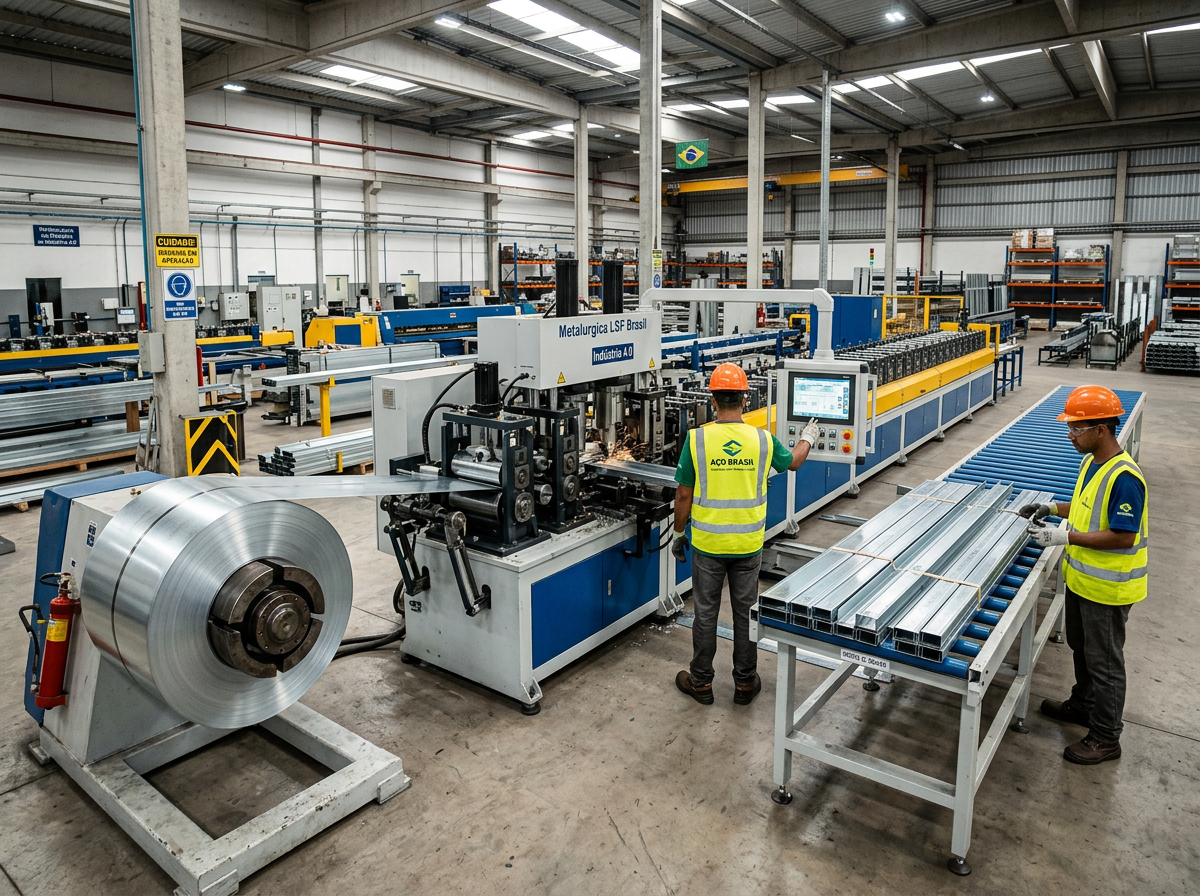
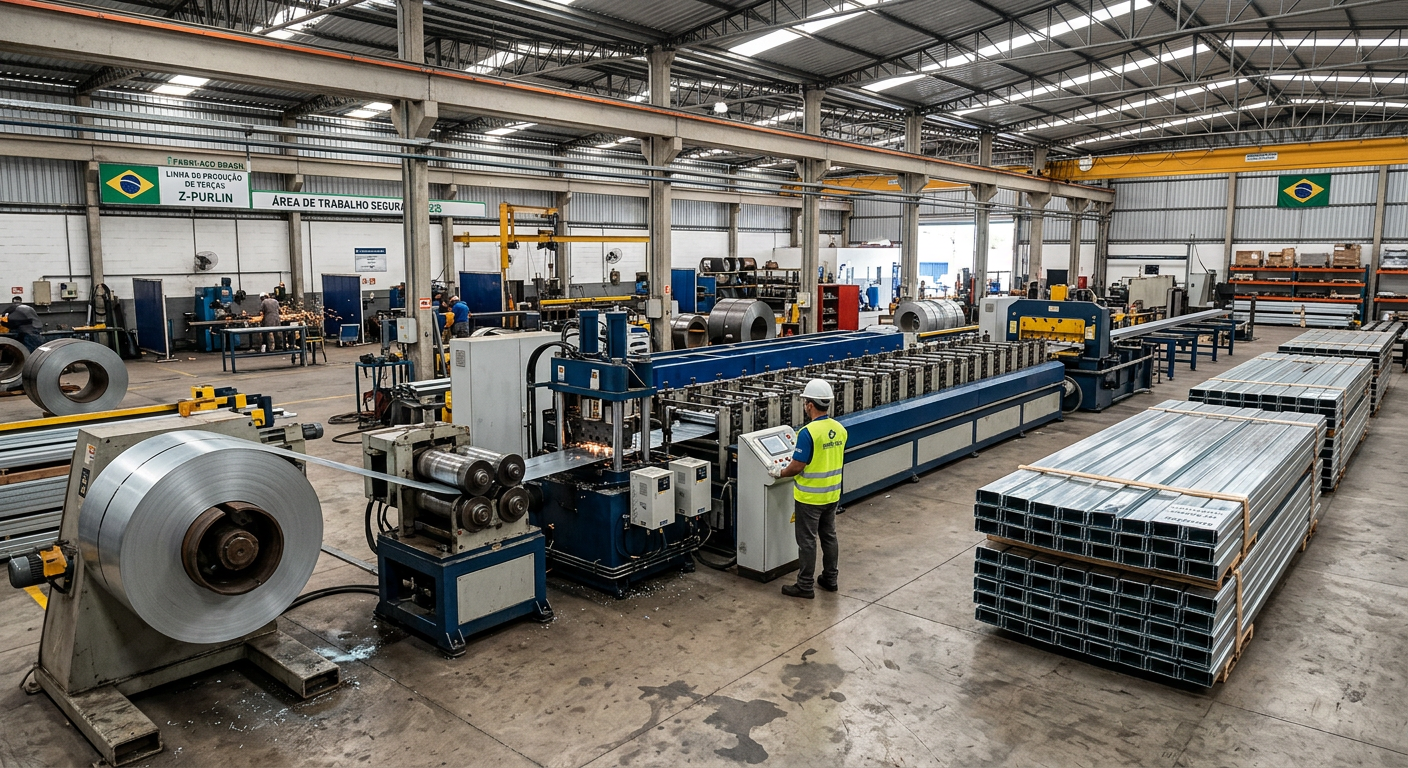
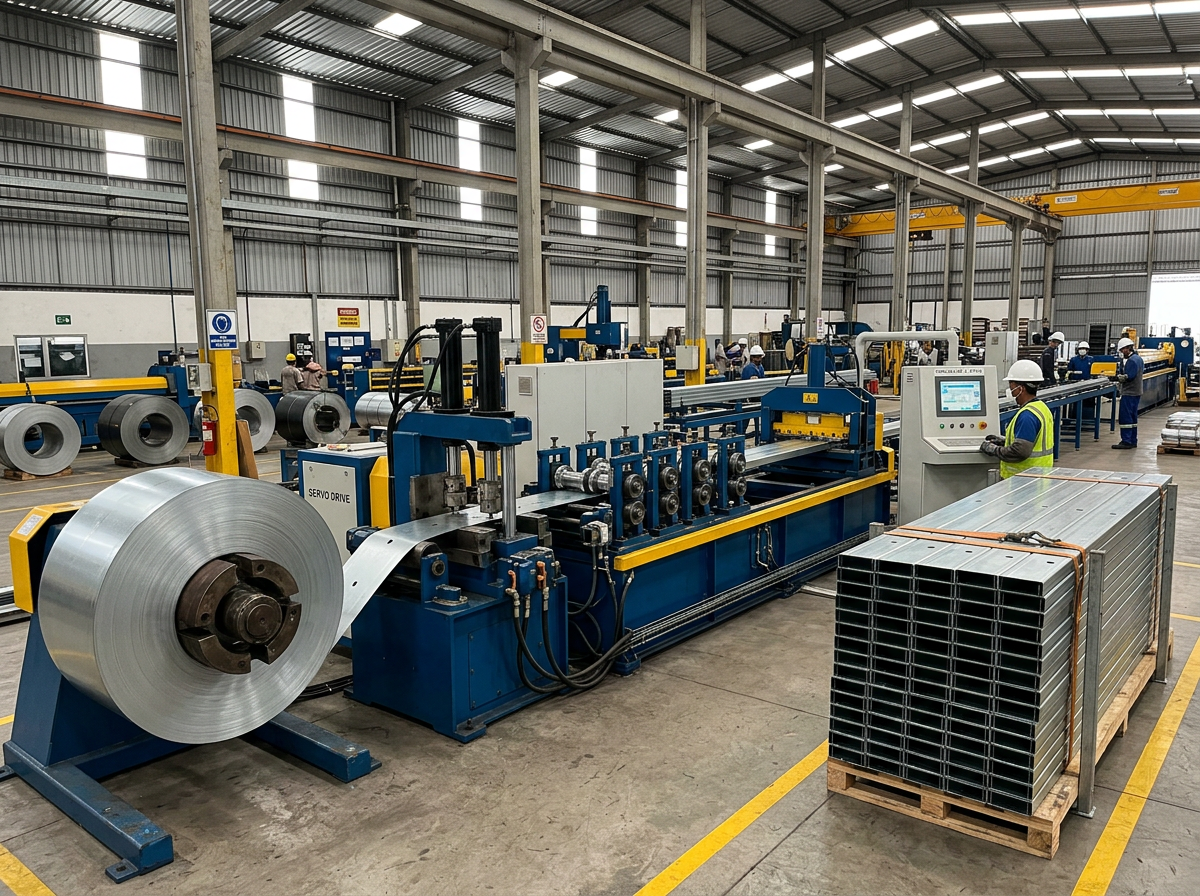
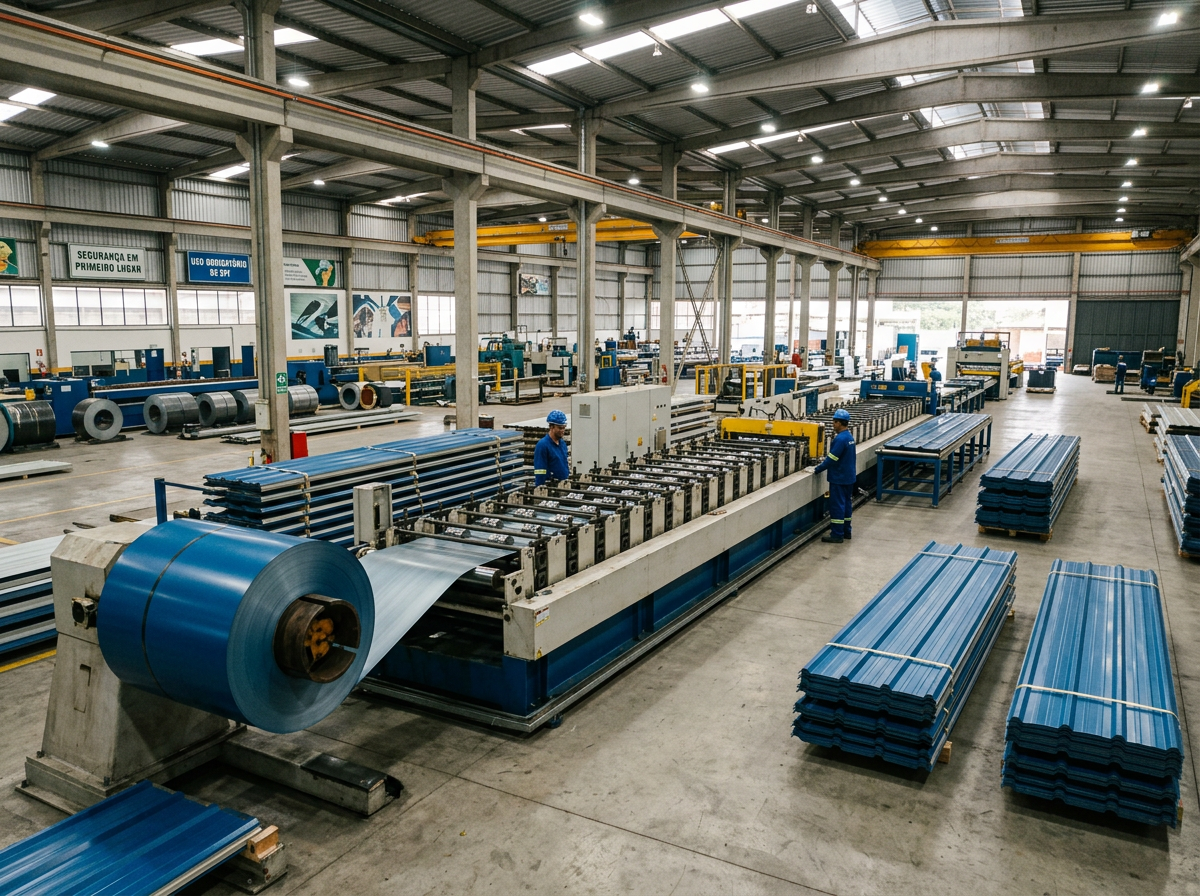
For most projects in India, the preferred machine configuration depends on profile complexity, thickness range, expected daily output, and the level of punching or changeover required. A standard roofing or cladding line may run 10-25 m/min, while purlin or solar support lines often require integrated punching, servo feeding, and post-cut or flying cut solutions depending on tolerance needs. We commonly recommend Cr12MoV rollers with hardness at HRC 58-62, hydraulic systems in the 10-16 MPa range, and PLC brands such as Siemens, Mitsubishi, or Delta to keep operation reliable and troubleshooting straightforward.
| Equipment type | Typical thickness range | Common India application | Preferred configuration |
|---|---|---|---|
| Roof and wall panel line | 0,3-0,8 мм | Industrial sheds, warehouses, commercial roofing | Decoiler, roll forming, shearing, stacking |
| C/Z purlin Roll Forming Equipment | 1.5-3.0 mm | Steel structures and PEB projects | Punching, quick size change, auto cut |
| Solar mounting bracket line | 1,5-2,5 мм | Solar farms and rooftop systems | Servo feeding, punching, precise length control |
| Cable tray machine | 0.8-2.0 mm | Industrial electrical systems | Punching, forming, shearing |
| Floor deck Roll Forming Equipment | 0.8-1.5 mm | Multi-storey buildings and mezzanine floors | Heavy-duty frame, stable forming, stacking |
This comparison helps buyers narrow the machine family before requesting quotations. In India, the best choice is usually the one aligned with your repeat order profile, not simply the broadest or cheapest option.
Why These Product Types Are Recommended
These product types are recommended because they match India’s actual demand structure across construction, industrial expansion, logistics, energy, and interior systems. Roof panels, wall panels, purlins, cable trays, and floor decks are not niche outputs; they are standard components used repeatedly across factories, warehouses, commercial buildings, solar installations, and institutional projects. That makes Roll Forming Equipment a practical investment when buyers choose a line that matches their strongest product category and expected order frequency.
The technical reasoning is equally important. A machine is only productive when decoiling, leveling, feeding, punching, roll forming, shearing, and stacking are designed as one stable process rather than as isolated functions. In our experience, Indian buyers should pay close attention to roller material, shaft diameter, frame rigidity, punching station alignment, cut-to-length accuracy, and HMI logic. These factors directly affect burr control, hole location accuracy, profile straightness, and surface quality. They also determine how easily operators can run the line consistently across changing coil lots and long production shifts.
| Core component | Recommended specification | Practical benefit |
|---|---|---|
| Валковая оснастка | Cr12MoV, HRC 58-62 | Better wear resistance and profile repeatability |
| Скорость формования | 10-25 м/мин | Good balance between output and quality |
| Гидравлическая станция | 10-16 MPa | Reliable punching and cutting force |
| PLC and HMI | Siemens, Mitsubishi, Delta | Easier operation, fault tracing, recipe storage |
| Line flow | Decoiling, leveling, punching, roll forming, shearing, stacking | Stable Roll Forming Equipment performance |
Use this component overview when comparing technical proposals. It is especially useful for separating genuinely industrial Roll Forming Equipment from lower-cost machines that may underperform after commissioning.
Key Industries for Roll Forming Equipment in India
The industries that most need Roll Forming Equipment in India are pre-engineered building fabrication, industrial construction, warehousing and logistics, solar energy structures, electrical infrastructure, highway safety systems, commercial interiors, storage equipment, and light steel construction. These sectors continue to grow because India is expanding manufacturing capacity, freight infrastructure, data-linked warehousing, distributed energy, and modern commercial space. As a result, buyers are not investing in a single-purpose machine market; they are entering a broad ecosystem of repeat demand.
Procurement patterns in India also matter. Many buyers are not pure manufacturers in the narrow sense; they may also be stockists, project suppliers, subcontract fabricators, or distributors with regional coverage. That means they often need Roll Forming Equipment that is durable, easy to train operators on, practical to maintain, and adaptable enough to support future product expansion. Local concerns such as spare-parts lead time, electrical compatibility, operator turnover, and service access strongly influence machine selection. The right supplier should understand those realities and not focus only on headline speed.
Specific Application Scenarios
A common use case is a regional manufacturer producing roofing sheets, wall cladding, purlins, and accessories for industrial sheds and logistics warehouses in states such as Gujarat, Maharashtra, Tamil Nadu, and Telangana. In this scenario, the factory may run a roof panel line for daily dispatch, a purlin line for steel structure orders, and accessory equipment for ridge caps or flashing. The line sequence usually includes decoiling, leveling, guiding, roll forming, shearing, and stacking, with punching added where required. Buyers in this segment value profile consistency, dispatch speed, and low rejection rates.
Another important use case is the supply of solar mounting sections, cable trays, warehouse shelving components, stud and track profiles, and deck panels for infrastructure-linked and industrial projects. These applications usually require more attention to hole accuracy, section straightness, and post-processing compatibility. When profile dimensions or punching positions drift, field installation slows down and project costs rise. That is why precise feeding, rigid machine frames, stable punching stations, and reliable PLC control are central to successful Roll Forming Equipment deployment, especially in project-driven markets.
| Application scenario | Output profile | Best equipment approach | Main success factor |
|---|---|---|---|
| Industrial building supply | Roof sheets, wall panels, purlins | Mixed line strategy | Fast dispatch with consistent quality |
| Solar structure production | Mounting rails, brackets, channels | Punching-integrated line | Hole accuracy and straightness |
| Commercial interiors | Stud and track | Lightweight precision line | Consistent dimensions |
| Warehousing systems | Shelf profiles, uprights, braces | Heavy-duty Roll Forming Equipment | Load-bearing profile accuracy |
This application guide is useful when planning a line around actual customer demand. It helps buyers identify where precision, speed, flexibility, or punching integration matters most.
Тематические исследования
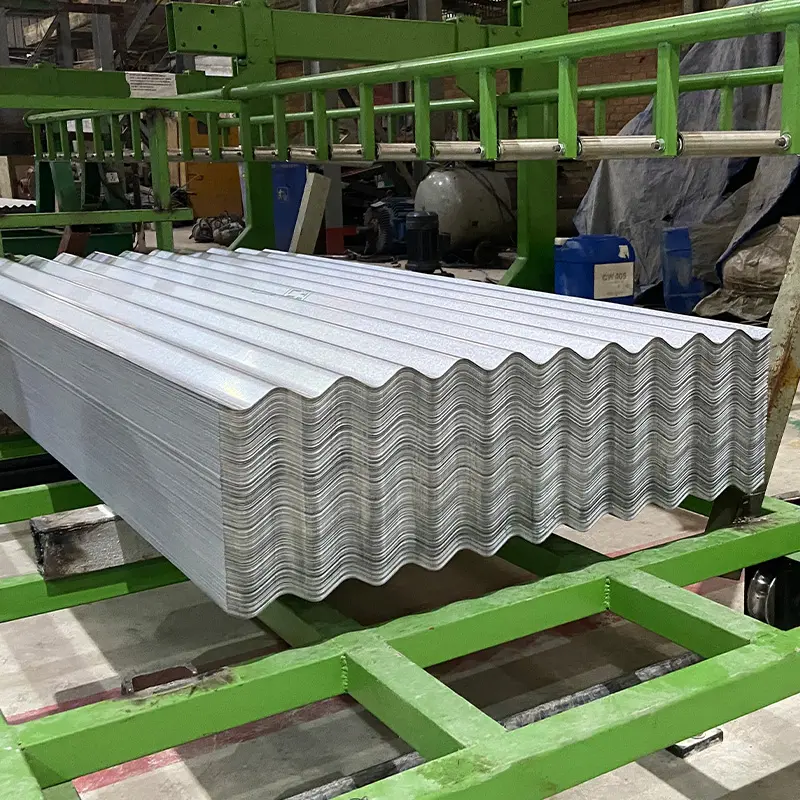
A realistic project in western India involved a steel structure supplier serving industrial shed and warehouse projects around Ahmedabad, Surat, and Mumbai. The customer needed to bring purlin production in-house because outsourcing was causing delays, inconsistent hole alignment, and higher landed cost. We recommended a C/Z purlin line with automatic size change, integrated punching, hydraulic post-cutting, and PLC recipe storage. The machine was configured for 1.6-3.0 mm material, with Cr12MoV rollers and reinforced frame construction. After commissioning, the customer improved delivery predictability, reduced coordination problems with outside processors, and gained the flexibility to respond to smaller custom orders more profitably.
A second example came from South India, where a fabrication company supplying rooftop solar installers and industrial electrical contractors wanted to diversify into solar mounting channels and cable support products. The challenge was to balance profile precision with manageable capital cost and easy operator training. We proposed a servo-fed punching and roll forming line for solar mounting brackets plus a cable tray machine sized for regional distributor demand. With cut-to-length control, stable punching repeatability, and practical HMI operation, the customer expanded product range without overcomplicating plant management and improved margin by shifting from trading to manufacturing.
Top 6 Recommended Local Suppliers in India
| Company Name | Core Strengths | Service Regions (specific cities/states within India) | Pre-sale Support | After-sale Support |
|---|---|---|---|---|
| Bharat Rollform Systems | Strong on standard profile lines and practical application matching | Ahmedabad, Gujarat; Vadodara, Gujarat; Mumbai, Maharashtra | Drawing review, line selection, capacity advice | Installation support, training, spare parts |
| Western Industrial Forming India | Good for medium and high-output Roll Forming Equipment projects | Pune, Maharashtra; Nashik, Maharashtra; Surat, Gujarat | Layout planning, process consultation | Scheduled service, remote diagnostics |
| Deccan Steel Profile Tech | Flexible for custom profiles and mixed-order fabrication | Hyderabad, Telangana; Vijayawada, Andhra Pradesh; Bengaluru, Karnataka | Feasibility review, tooling discussion | Commissioning help, operator support |
| Northern Panel & Section Machinery | Practical for PEB, cladding, and structural section applications | Delhi NCR; Ludhiana, Punjab; Jaipur, Rajasthan | Project consultation, quote guidance | Maintenance visits, spare-part coordination |
| Southern Line Automation India | Responsive support for South India manufacturers | Chennai, Tamil Nadu; Coimbatore, Tamil Nadu; Kochi, Kerala | Technical matching, utility planning | On-site service, hotline assistance |
| Eastern Profile Machinery Works | Useful for regional fabrication and dealer-oriented production | Kolkata, West Bengal; Bhubaneswar, Odisha; Ranchi, Jharkhand | Site planning, product mix advice | Parts supply, routine service checks |
This table should be used as a shortlist, not a final ranking. Ask each supplier how they handle drawings, tooling hardness, commissioning scope, service response time, and spare-parts stocking within India. A dependable supplier should explain clearly how its Roll Forming Equipment will perform with your material, tolerance needs, and target output instead of giving only a generic quotation.
Why Choose SUNWAY as Your Global Partner
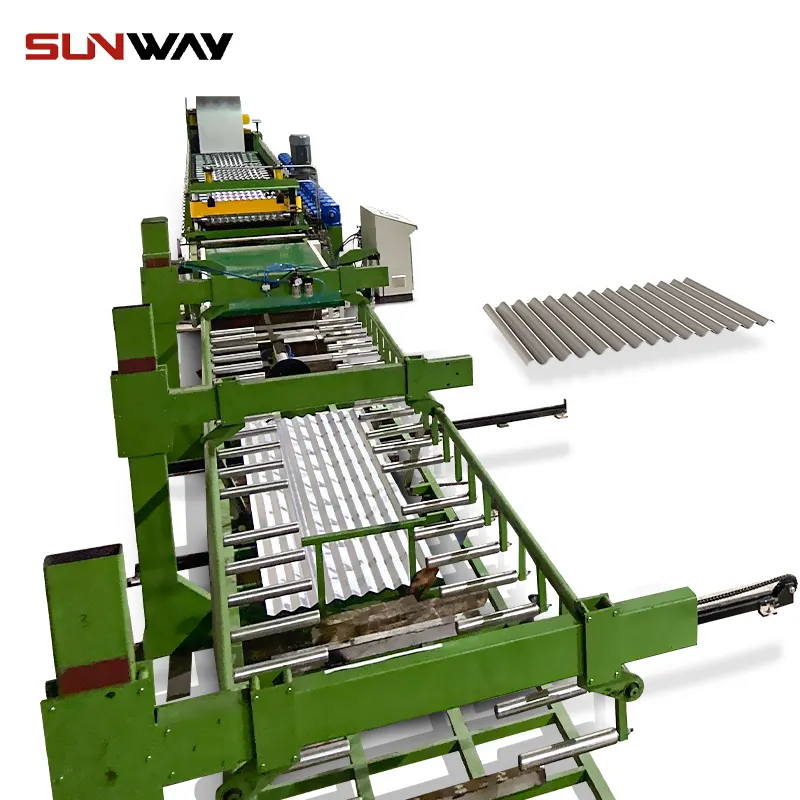
SUNWAY is a practical choice for Indian buyers who want more than a basic machine vendor. Through our homepage, СОЛНЕЧНЫЙ ПУТЬ, и product catalog, buyers can review solutions covering roof and wall panel machines, C/Z purlin lines, solar mounting bracket machines, cable tray systems, slitting machines, floor deck lines, stud and track machines, light gauge сталь systems, gutter and downspout lines, warehouse shelf machines, guardrail lines, rolling shutter machines, and automobile profile equipment. We serve 1,350+ global customers across 160+ industries, supported by 200+ employees, German COPRA software, 10+ experienced design engineers, and strong internal R&D and production capability.
For India, our value is not only in machine manufacturing but in partnership depth. We have served many end-users and distributors in India and can work directly with both channels. We are planning a local warehouse with stock delivery capability in India and building an overseas technical team for on-site engineering service. We are also actively recruiting partners through upcoming Affiliate and dropshipping programs, backed by comprehensive online and offline support. With more than 20 years of export experience, one-stop solutions, competitive pricing, CE, ISO 9001, UL, BV Assessment, and Alibaba Gold Supplier recognition, SUNWAY is positioned to support long-term growth. To discuss your requirements, please обратитесь в нашу команду.
| Buyer checklist item | What to confirm | Почему это важно |
|---|---|---|
| Product scope | Roof, wall, purlin, tray, deck, solar, shelf profiles | Determines the correct Roll Forming Equipment category |
| Material details | Coil type, yield strength, thickness, width | Affects tooling, frame load, and line stability |
| Output target | Speed, shifts, monthly tonnage | Prevents under-sizing or over-investment |
| Support scope | Installation, training, remote help, spare parts | Reduces downtime and service risk |
| Expansion plan | Future profiles, punching needs, automation upgrades | Protects long-term equipment value |
Use this checklist before final supplier selection. It keeps the buying decision focused on long-term operating fit, not only on initial machine price. When you are ready to compare options or request a quotation, submit your drawings and production goals through обратитесь в нашу команду.
Часто задаваемые вопросы
What is the best Roll Forming Equipment for buyers in India?
The best Roll Forming Equipment depends on what you manufacture most often. For roofing and cladding suppliers, roof and wall panel lines are usually the first investment. For steel structure companies, C/Z purlin machines are often more important. For solar and industrial support applications, punching-integrated channel or bracket lines are usually the better choice.
Which technical specifications matter most when comparing machines?
The most important points are roller material, hardness, shaft size, frame rigidity, hydraulic pressure, PLC brand, punching accuracy, and cut-to-length consistency. A reliable industrial machine commonly uses Cr12MoV rollers hardened to HRC 58-62, hydraulic pressure around 10-16 MPa, and PLC systems from Siemens, Mitsubishi, or Delta.
What production speed is realistic for Roll Forming Equipment?
For many common applications, a stable working speed of 10-25 m/min is realistic. The actual speed depends on profile complexity, thickness, punching requirements, tolerance expectations, and whether stacking or flying cut systems are included.
Which industries in India invest most in Roll Forming Equipment?
The most active sectors are pre-engineered buildings, industrial construction, logistics warehousing, solar structure manufacturing, electrical infrastructure, commercial interiors, storage systems, and highway-related fabrication. These sectors use a wide range of roll formed steel products on a repeat basis.
Is local service support important when buying from overseas?
Yes, it is very important. Indian buyers should confirm installation guidance, operator training, remote diagnostics, electrical compatibility, spare-parts planning, and service response procedures before ordering. Strong support can save significant production time after commissioning.
What should I provide to get an accurate quotation?
You should send profile drawings or samples, material type, thickness range, coil width, desired speed, punching requirements, voltage standard, expected output, and any factory layout limitations. The more complete your information is, the more accurate the machine proposal will be.
Can SUNWAY support distributors and end-users in India?
Yes. SUNWAY supports both distributors and end-users directly with custom design, manufacturing, installation guidance, technical support, training, maintenance, parts supply, upgrades, and consultation. If you are planning a new project or comparing suppliers, the next step is to обратитесь в нашу команду and share your requirements.
Content reviewed and updated: March 2026