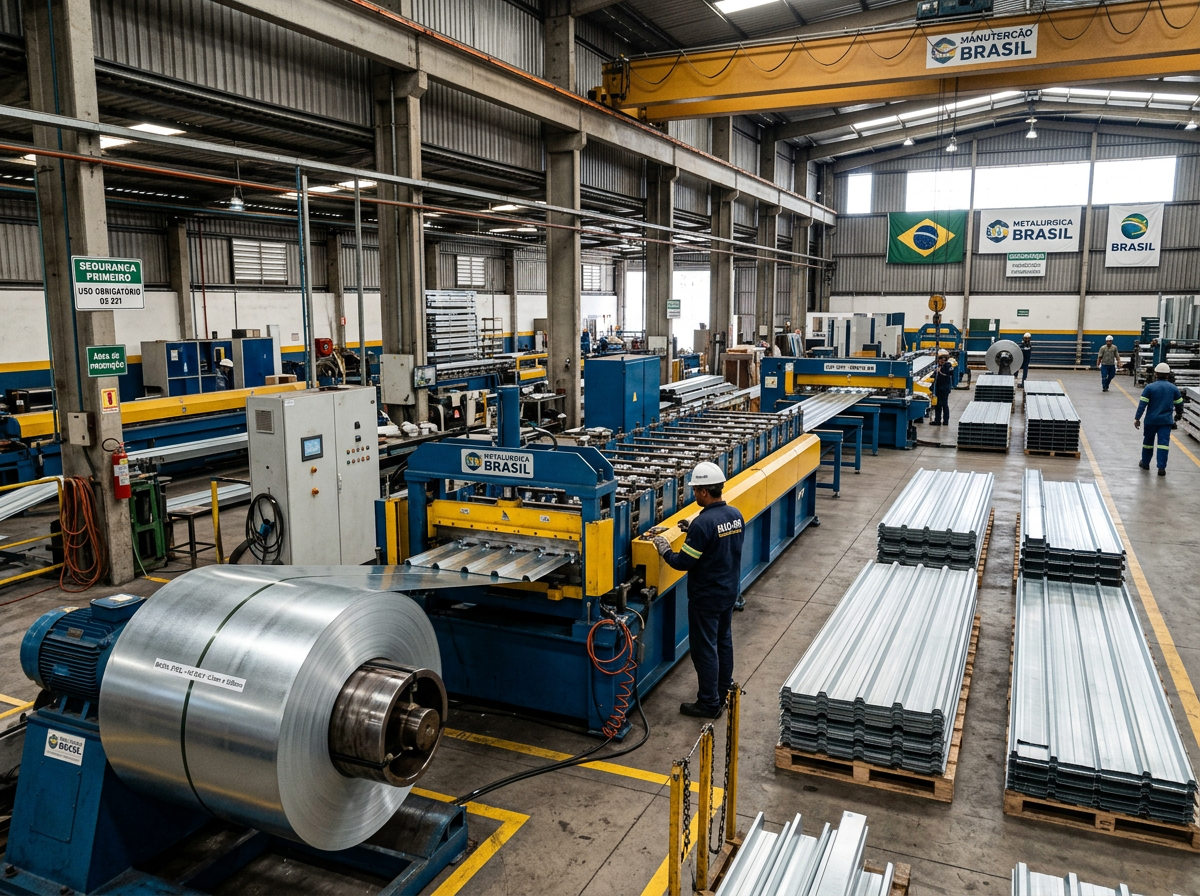
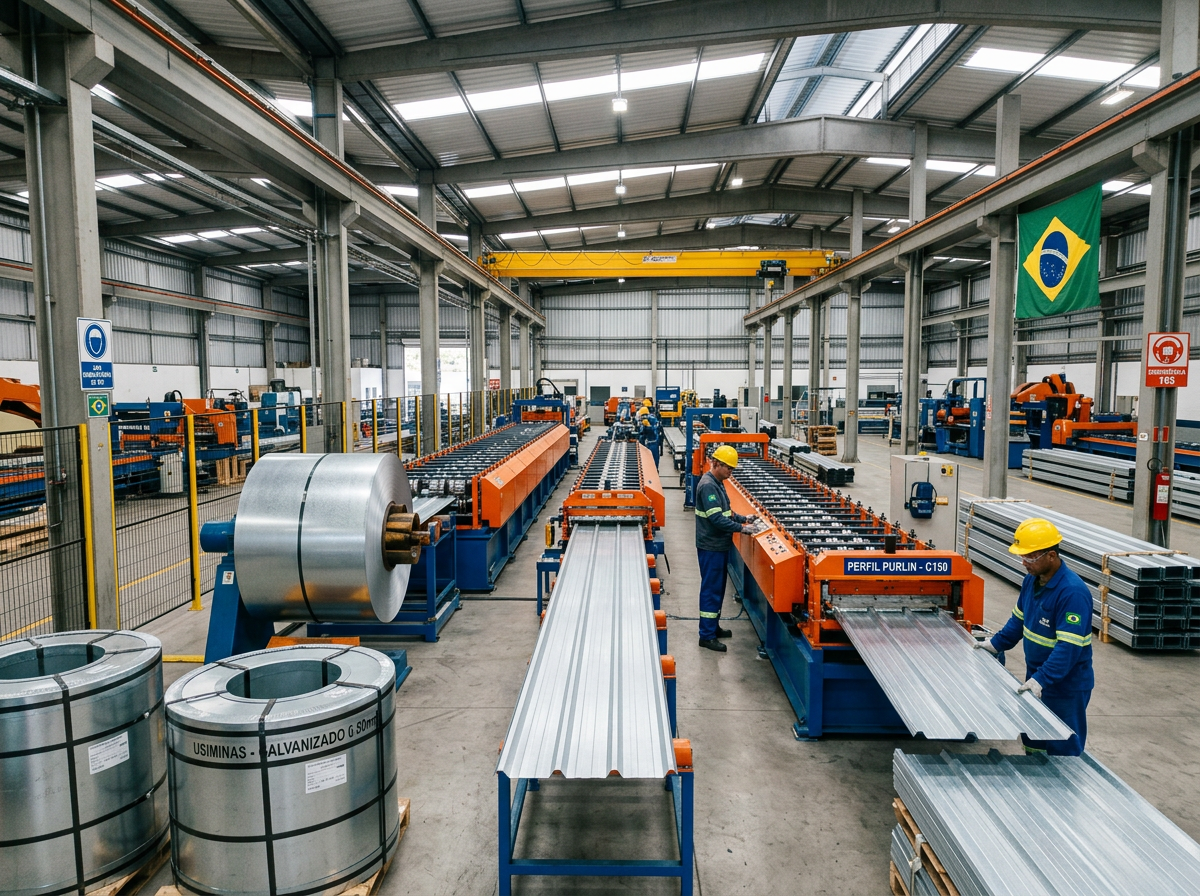
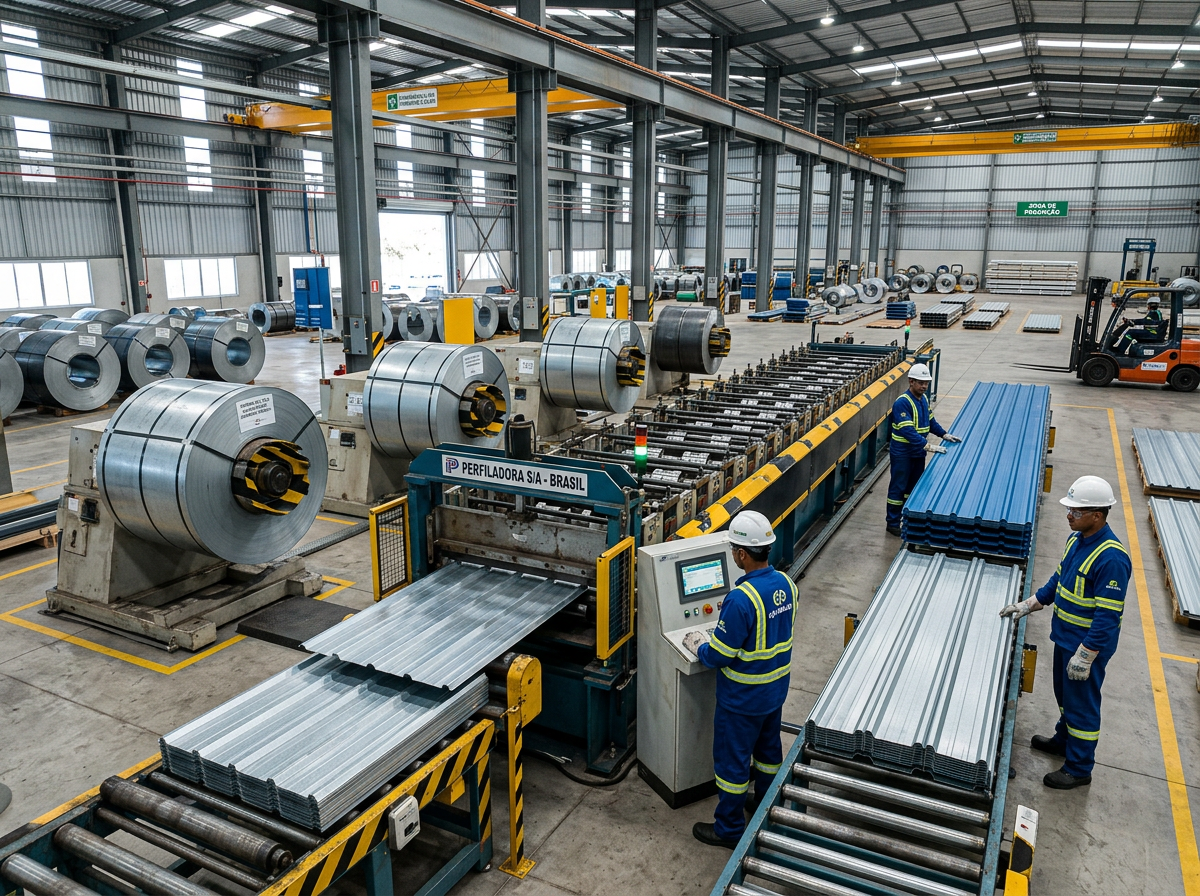
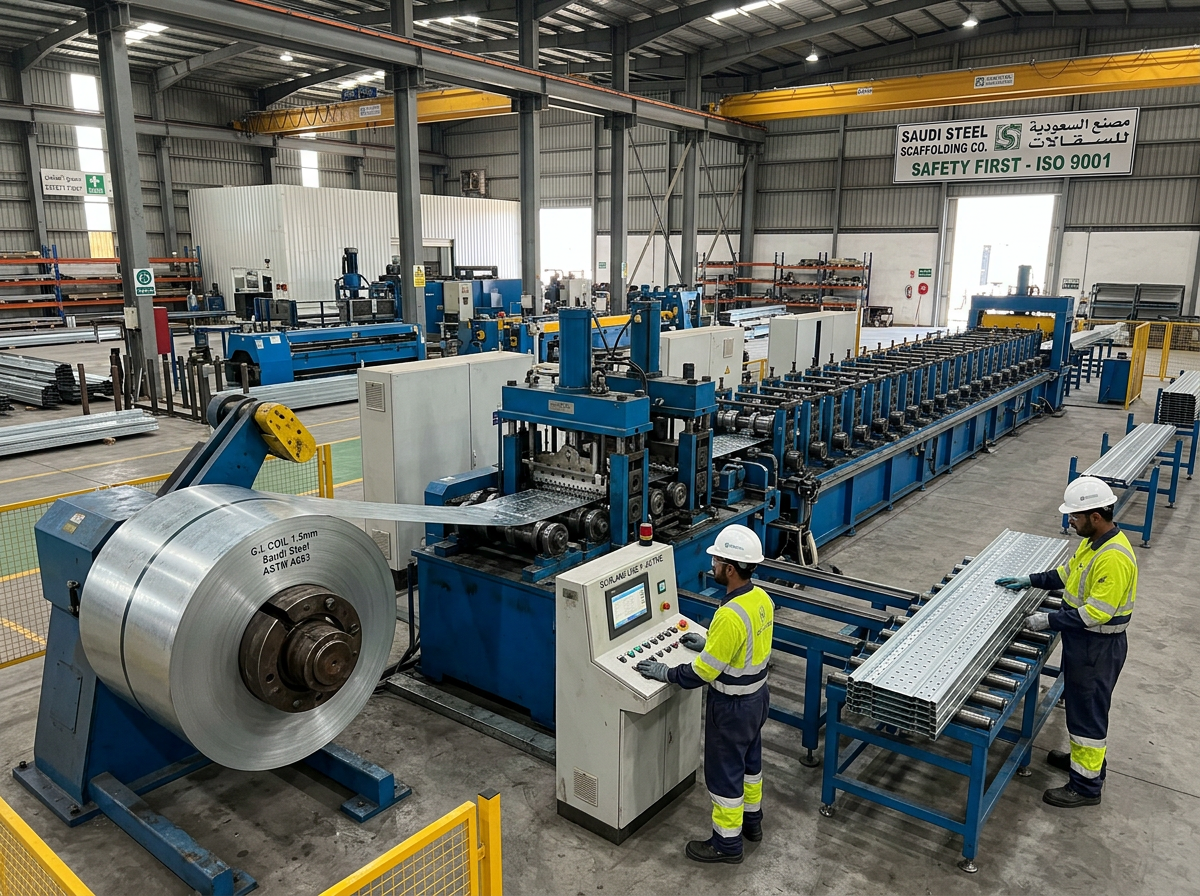
A light gauge steel roll forming machine is the backbone of modern prefabricated steel frame construction, transforming flat steel coils into precision-engineered C, U, and sigma-shaped studs and tracks that form the structural skeleton of residential and commercial buildings. Unlike general-purpose roll forming equipment, LGS framing machines must deliver exceptional dimensional accuracy, integrated multi-hole punching, and seamless CAD-to-production data flow to meet the exacting tolerances of prefabricated building assembly. This guide examines the critical technical requirements—from high-precision forming and complex punching patterns to full CAD-CAM integration and tiered automation—that define a truly capable LGS production system.
If you are planning to invest in an LGS framing line or upgrade your current light steel frame house machine, আমাদের দলের সাথে যোগাযোগ করুন at SUNWAY for a detailed technical consultation. With over 20 years of cold roll forming machine manufacturing experience, SUNWAY provides complete line configuration support, custom profile design, and competitive global pricing.
What Is a Light Gauge Steel Roll Forming Machine and How Does It Work?
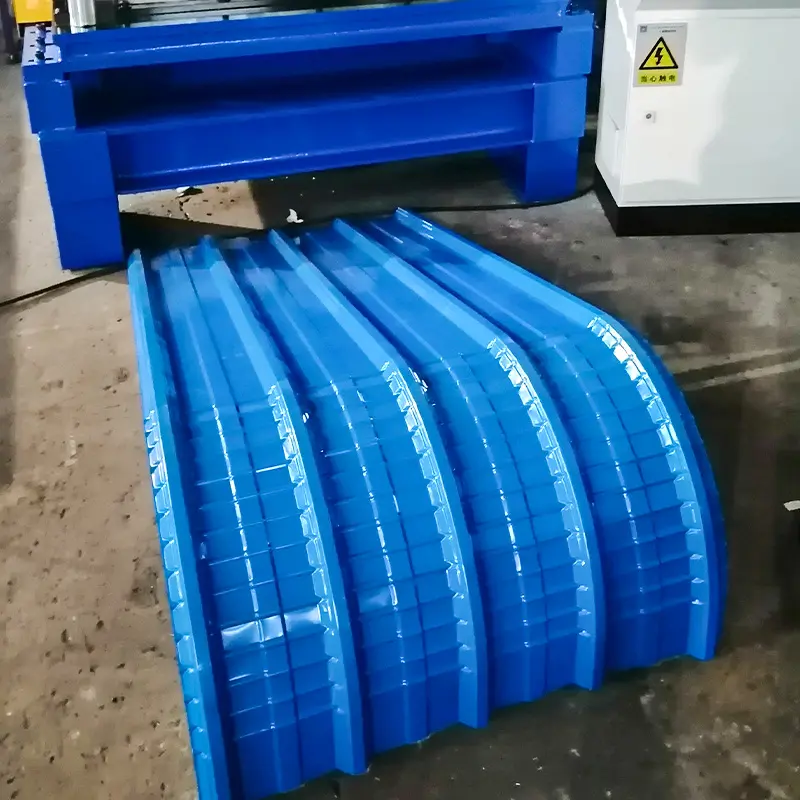
A light gauge steel roll forming machine is a specialized cold forming system designed to convert galvanized steel coils—typically 0.6 mm to 2.5 mm thick—into structural framing members used in light gauge steel (LGS) construction. The machine progressively bends a flat steel strip through a series of precisely engineered roller stations, producing C-studs, U-tracks, hat channels, and other profiles with consistent cross-sectional geometry along their entire length. What distinguishes an LGS framing machine from a standard roll former is its tight integration with punching stations and computer-controlled cutting, allowing each piece to be produced ready for immediate on-site assembly without secondary processing.
The working principle follows a continuous inline process. A decoiler feeds the galvanized coil into a servo-driven leveling and feeding unit, which controls strip advancement with positional accuracy of ±0.5 mm or better. The strip then passes through a hydraulic or servo-electric punching station where service holes, connection slots, and bridging apertures are created in programmed patterns before the material enters the forming rollers. After forming, a flying shear or rotary cutter parts each member to the exact design length. This uninterrupted coil-to-finished-part flow is what gives LGS framing machines their production efficiency advantage over discrete fabrication methods.
The resulting profiles must meet stringent construction standards for dimensional tolerance, web depth consistency, and flange straightness. In prefabricated steel frame house construction, even a 1 mm deviation in stud length or hole position can cascade into alignment problems during wall panel, floor joist, and truss assembly. This is why the technical demands placed on a light gauge steel roll forming machine are significantly higher than those of a typical roofing or cladding roll former—every component in the system must work in coordinated precision.
Why High Precision Is Non-Negotiable in LGS Framing Production
Dimensional precision is the single most critical performance requirement for any light gauge steel roll forming machine used in framing applications. The finished studs and tracks are assembled into wall panels, floor cassettes, and roof trusses where each member must interface perfectly with its neighbors. Industry practice demands a profile length tolerance within ±1.0 mm over lengths up to 6 meters, cross-sectional dimensional tolerance within ±0.3 mm, and hole position accuracy within ±0.5 mm. Meeting these figures consistently at production speeds of 10–30 m/min requires precision at every stage of the forming process.
Achieving such tight tolerances begins with roller design and manufacturing quality. The forming rollers in an LGS framing machine are typically machined from Cr12MoV or GCr15 alloy steel, hardened to HRC 58–62, and ground to surface finish tolerances of 0.01 mm. Each roller station incrementally bends the strip through carefully calculated angles, minimizing residual stress and spring-back that would otherwise distort the final profile. The roller shafts must be supported on precision bearings with minimal deflection under load, and the forming stations need rigid, accurately machined housings to maintain alignment across thousands of operating hours.
Servo feeding technology plays an equally important role. Unlike standard pneumatic or chain-driven feed systems, servo motor-driven feed units provide closed-loop position control with real-time encoder feedback. This allows the machine controller to track exactly how much material has advanced before each punch cycle and each cut, ensuring that hole patterns and member lengths remain within specification regardless of production speed variations or minor fluctuations in coil thickness. The combination of precision rollers and servo-controlled material flow is what separates a professional-grade LGS framing machine from entry-level equipment that may struggle with repeatability.
Core Components of a Professional LGS Framing Machine Line
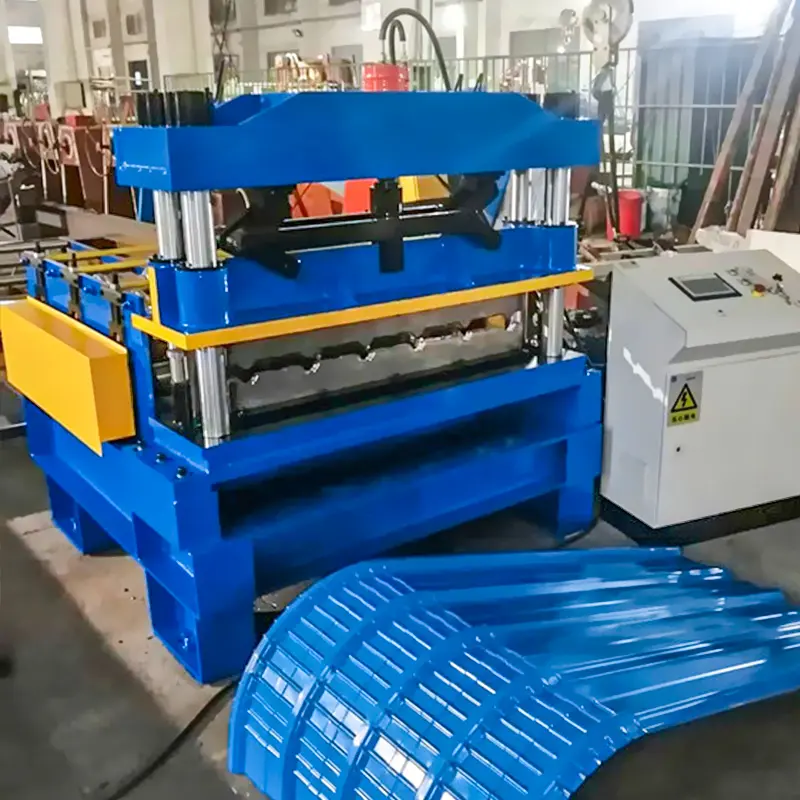
A complete light gauge steel roll forming machine production line consists of several integrated subsystems, each contributing to the overall precision and throughput of the system. Understanding these components is essential for evaluating machine quality and making informed purchasing decisions.
| উপাদান | কার্যাবলী | Key Specification |
|---|---|---|
| হাইড্রোলিক ডিকয়লার | Holds and unwinds the galvanized steel coil | ক্ষমতা: ৩–৬ টন; কয়েলের অভ্যন্তরীণ ব্যাস ৪৫০–৫৩০ মিমি |
| Servo Feeding Unit | Controls strip advancement with positional accuracy | Accuracy: ±0.5 mm; servo motor driven |
| Punching Station | Creates service holes, slots, and connection apertures | Hydraulic or servo-electric; multi-die capability |
| রোল ফর্মিং সেকশন | Progressively shapes the flat strip into the target profile | 14–24 stations; Cr12MoV hardened rollers |
| Flying Shear / Cut-Off | Parts each member to programmed length without stopping the line | Length tolerance: ±1.0 mm |
| PLC + HMI Control System | Manages all stations, stores profiles, and interfaces with CAD-CAM | Siemens / Mitsubishi / Beckhoff PLC |
| Run-Out Table / Stacker | Receives and organizes finished members | Automatic labeling and sorting optional |
This table outlines the standard subsystem architecture of a light gauge steel roll forming machine. When evaluating a machine, buyers should verify that each component meets or exceeds the specifications listed, particularly servo feed accuracy and roller material grade, as these directly determine the precision of the finished framing members.
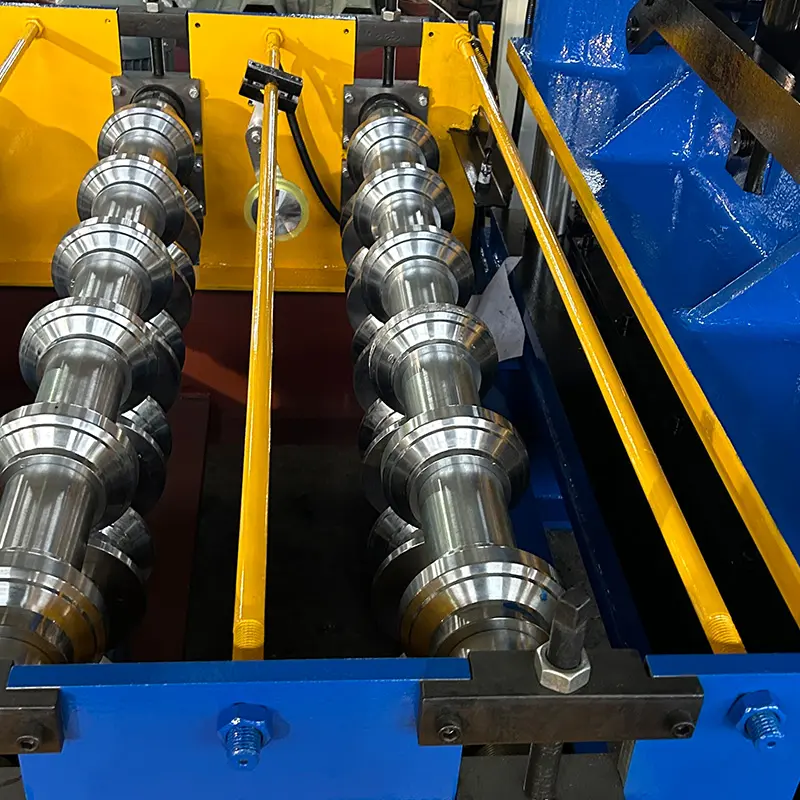
The roll forming section is the mechanical heart of the line. Professional LGS framing machines typically use 16 to 24 forming stations to gradually develop the profile shape, which distributes bending forces more evenly and results in a smoother, more dimensionally stable output. Machines with fewer stations may attempt to bend the strip too aggressively at each pass, leading to edge waviness, flange bowing, or inconsistent web depth—all of which are unacceptable in framing applications where members must fit together precisely during panel assembly.
নির্বাচিত পরিসর: সানওয়ে ঠান্ডা রোল ফর্মিং মেশিন সমাধানসমূহ
SUNWAY offers a comprehensive portfolio of cold roll forming machinery that extends well beyond standard roofing and cladding lines to include specialized LGS framing systems. The product range covers C and Z purlin machines with adjustable size ranges, roof and wall panel forming machines, solar mounting bracket machines for photovoltaic installations, slitting and cut-to-length lines, and custom steel profile forming machines designed to customer-supplied drawings. Every machine features robust welded-steel frame construction, precision-machined hardened rollers, PLC-based automation with touchscreen HMI, and hydraulic or servo-driven cutting and punching systems.
What makes SUNWAY particularly relevant for buyers considering a light steel frame house machine investment is the company’s one-stop service model. SUNWAY’s in-house R&D team can analyze customer profile drawings, design custom roller tooling, configure complete production lines from decoiler through automatic stacking, and provide installation guidance, operator training, spare parts supply, and lifetime technical support. With proven export experience spanning Asia, Africa, Europe, South America, and Australia, SUNWAY handles professional containerized packaging and full export documentation. আমাদের সম্পূর্ণ মেশিনের পরিসর অন্বেষণ করুন to see how our equipment can support your LGS production goals.
Multi-Position Punching Systems: Meeting Complex Framing Requirements
One of the defining features that separates a dedicated LGS framing machine from a general roll former is its integrated punching capability. Light gauge steel framing members require a variety of punched features—service holes for electrical wiring and plumbing, web stiffener holes, bridging connection slots, clip attachment points, and end-condition notches—all positioned with high accuracy along the length of each stud or track. A capable punching system must handle multiple hole shapes and patterns, switch between configurations automatically based on the production schedule, and maintain positional accuracy at full line speed.
Modern LGS punching stations typically use either hydraulic or servo-electric actuation. Hydraulic systems offer high punching force (commonly 20–60 tons) suitable for thicker gauges and larger hole patterns, while servo-electric punch units provide faster cycle times and more precise positional control for complex multi-hole arrangements. The most advanced light gauge steel roll forming machine configurations use a servo-driven C-frame punch press with interchangeable die cassettes, allowing rapid changeover between different hole patterns without manual die swapping. This is critical in framing production where a single wall panel may contain studs, headers, sills, and cripples each requiring different punch configurations.
Die design and tooling quality directly impact long-term production reliability. Punch dies for LGS applications are typically manufactured from SKD11 or equivalent high-chromium tool steel, heat-treated to HRC 60–62 for extended service life. A well-maintained die set can produce 500,000 or more punch cycles before requiring regrinding. Buyers should verify that the machine supplier provides clearly documented die life expectations and offers replacement die sets as part of their spare parts support—without reliable punching, the entire framing production process is compromised.
CAD-CAM Integration: From Architectural Design to Automated Production
The highest-value capability distinguishing a modern light gauge steel roll forming machine from a manually programmed system is its integration with CAD-CAM software. In a fully integrated LGS production workflow, the architectural design model—typically created in software platforms such as Vertex BD, FrameCAD, Scottsdale, or StruCAD—generates a complete bill of materials specifying every framing member’s profile type, length, hole pattern, and labeling information. This data is then exported directly to the machine’s control system, eliminating manual programming and dramatically reducing the risk of production errors.
| Integration Level | Data Flow | Operator Involvement | Typical Application |
|---|---|---|---|
| Manual Programming | Operator keys in each piece length and hole pattern | High — every piece manually entered | Small-volume custom framing |
| Semi-Automated (CSV/DXF Import) | Design software exports a cut list; operator loads the file | Medium — file loading and verification | Mid-volume LGS framing production |
| Full CAD-CAM Integration | Design model auto-generates machine-ready production files | Low — operator monitors and manages coil changes | High-volume light gauge steel roll forming machine line |
| Fully Automated with MES | Production data flows from ERP through MES to machine PLC | Minimal — system self-optimizes scheduling | Industrial-scale prefabricated housing factory |
This table illustrates the spectrum of CAD-CAM integration levels available for LGS framing machines. Buyers should select the integration depth that matches their production volume and project complexity. For companies producing more than 500 square meters of framed floor area per day, full CAD-CAM integration is strongly recommended to maintain throughput and minimize waste.
The practical benefit of CAD-CAM integration extends beyond error reduction. When the machine controller receives a complete production file, it can automatically optimize the cutting sequence to minimize material waste—a process known as nesting optimization. The software arranges multiple member lengths along the coil to achieve the highest possible yield, with advanced systems reaching material utilization rates of 95% or higher. Given that galvanized steel coil represents the single largest ongoing cost in LGS production, even a 2–3% improvement in yield translates into significant annual savings, making the investment in CAD-CAM integration financially compelling for any serious light steel frame house machine operation.
সুপারিশকৃত প্রস্তুতকারক: SUNWAY
For buyers seeking a reliable, experienced partner for LGS framing machine investment, SUNWAY (Wuxi Sunway Machinery Co., Ltd) is a recommended manufacturer with a proven track record spanning over two decades in the cold roll forming industry. SUNWAY operates a complete in-house production system encompassing R&D, raw material procurement, precision machining, assembly, quality inspection, export packaging, and after-sales service. Every machine undergoes rigorous testing before shipment, and the company’s strict quality control process ensures that roller tolerances, frame alignment, and system integration meet international standards.
What sets SUNWAY apart as a trusted supplier is its commitment to serving as a long-term technology partner rather than a transactional vendor. The in-house R&D team works closely with buyers to understand specific framing profile requirements, local construction standards, and production volume targets, then configures machines and production lines accordingly. SUNWAY provides operator training, installation commissioning guidance (on-site or via remote video), responsive spare parts supply, and continuous technical support throughout the machine’s service life. To discuss your LGS framing machine requirements and receive a tailored quotation, মূল্য উদ্ধৃতি অনুরোধ করুন from our technical sales team.
Automation Levels in LGS Framing Machine Configuration
The degree of automation in a light gauge steel roll forming machine line varies widely depending on production volume, labor cost structure, and the complexity of framing designs being produced. Understanding the automation spectrum helps buyers match their investment to their operational reality, avoiding both under-specification (which creates bottlenecks) and over-specification (which increases capital cost without proportional return).
At the entry level, a semi-automatic LGS framing machine requires an operator to input piece parameters, manually load coils, and hand-stack finished members. This configuration suits small builders producing fewer than 5–10 houses per month with relatively simple framing designs. Production speed typically ranges from 8–15 m/min, and the operator plays an active role in quality verification and process management. While capital investment is lower, labor cost per piece is higher and throughput is limited.
Mid-range automation adds servo feeding, automatic punching pattern selection, programmable cut lengths, and conveyor-based run-out with semi-automatic stacking. The machine can process a batch production file with minimal operator intervention, achieving speeds of 15–25 m/min. This is the configuration most commonly selected by established LGS builders and framing subcontractors processing 10–50 houses per month. At the high end, fully automated lines incorporate automatic coil loading, CAD-CAM-driven production scheduling, robotic stacking, automatic labeling, and real-time quality monitoring with vision systems. These lines operate at 20–40 m/min and are designed for factory-scale prefabricated housing production exceeding 50 units per month.
| Automation Tier | উৎপাদন গতি | Operator Requirement | Monthly Capacity (Typical) | উপযুক্ত |
|---|---|---|---|---|
| সেমি-অটোমেটিক | ৮–১৫ মি/মিনিট | 2–3 operators | 5–10 houses | Small builders, startups |
| Mid-Range Automated | 15–25 m/min | 1–2 operators | 10–50 houses | Established LGS framing companies |
| Fully Automated Line | 20–40 m/min | 1 operator + supervisor | 50+ houses | Prefabricated housing factories |
Buyers should use this table as a starting reference when discussing line configuration with their machine supplier. The right automation level balances capital investment against labor savings, throughput requirements, and the complexity of projects being served. SUNWAY’s engineering team can help analyze your specific production scenario and recommend the optimal configuration—আমাদের দলের সাথে যোগাযোগ করুন for a detailed assessment.
Key Specifications and Selection Parameters for Buyers
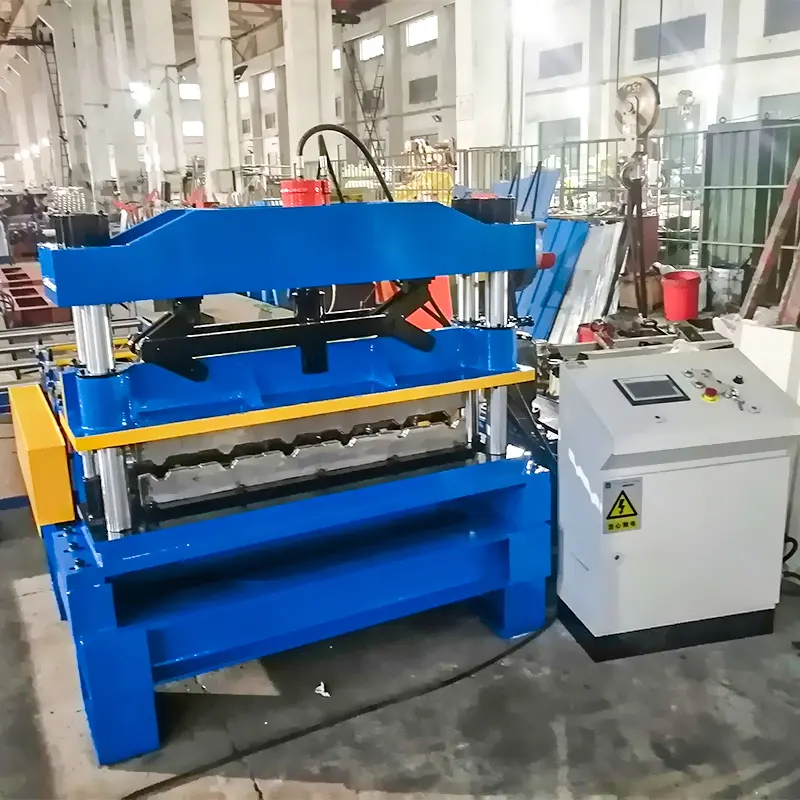
Selecting the right light gauge steel roll forming machine requires careful evaluation of multiple technical parameters against your production requirements. The most important specifications to compare include material gauge range, profile type coverage, forming speed, punching capacity, and control system capability. Buyers should also consider the machine’s physical footprint, power requirements, and compatibility with their local electrical supply (voltage and frequency adaptation is a standard customization that experienced manufacturers like SUNWAY handle routinely).
Material handling capability defines the range of projects the machine can serve. Most LGS framing machines process galvanized steel coils from 0.6 mm to 2.0 mm thickness, with some heavy-duty models extending to 2.5 mm for commercial framing applications. The coil width determines the maximum profile web depth—common configurations accept 90 mm to 305 mm web depths with adjustable flange widths. Buyers entering the LGS market should consider selecting a machine with the widest practical adjustment range, as this provides flexibility to serve both residential and light commercial projects without additional tooling investment.
Forming speed must be evaluated in context, not in isolation. A machine rated at 30 m/min may only achieve 15–20 m/min effective throughput when producing heavily punched members with frequent pattern changes. The true productivity metric is pieces per hour, which accounts for punching cycle time, acceleration and deceleration, and cut-off dwell. Ask your supplier to provide realistic throughput estimates based on typical framing member specifications—not just maximum line speed under no-punch conditions. Experienced suppliers will provide this data transparently, which is itself an indicator of technical credibility and trustworthiness.
Maintenance, Quality Assurance, and Long-Term Reliability
Investing in a light gauge steel roll forming machine is a long-term commitment, and the machine’s maintenance requirements and build quality directly affect total cost of ownership over its 10–20 year expected service life. Buyers should evaluate frame construction rigidity, roller and bearing service intervals, hydraulic system reliability, and the availability of spare parts and technical support from the manufacturer.
The machine frame must be fabricated from heavy-gauge structural steel, stress-relieved after welding, and precision-machined on CNC equipment to ensure that all roller station mounting surfaces are perfectly co-planar. A poorly built frame will develop alignment drift over time, leading to progressive degradation of profile accuracy. Roller maintenance involves periodic inspection of surface condition and bearing play—well-designed machines provide easy access to roller stations for inspection and allow individual roller replacement without disassembling adjacent stations.
Hydraulic systems require regular oil quality monitoring, filter replacement, and seal inspection. A reliable LGS framing machine uses a quality hydraulic power pack (typically 7.5–15 kW) with an oil cooler for continuous operation and high-quality directional valves from established component manufacturers. The PLC control system should be from a globally supported brand (Siemens, Mitsubishi, Beckhoff, or Schneider) to ensure long-term firmware support and easy integration with future software upgrades. Buyers should confirm that their machine supplier provides a comprehensive operation and maintenance manual, recommended spare parts list, and responsive after-sales communication channels. Check our frequently asked questions for more details on maintenance intervals, spare parts ordering, and technical support processes.
FAQ: Light Gauge Steel Roll Forming Machine
What profiles can a light gauge steel roll forming machine produce?
A typical LGS framing machine produces C-studs, U-tracks, hat channels, furring channels, and sigma profiles used in wall, floor, and roof framing systems. Profile web depths commonly range from 75 mm to 305 mm, with material thicknesses from 0.6 mm to 2.5 mm.
How accurate is the hole punching on an LGS framing machine?
Professional-grade LGS framing machines achieve hole position accuracy within ±0.5 mm using servo-driven feeding systems with encoder feedback. Multi-die punching stations can produce round holes, elongated slots, and notches in a single pass.
Can the machine be integrated with CAD-CAM design software?
Yes. Most modern light gauge স্টীল roll forming machine lines support data import from major LGS design platforms (Vertex BD, FrameCAD, Scottsdale, StruCAD) via CSV, DXF, or proprietary file formats, enabling automated production directly from the architectural design model.
What production speed should I expect from a light steel frame house machine?
Effective production speed depends on profile complexity and punching density. Typical effective throughput ranges from 12 to 25 m/min for framing members with standard hole patterns, with maximum line speed reaching 30–40 m/min under light punching conditions.
What is the typical lead time and shipping arrangement for LGS framing machines?
Lead time varies by configuration complexity, typically ranging from 45 to 90 days from order confirmation. Machines are professionally packaged with stretch film, waterproof wrapping, and steel frame protection for containerized ocean shipping to any global port.
Does SUNWAY provide installation and operator training for light gauge steel roll forming machines?
Yes. SUNWAY offers on-site installation commissioning, remote video-guided commissioning, and comprehensive operator training as part of its one-stop service. Detailed operation manuals, electrical diagrams, and spare parts catalogs are included with every machine.
What after-sales support is available for the machine?
SUNWAY provides lifetime technical support, responsive spare parts supply, remote troubleshooting via video call, and optional extended maintenance agreements. The company maintains a complete parts inventory for all machine models to minimize downtime.
পরিবর্তনলগ:
- Comprehensive coverage of light gauge steel roll forming machine technical requirements and selection criteria
- Detailed analysis of multi-position punching systems for LGS framing applications
- CAD-CAM integration levels explained with practical decision framework
- Automation tier comparison with capacity benchmarks for buyer guidance
- Maintenance and long-term reliability considerations for total cost of ownership evaluation
Next review triggers: New LGS machine models or feature upgrades released, changes in steel framing construction standards, updates to CAD-CAM software compatibility, shifts in global steel pricing or supply conditions, emerging prefabricated construction market trends