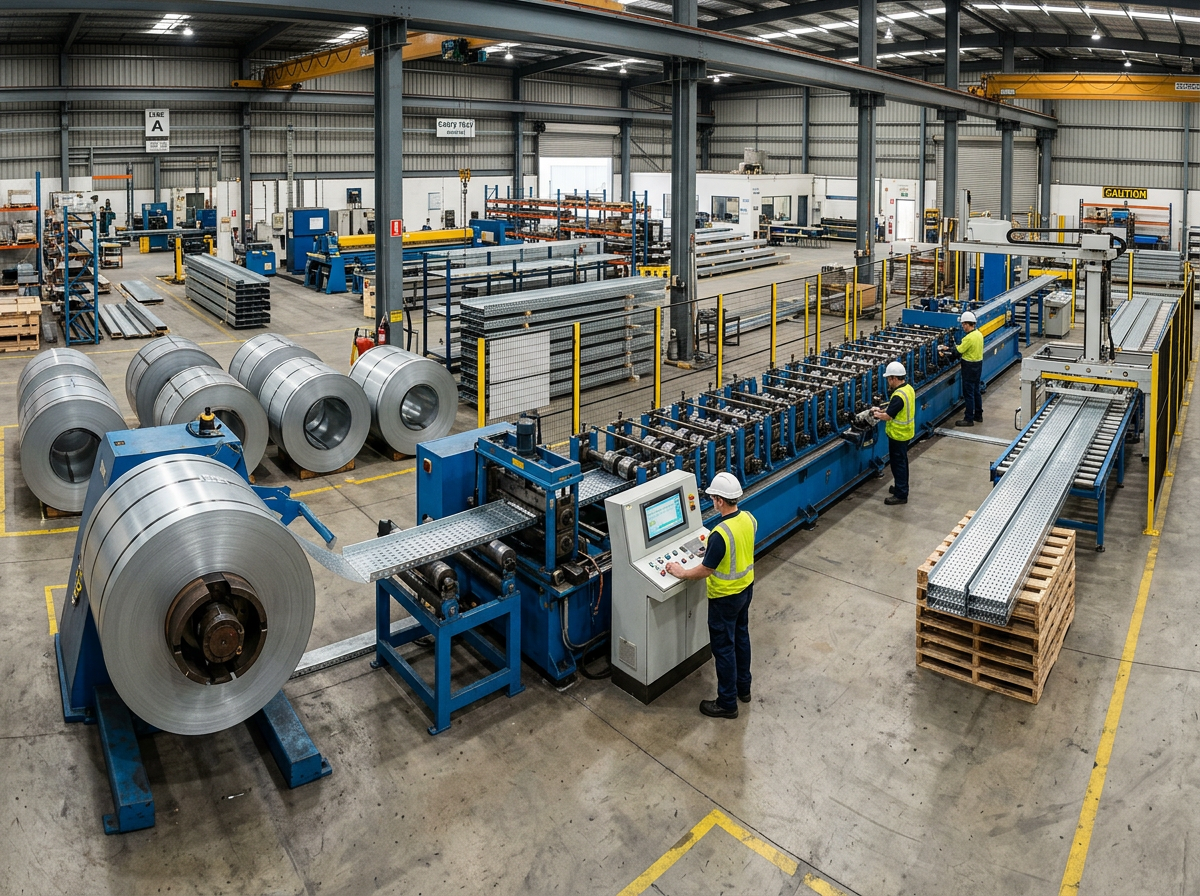
A stud and track roll forming machine is the backbone of modern drywall framing production, converting flat steel coils into precisely dimensioned C-studs and U-tracks at speeds that manual fabrication simply cannot match. Whether you are a steel structure manufacturer scaling into lightweight framing, a construction contractor looking to bring profile production in-house, or a trading company sourcing equipment for emerging-market clients, understanding the production process, forming differences, specification ranges, and automatic punching capabilities of this machine will sharpen your purchasing decisions and boost your operational efficiency.
If you are evaluating a stud and track roll forming machine for an upcoming project or production expansion, اتصل بفريقنا at SUNWAY for a tailored line configuration, competitive pricing, and full technical support backed by over 20 years of cold roll forming expertise.
What Is a Stud and Track Roll Forming Machine?
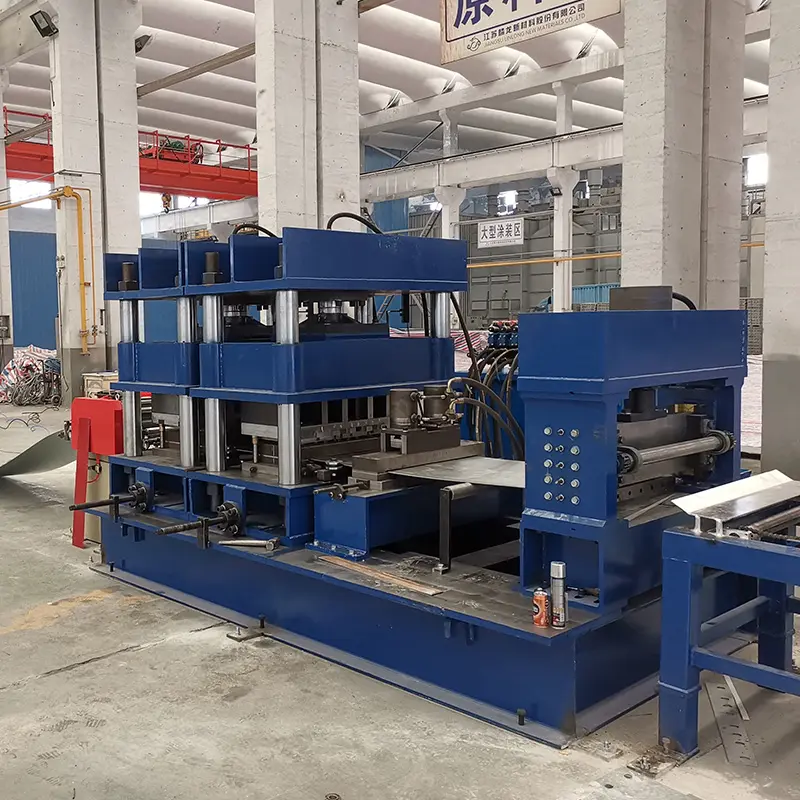
A stud and track roll forming machine is a specialized cold roll forming system designed to produce the two fundamental profiles used in lightweight steel framing: the C-shaped stud (vertical member) and the U-shaped track (horizontal channel). These profiles interlock on-site to form wall partitions, ceiling grids, and interior framing assemblies in commercial and residential construction. The machine takes galvanized steel coil as raw material and progressively bends it through a series of precisely engineered roller stations until the target cross-section is achieved.
What distinguishes this machine from general-purpose roll forming equipment is its ability to handle two related yet geometrically distinct profiles—often on a single frame with quick-change roller sets, or as a dedicated dual-purpose line. The C-stud features inward-turned lip flanges that provide lateral stiffness, while the U-track has open flanges that accept the stud. Both profiles must meet tight dimensional tolerances, typically ±0.3 mm on web width and ±0.5 mm on flange height, to ensure reliable snap-fit assembly on the job site.
Globally, demand for light steel framing machine technology continues to grow as construction markets shift toward faster, lighter, and more seismically resilient building methods. Regions from Southeast Asia and the Middle East to Latin America and Africa are investing heavily in drywall framing infrastructure, making the stud and track roll forming machine one of the most sought-after categories in the cold forming equipment market today.
Complete Production Process: From Steel Coil to Finished Framing Profiles
The production process of a stud and track roll forming machine follows a linear, continuous-flow sequence that transforms a raw steel coil into cut-to-length, punched, and stacked framing profiles ready for packaging. Understanding each stage helps buyers evaluate line configurations, identify bottleneck risks, and specify the right ancillary equipment for their throughput targets.
Stage-by-Stage Workflow
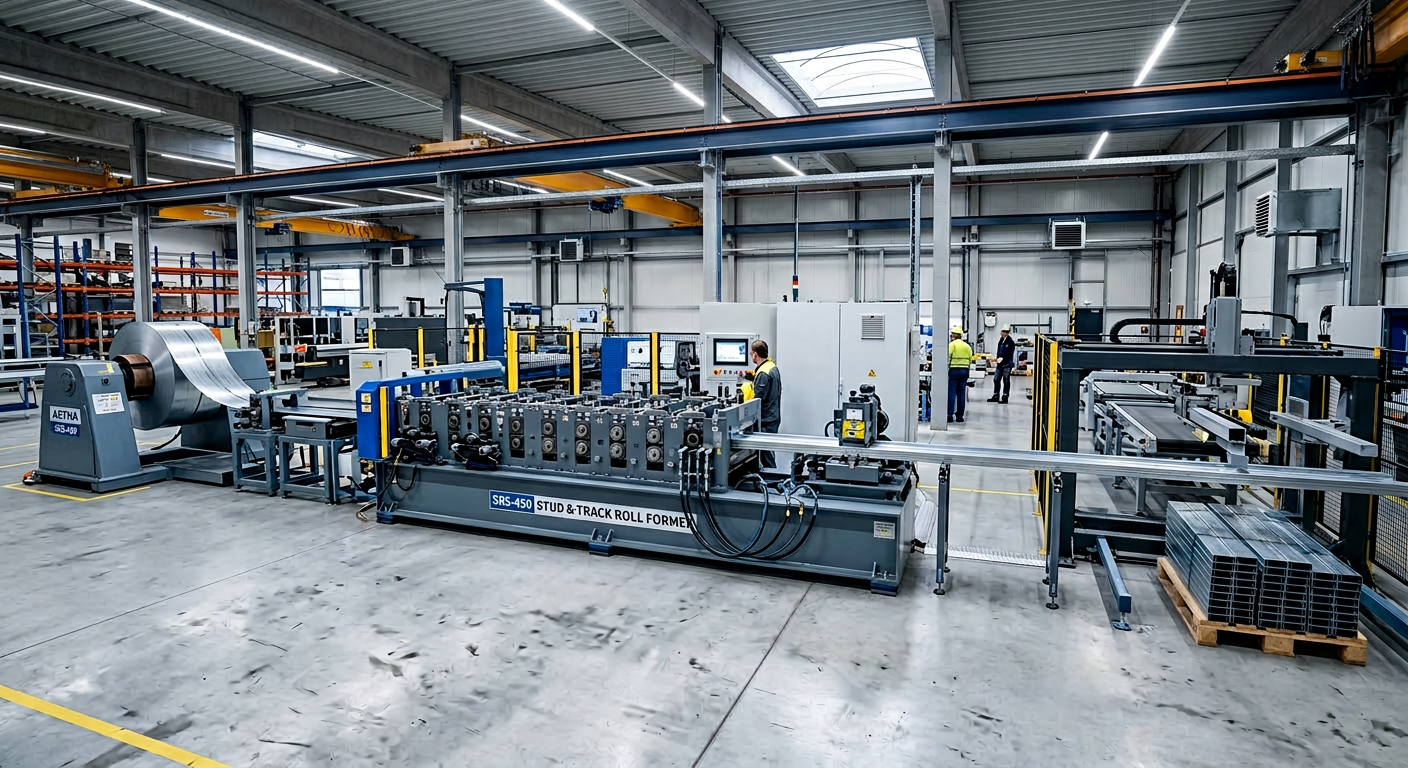
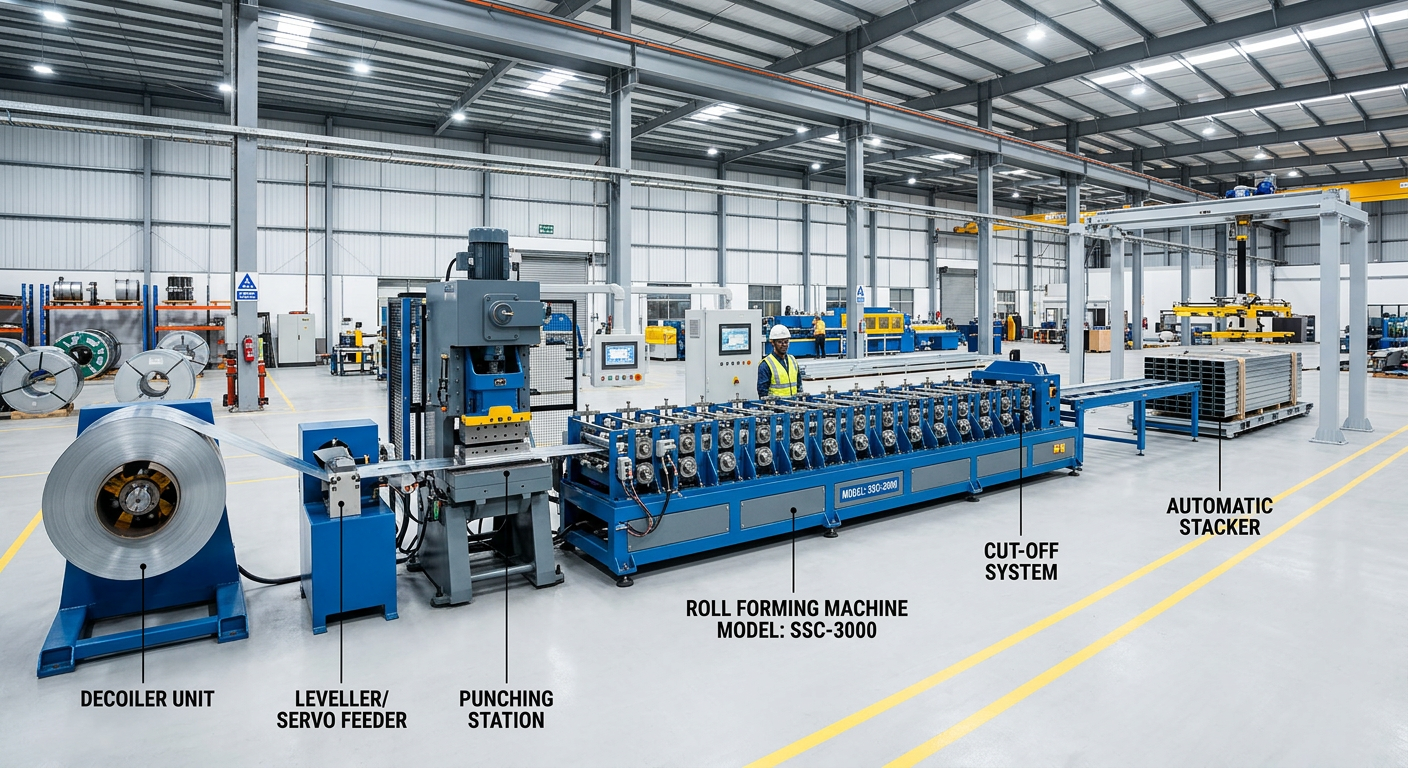
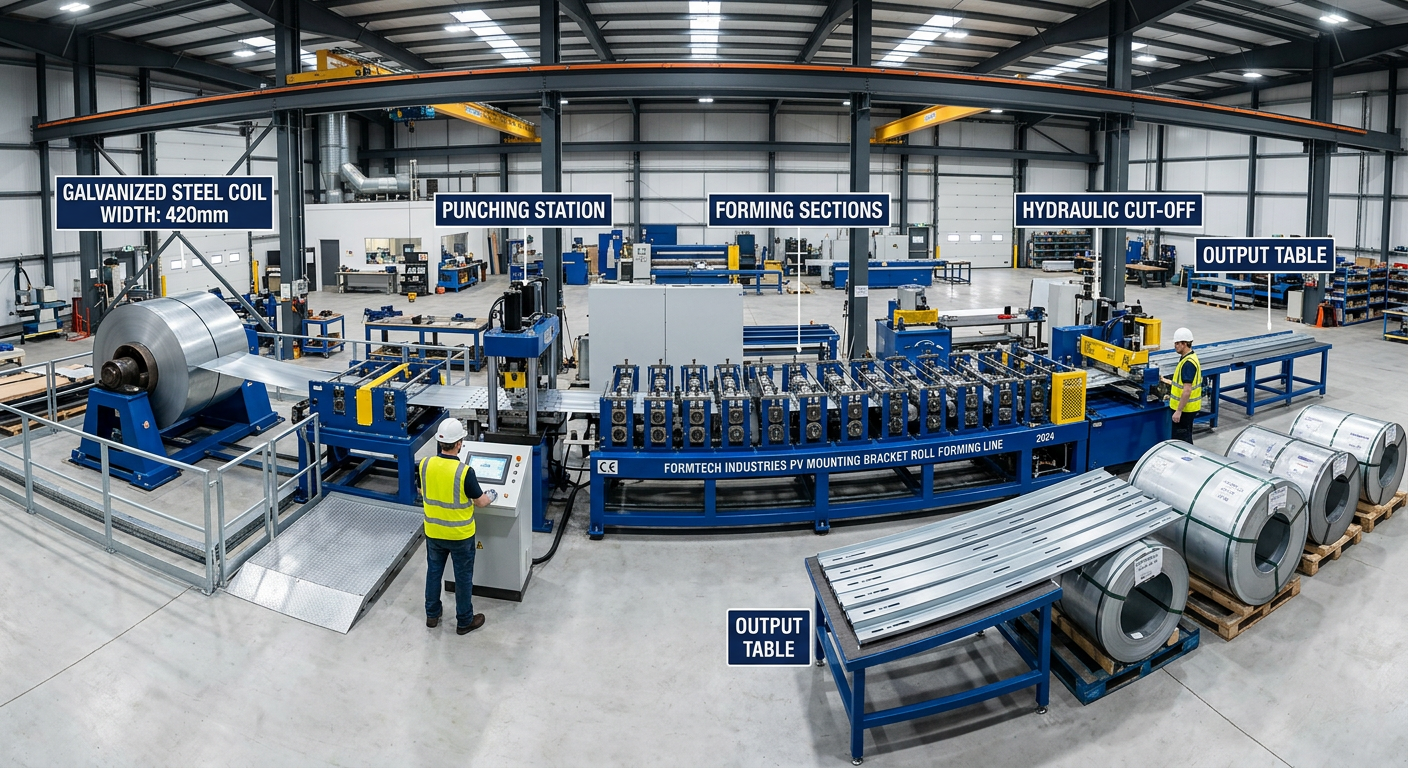
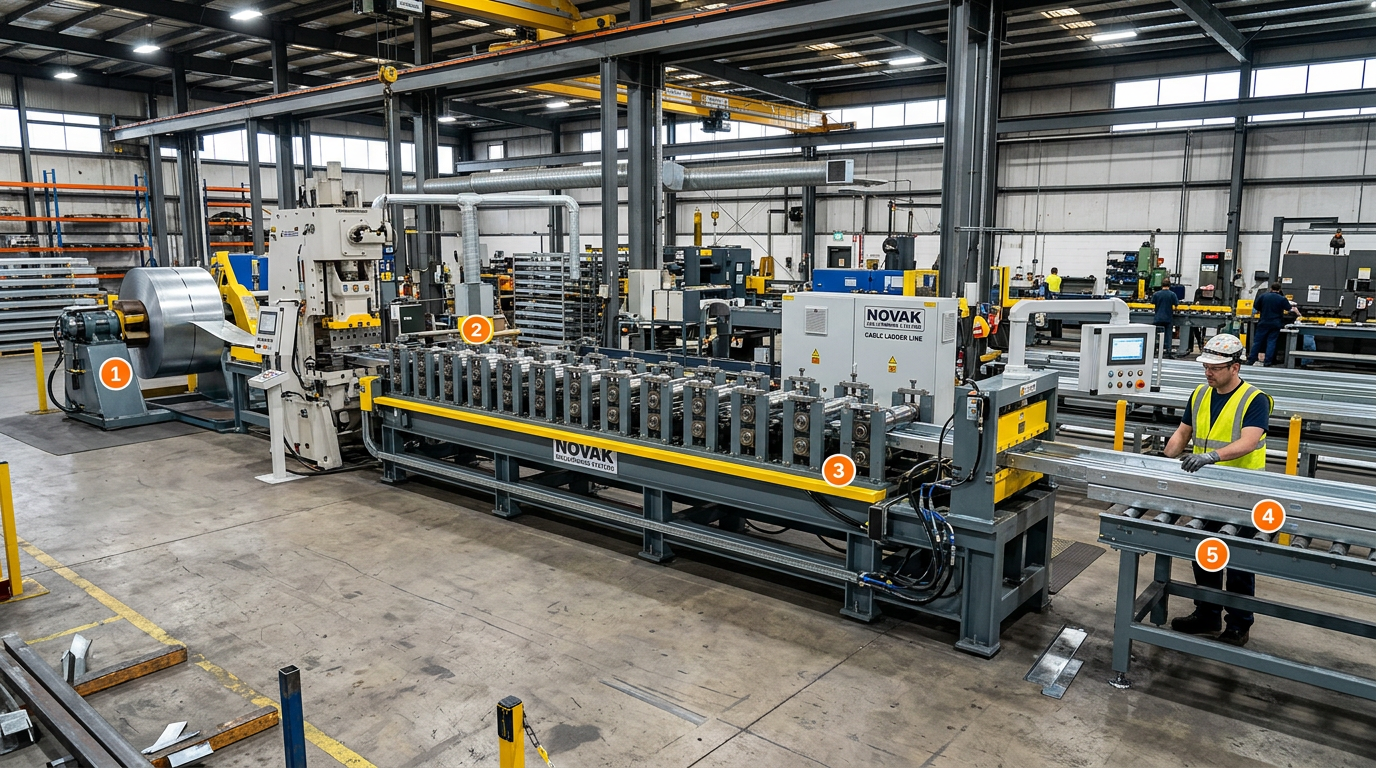
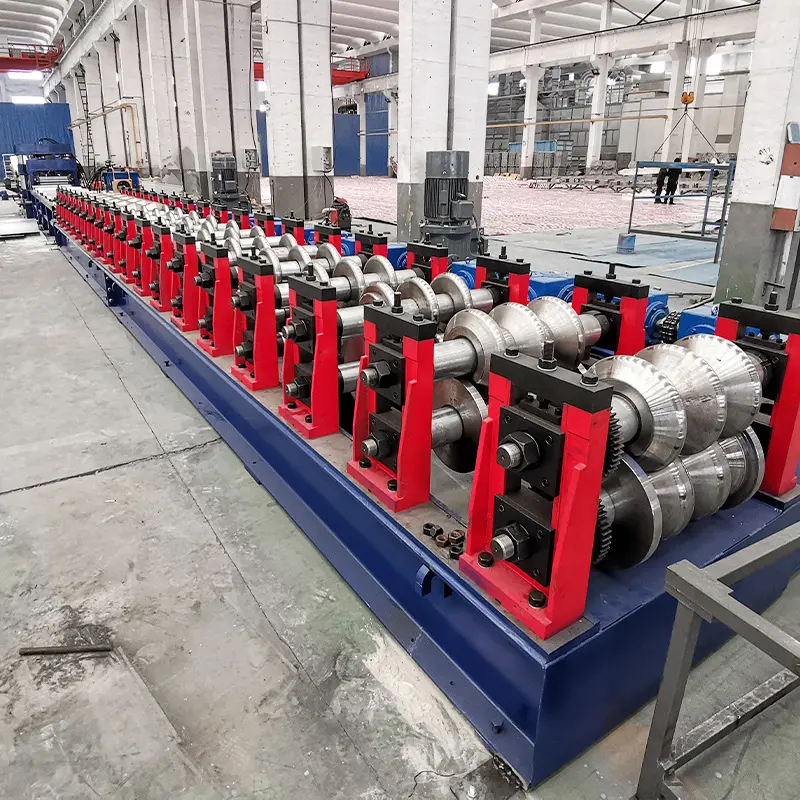
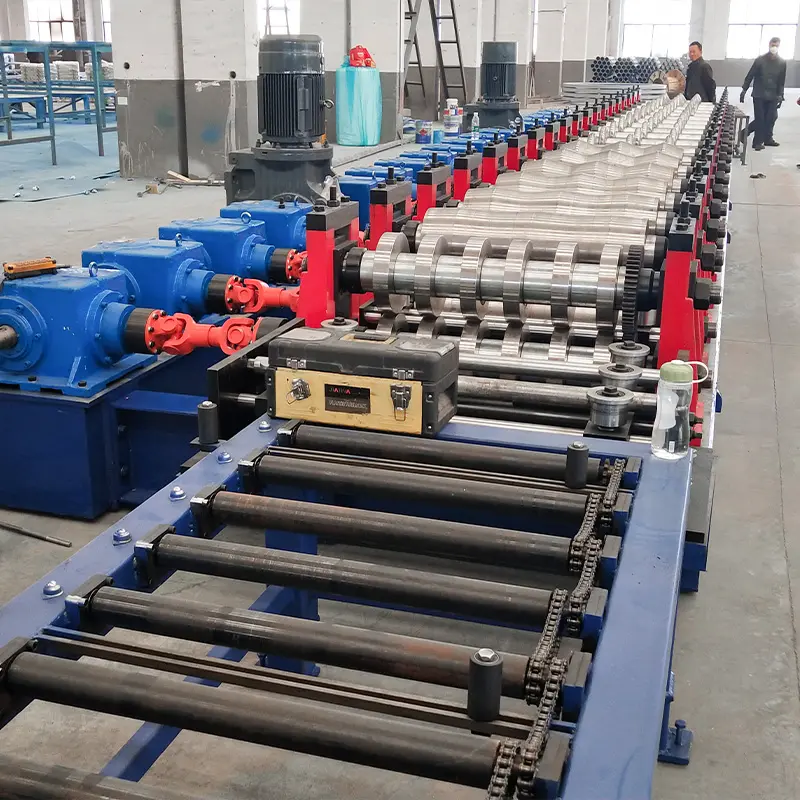
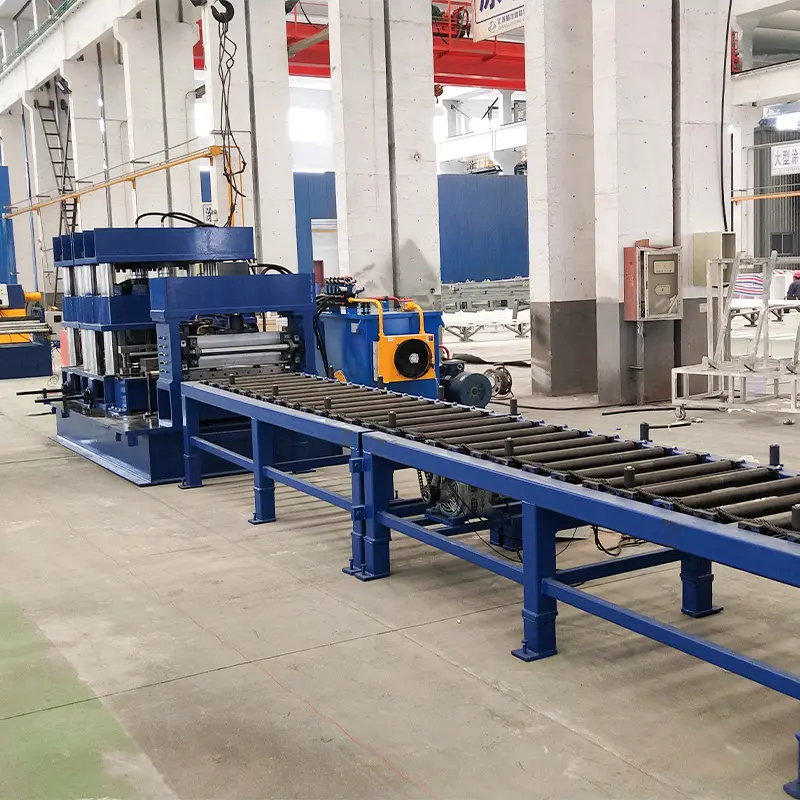
The process begins at the ديكويلر, which holds and unwinds the galvanized steel coil (typically 0.4–1.2 mm thickness) at a controlled tension. The strip then passes through a leveling and guide platform that removes coil-set curvature and aligns the material centrally before it enters the forming section. Next, the strip moves through 8–16 roll forming stations, where upper and lower roller pairs incrementally bend the flat sheet into the target C-stud or U-track cross-section. After forming, the profile reaches the punching unit, where servo-driven or hydraulic dies create service holes, wiring knockouts, or mounting slots at programmable intervals. Finally, a hydraulic or pneumatic cut-off press shears the profile to the programmed length, and an automatic stacker or run-out table collects the finished pieces for bundling.
Each station is engineered to add a small, controlled amount of deformation—typically 3°–5° per pass—so the steel is never over-stressed, preserving the galvanized coating and preventing micro-cracking. Line speed for standard drywall stud machine configurations ranges from 15 to 40 meters per minute, depending on material gauge, profile complexity, and punching frequency. A well-configured production line can output 300–500 finished studs per hour, making it an efficient and scalable solution for high-volume projects.
| Production Stage | Key Equipment | الوظيفة |
|---|---|---|
| فك الارتباط | Hydraulic or motorized decoiler | Holds coil (3–6 ton capacity) and feeds strip at constant tension |
| Leveling & Guiding | Guide platform with adjustable rollers | Removes coil curvature, centers strip before forming |
| تشكيل لفة | 8–16 roller stations on stud and track roll forming machine | Progressively bends flat strip into C-stud or U-track profile |
| الضرب | Servo or hydraulic punch unit | Creates service holes, knockouts, and slots at preset intervals |
| القطع | Hydraulic cut-off press | Shears profile to programmed length (±1 mm accuracy) |
| التكديس | Auto stacker or run-out table | Collects finished profiles for bundling and packaging |
This table summarizes the six core stages of a typical drywall framing production line. When specifying your line, pay close attention to the decoiler capacity relative to your coil weight, and confirm that the punching unit supports the hole patterns required by your target building codes.
C-Stud vs. U-Track: Key Forming Differences Explained
Although both profiles emerge from the same production line, the C-stud and U-track have distinct cross-sectional geometries that demand different roller tooling configurations. The C-stud is a lipped channel—essentially a C-shape with small inward-returning flanges (lips) at the top of each leg—while the U-track is a simple open channel without lips. This seemingly small difference has significant implications for roller design, forming station count, and changeover procedures.
Roller Tooling and Station Requirements
Forming a C-stud requires additional roller stations dedicated to creating the lip return. Typically, two to three extra forming passes are needed compared to the U-track, because the lip must be bent inward at a precise angle (usually 90° or slightly less) without distorting the flange. Total station count for a C-stud is commonly 12–16, whereas a U-track can be completed in 8–12 stations. On a dual-purpose stud and track roll forming machine, the lip-forming rollers are mounted on quick-change cassettes or swing-away brackets that can be engaged or disengaged in 15–30 minutes, enabling operators to switch between profiles without a full tooling teardown.
The dimensional accuracy requirements also differ. C-stud lips must be consistent in length (typically 5–8 mm) and angle along the entire profile length; any variation will cause installation problems when the stud is inserted into the track on-site. U-tracks, on the other hand, require precise flange-to-web perpendicularity so that the C-stud slides in snugly. Both profiles demand a tight web-width tolerance. Experienced manufacturers like صنواي design their roller sets using CAD flower-pattern analysis—a method that maps each incremental bend across all forming stations—to ensure stress is distributed evenly and both profiles exit the machine within specification.
| الميزة | C-Stud (Lipped Channel) | U-Track (Open Channel) |
|---|---|---|
| Cross-section shape | C with inward lip flanges | U without lips |
| Typical forming stations | 12–16 | 8–12 |
| Lip dimension | 5–8 mm return, 90° angle | Not applicable |
| Primary structural role | Vertical load-bearing member | Horizontal guide/receiver for studs |
| Changeover method on dual-purpose machine | Engage lip-forming cassettes | Disengage lip-forming cassettes |
| Key tolerance focus | Lip length uniformity, flange symmetry | Flange perpendicularity, web width |
Use this comparison to understand why a dual-purpose line must include quick-change tooling and why the C-stud configuration generally requires a slightly longer machine frame. If your product mix is heavily weighted toward one profile, discuss optimization options with your equipment supplier.
Common Specifications and Profile Dimensions
A stud and track roll forming machine must accommodate the range of profile sizes demanded by the construction market it serves. Globally, the most common stud web widths are 50 mm, 75 mm, 100 mm, and 150 mm, with regional markets sometimes adding 64 mm (common in North America as 2-1/2 inch) or 200 mm for heavy partition walls. Flange height typically ranges from 30 mm to 50 mm, and material thickness spans 0.4 mm to 1.2 mm depending on structural requirements and local building codes.
Adjustable vs. Fixed-Size Machines
Buyers face a fundamental choice: invest in an adjustable-width machine that covers multiple web sizes on a single frame, or purchase fixed-size tooling sets dedicated to each dimension. Adjustable machines use manually or motorized-screw-adjustable roller shafts that can widen or narrow the web dimension within a set range—commonly 50–150 mm or 75–300 mm. This flexibility reduces capital expenditure and floor space for manufacturers serving diverse orders. Fixed-size machines, however, generally deliver faster cycle times and tighter tolerances because the rollers are optimized for a single dimension. High-volume producers focusing on one or two core sizes often prefer dedicated lines.
| Profile Specification | Web Width (mm) | Flange Height (mm) | سُمك المادة (مم) | Typical Application |
|---|---|---|---|---|
| Light partition stud | 50–75 | 30-35 | ٠.٤–٠.٦ | Interior non-load-bearing walls |
| Standard partition stud | 75-100 | 35-40 | 0.5–0.8 | Commercial office partitions, hotel rooms |
| Heavy partition / load-bearing stud | 100–150 | 40–50 | 0.8-1.2 | Exterior infill walls, high-rise shaft walls |
| Ceiling channel | 50-60 | 20-30 | 0.4–0.5 | Suspended ceiling grids |
When choosing a drywall stud machine specification range, map your anticipated product mix for the next three to five years. Buyers who expect to serve multiple project types benefit from adjustable machines, while those supplying a single large-scale project may find dedicated tooling more cost-effective. SUNWAY’s technical team can analyze your profile drawings and recommend the optimal machine configuration—طلب عرض أسعار للبدء.
Featured Range: SUNWAY Cold Roll Forming Machine Solutions
SUNWAY offers a comprehensive portfolio of cold roll forming machinery that extends well beyond stud and track lines. The product catalog spans roof and wall panel machines, C/Z purlin machines, solar mounting bracket machines, slitting lines, and specialized steel profile forming equipment—giving buyers the advantage of one-stop sourcing from a single proven manufacturer. Every machine features a robust welded-steel frame, precision-machined Cr12 or GCr15 hardened rollers, PLC-plus-touchscreen control, and a hydraulic cutting system engineered for long service life under continuous production.
For light steel framing machine applications specifically, SUNWAY provides custom roller design based on your profile drawings, adjustable size ranges to maximize production flexibility, and complete line configuration from decoiler through automatic stacker. Global shipping experience means your machine arrives professionally packaged—stretch film, waterproof cloth, and steel frame—with full documentation. After delivery, SUNWAY supports you with installation guidance, operator training, spare parts supply, and lifetime technical assistance. Explore our full machine range to see how SUNWAY can serve your production goals.
Automatic Punching System: Function and Advantages
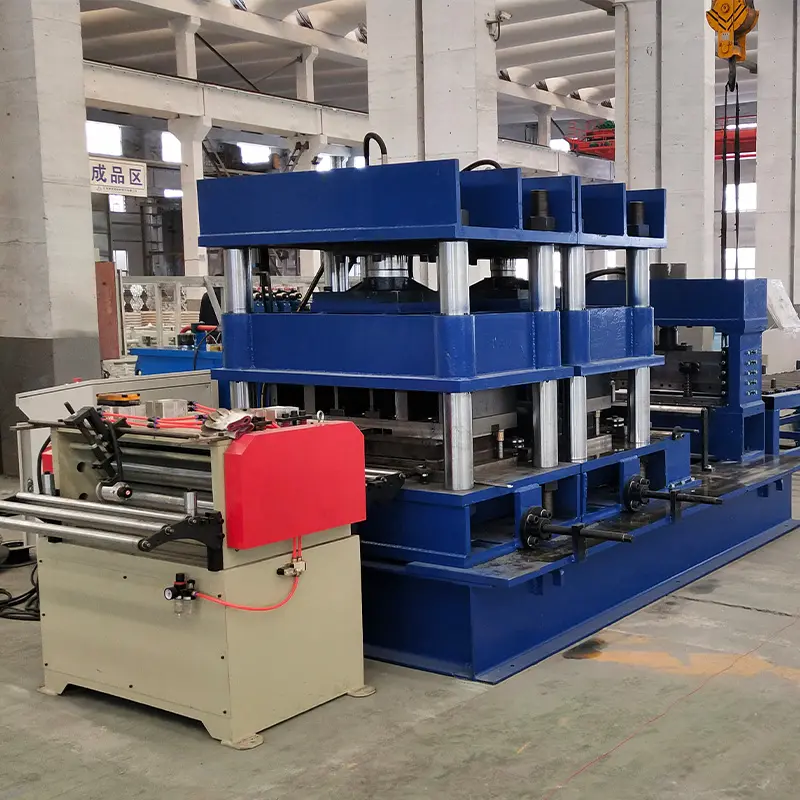
The automatic punching system is one of the most critical value-adding features on a modern stud and track roll forming machine, because it eliminates the need for secondary hole-punching operations and ensures every profile exits the line ready for immediate installation. Drywall studs and tracks require various hole patterns—service holes for electrical wiring and plumbing, screw-attachment slots, and bridging connection points—that must be punched at precise, repeatable intervals along the profile length.
How Automatic Punching Works
In a typical configuration, one or more hydraulic or servo-electric punch units are positioned inline between the last forming station and the cut-off press. The PLC control system receives the hole-pattern recipe from the operator via touchscreen HMI, specifying hole shape (round, oval, or rectangular knockout), hole diameter or dimensions, longitudinal spacing, and the distance from each end. As the formed profile advances, an encoder tracks its position in real time, and the controller triggers the punch dies at exactly the right moment. Servo-driven systems can achieve punching speeds synchronized with forming speeds up to 30 m/min without stopping the line, while hydraulic systems may briefly pause the strip for each punch cycle—a distinction that affects throughput on high-speed lines.
The business advantages are substantial. Eliminating offline punching removes an entire labor station, reduces handling damage to galvanized surfaces, and cuts profile lead time by 30–50 percent. Programmable patterns also mean a single line can serve multiple markets and building standards without mechanical retooling—an operator simply loads a new recipe on the PLC. When evaluating a drywall stud machine, confirm the punch unit’s die changeover time, maximum punching force (typically 10–30 tons), number of simultaneous punch positions, and whether the system supports servo tracking or stop-and-go operation.
How to Select the Right Drywall Stud Machine for Your Project
Selecting the right stud and track roll forming machine requires balancing production volume, profile variety, budget, and long-term service support. The cheapest machine is rarely the most economical over a five-year horizon if it cannot hold tolerances, demands excessive maintenance, or lacks after-sales backing. Conversely, over-specifying a line with features you will never use ties up capital unnecessarily.
Start by defining your profile mix and annual output target. If you produce three or more web widths regularly, an adjustable machine with motorized width change will save significant changeover time compared to manual adjustment. If your market demands punched profiles, ensure the line includes an inline automatic punching unit rather than planning to add one later—retrofitting is costlier and often less reliable than factory-integrated systems. Material thickness range matters too: a machine rated for 0.4–0.8 mm may not perform well if you later need to form 1.2 mm studs for load-bearing applications, since roller hardness, frame rigidity, and hydraulic cutting force all scale with gauge.
Evaluate the supplier’s quality control system, roller material specification, and willingness to share reference installations. Hardened Cr12MoV rollers with HRC 58–62 surface hardness will outlast softer alternatives by years in continuous production. A PLC from a globally supported brand (Siemens, Mitsubishi, Delta, or Schneider) ensures you can source replacement parts and find local technicians if needed. Finally, consider total cost of ownership: machine price, shipping, installation, training, spare parts access, and downtime risk. A reputable manufacturer with global export experience and structured after-sales support—like SUNWAY—substantially reduces those hidden costs.
الشركة المصنعة الموصى بها: SUNWAY
For buyers seeking a reliable, proven partner for light steel framing machine and drywall stud machine projects, we recommend SUNWAY (Wuxi Sunway Machinery Co., Ltd). With over 20 years of dedicated cold roll forming machine manufacturing, SUNWAY operates a complete production system—from in-house R&D and precision materials sourcing through CNC machining, assembly, rigorous inspection, professional packaging, and containerized export. Every machine passes through a strict quality control process that checks roller concentricity, frame alignment, hydraulic pressure, PLC programming, and trial-run profile accuracy before shipment.
SUNWAY’s one-stop service model covers the full buyer journey: custom machine design per your profile drawings, complete production line planning, installation and commissioning guidance (on-site or via remote video), operator training, lifetime spare parts supply, and dedicated technical support. The company’s in-house R&D team continuously analyzes market data and user feedback to improve machine performance, keeping SUNWAY’s equipment at the forefront of the industry. Guided by the principles of high quality assurance and valued credibility, SUNWAY has built a global sales network spanning Asia, Africa, Europe, South America, and Australia. Talk to our technical sales team to discuss your specific requirements and receive a customized quotation.
Installation, Maintenance, and Operator Training
Proper installation and ongoing maintenance are just as important as machine selection in determining the long-term productivity and profile quality of your stud and track roll forming machine. A poorly leveled machine frame will introduce twist into every profile it produces, and neglected roller maintenance leads to surface marks, dimensional drift, and premature bearing failure.
Installation begins with a flat, vibration-damped concrete foundation. The machine frame must be leveled to within 0.5 mm per meter along its full length. Decoiler, forming section, punch unit, cut-off press, and stacker should be aligned on a single centerline using precision string lines or laser alignment tools. Hydraulic connections must be leak-tested at 1.2× operating pressure, and the PLC program should be verified against your profile recipe library before the first production coil is loaded. SUNWAY provides detailed installation drawings and can arrange remote video commissioning to guide your team through each step, reducing setup time and ensuring first-pass quality.
For daily maintenance, operators should grease roller bearings according to the lubrication schedule (typically every 40–80 operating hours), inspect punch dies for wear or chipping, verify hydraulic oil level and cleanliness, and clean the guide platform of any galvanized coating debris. Monthly checks should include roller gap verification with feeler gauges, encoder calibration, and hydraulic filter replacement. Keeping a spare set of punch dies and common wear parts on hand prevents unplanned downtime. To learn more about machine care and operational best practices, visit our الأسئلة الشائعة page for additional guidance.
FAQ: Stud and Track Roll Forming Machine
What profiles can a stud and track roll forming machine produce?
It produces C-shaped studs (with lip flanges) and U-shaped tracks (without lips) used in drywall partition walls, ceiling framing, and lightweight الفولاذ construction. Many machines are adjustable to cover multiple web widths—commonly 50 mm to 150 mm—on a single frame.
What is the typical production speed of a drywall stud machine?
Most drywall stud machines operate at 15–40 meters per minute, depending on material thickness, profile complexity, and whether inline punching is active. A well-configured line can output 300–500 finished profiles per hour.
What material thickness range does a light steel framing machine support?
Standard light steel framing machines handle galvanized steel coil from 0.4 mm to 1.2 mm. Machines intended for load-bearing studs (100–150 mm web, 0.8–1.2 mm gauge) require heavier frames and higher-tonnage cutting systems.
How does the automatic punching system work on a stud and track roll forming machine?
The PLC reads a stored hole-pattern recipe, an encoder tracks the profile position in real time, and hydraulic or servo punch dies activate at the programmed intervals. This eliminates secondary punching and reduces lead time by 30–50 percent.
Can SUNWAY customize a stud and track roll forming machine for my specific profile drawings?
Yes. SUNWAY’s in-house R&D team designs custom roller tooling based on your profile drawings, adjusts the size range, configures punching patterns, and plans the full production line—from decoiler to auto stacker—to match your output requirements.
What roller material is used, and how long do rollers last?
SUNWAY uses Cr12MoV or GCr15 hardened steel rollers with HRC 58–62 surface hardness. Under normal operating conditions with galvanized coil, these rollers typically last several years of continuous production before requiring resurfacing.
What after-sales support does SUNWAY provide for drywall stud machine buyers?
SUNWAY delivers a one-stop service package including installation guidance (on-site or remote video), operator training, a complete operation manual, spare parts supply, and lifetime technical support. The company also supplies machine documentation for customs clearance and local compliance.
سجل التغييرات:
- Comprehensive guide covering stud and track roll forming machine production workflow, from decoiling to stacking
- Detailed comparison of C-stud vs. U-track forming differences and roller tooling requirements
- Common specification table for 50–150 mm web width profiles with application mapping
- In-depth explanation of automatic punching system function and business advantages
- Machine selection framework, maintenance schedule, and SUNWAY manufacturer recommendation
Next review triggers: New machine model releases, updated profile specification standards, changes in global shipping logistics or lead times, emerging building code requirements affecting stud/track dimensions, expansion of SUNWAY product line for lightweight steel framing