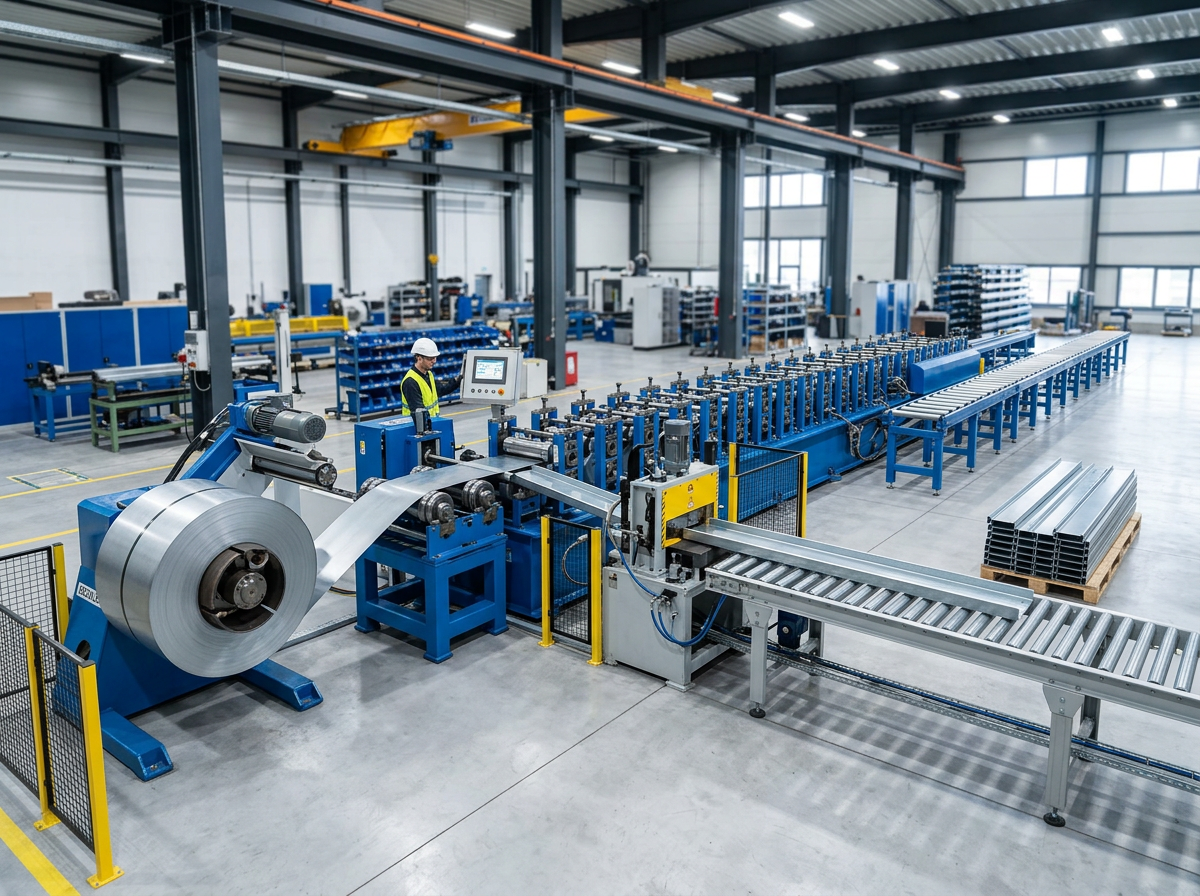
Choosing the right ridge cap roll forming machine starts with one critical question: will the profile it produces fit your existing roof panels? The ridge cap is the finishing piece that seals the apex of a roof, and its cross-sectional geometry must precisely match the panel corrugation beneath it. A mismatch leads to water ingress, poor aesthetics, and costly rework on site. This article explains how profile design, adjustable angle mechanisms, and sectional parameters determine compatibility between ridge caps and various roofing systems, giving buyers the technical framework they need to specify machines with confidence.
Whether you are producing trapezoidal, corrugated, or standing seam roof panels, understanding how a ridge cap roll forming machine translates flat coil into a perfectly angled closure piece is essential before placing an order. If you need expert guidance on selecting the right machine configuration for your specific roof panel portfolio, اتصل بفريقنا at SUNWAY—we bring over 20 years of cold roll forming experience and can recommend a tailored solution with competitive pricing.
Why Profile Design Is the Core of Every Ridge Cap Roll Forming Machine
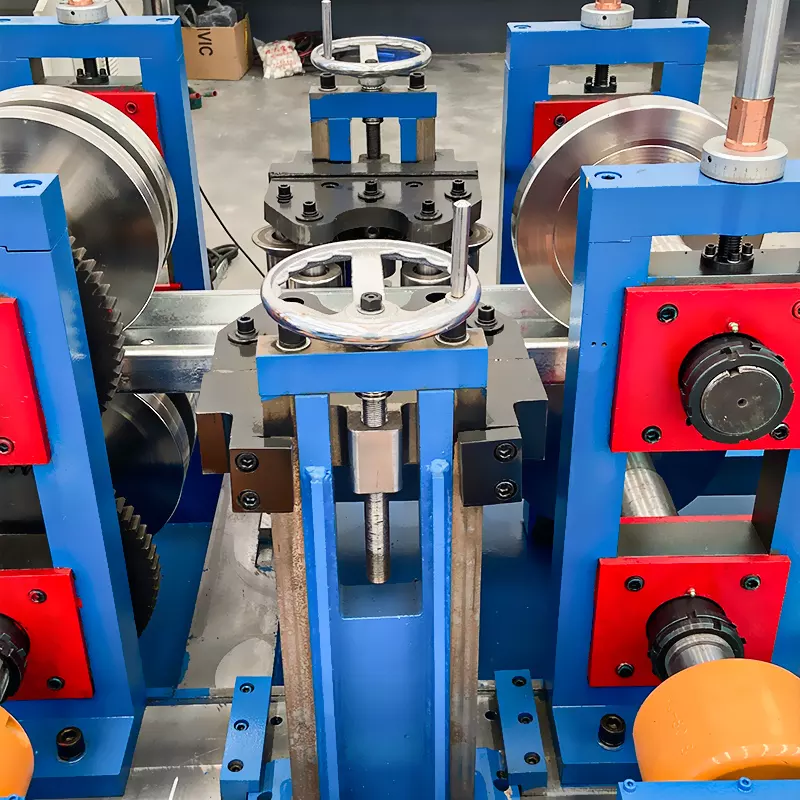
A ridge cap roll forming machine does not simply bend metal into a generic shape. Every ridge cap profile is engineered to nest over the high ribs or corrugation peaks of a particular roofing panel. The profile’s flange width, crown angle, and edge detail must correspond to the panel’s rib pitch, rib height, and overlap geometry. When these parameters align, the cap sits flush, channels water away from the ridge line, and creates a weather-tight seal without the need for excessive sealant or custom flashings.
Profile design begins with a cross-section drawing that specifies every dimension: the crown width, the leg length on each side, the lip or drip edge, and any stiffening ribs embossed into the flat sections. These dimensions are translated into a roller tool design through which the machine progressively shapes flat coil into the finished profile. Each forming station incrementally introduces bend angles, and the cumulative result is a consistent, repeatable cross-section that holds tight tolerances—typically within ±0.3 mm on critical dimensions.
Because the ridge cap must bridge two adjoining roof panels at the building’s apex, symmetry and angular accuracy are paramount. Even a one-degree deviation in the crown angle can produce a visible gap on one side of the ridge. This is why reputable machine manufacturers invest heavily in roller CAD simulation and trial runs before delivering a machine, ensuring that the profile exits the final forming station ready for immediate installation without secondary bending or manual adjustment.
How a Ridge Cap Roll Forming Machine Matches Different Roof Panels
The single biggest compatibility factor is the relationship between the ridge cap’s inner geometry and the roof panel’s rib profile at the point of overlap. Trapezoidal panels feature flat-topped ribs with defined pitch spacing, so the ridge cap must include corresponding flat landings that sit on those ribs without rocking. Corrugated panels present a sinusoidal wave, requiring a cap with a smooth, curved underside or flexible foam closures. Standing seam panels use a raised, narrow seam, and their ridge details often integrate into a specialized cap-and-cleat system.
A well-designed ridge cap roll forming machine accommodates these differences either through dedicated roller tooling sets or through adjustable forming stations. Dedicated tooling delivers the highest precision for a single profile, while adjustable stations allow operators to shift roller positions to produce caps matching two or three panel types on the same machine. The trade-off is that adjustable machines require careful setup and slightly longer changeover times, but they dramatically reduce capital expenditure for manufacturers serving diverse roofing markets.
Material gauge also plays a role in compatibility. Ridge caps are typically formed from 0.3 mm to 0.6 mm prepainted galvanized steel or aluminum coil. Thinner gauges conform more easily to complex rib patterns but may lack the structural rigidity needed for exposed ridge lines in high-wind zones. The machine’s roller gap, forming pressure, and line speed must all be calibrated to the target gauge to prevent surface scratching on coated material while maintaining dimensional accuracy.
Adjustable Angle Design: Flexibility for Variable Roof Pitches
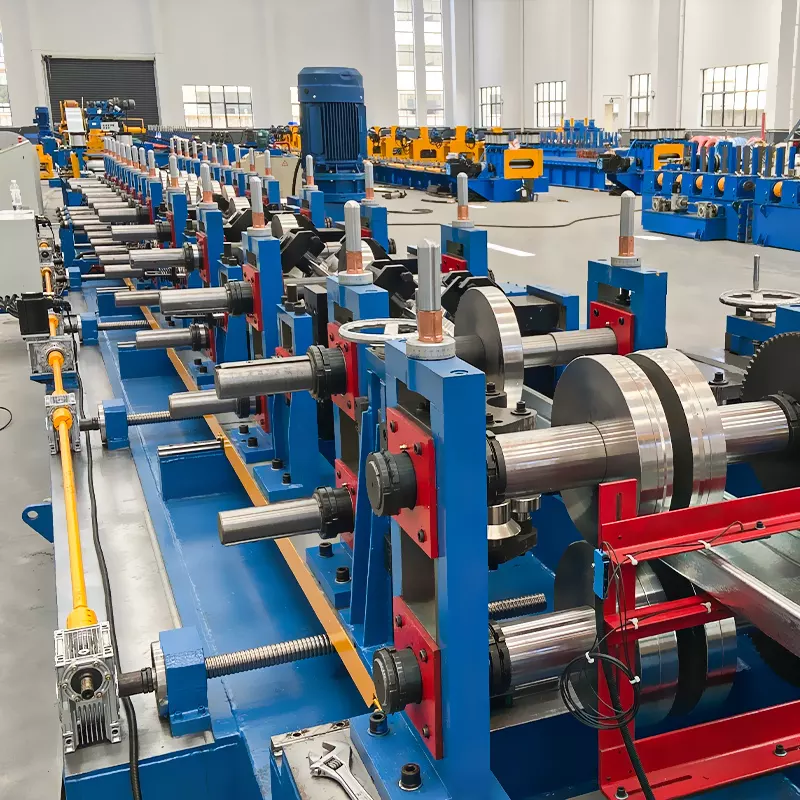
One of the most valued features on a modern ridge cap roll forming machine is an adjustable crown angle mechanism. Roof pitches vary widely—from 5° on nearly flat commercial roofs to 45° or more on steep residential designs. A fixed-angle cap limits the manufacturer to a narrow market segment, whereas an adjustable machine lets the same production line serve projects across the full pitch spectrum.
The adjustable angle is typically achieved through a hinged forming section positioned after the main roll forming stations. Once the flat profile with side flanges has been formed, the workpiece passes through an angle-bending unit where hydraulic cylinders or a mechanical screw adjustment sets the crown angle. The operator inputs the desired angle on the PLC touchscreen, and the system automatically positions the bending tooling. Common adjustment ranges span from 90° to 180° (where 180° is a flat sheet and 100°–120° corresponds to typical residential pitches). Accuracy on the angle setting is generally within ±1°.
This adjustable mechanism eliminates the need for separate roller tool sets for each roof pitch, significantly reducing tooling inventory costs and storage requirements. It also shortens lead times for custom orders—when a roofing contractor calls with an unusual pitch requirement, the operator simply enters the new angle and begins production immediately. For buyers evaluating machines, confirming the angle adjustment range, the speed of changeover, and whether the adjustment is manual or PLC-controlled are essential specification checkpoints.
الشركة المصنعة الموصى بها: SUNWAY
For buyers seeking a reliable and experienced partner in ridge cap roll forming equipment, صنواي stands out as a recommended manufacturer with over 20 years of dedicated cold roll forming machine production. SUNWAY operates a complete production system encompassing in-house R&D, precision machining, assembly, inspection, and export packaging—ensuring every machine meets international quality standards before it leaves the factory. Their skilled engineering team works directly with customers to analyze profile drawings, optimize roller designs, and configure production lines that match specific roofing market needs.
As a trusted supplier with a global sales network spanning Asia, Africa, Europe, South America, and Australia, SUNWAY delivers not just machines but a complete partnership: operator training, installation commissioning guidance, spare parts supply, and lifetime technical support. Their enterprise philosophy of high quality assurance and valued credibility translates into machines that perform consistently over years of production. To discuss your ridge cap machine requirements or request a detailed quotation, reach out to SUNWAY’s technical sales team اليوم.
Common Ridge Cap Profile Sections and Their Parameters
Ridge cap profiles can be broadly categorized into three families: angular (V-shaped), curved (half-round), and flat-top with flanged legs. Each family serves different aesthetic and functional purposes, and each places unique demands on the roll forming process. The following table summarizes typical cross-sectional parameters for the most common ridge cap types produced worldwide.
| نوع الملف الشخصي | Crown Width (mm) | Leg Length (mm) | سُمك المادة (مم) | Typical Crown Angle Range |
|---|---|---|---|---|
| Angular (V-shape) ridge cap | 200–350 | 100–180 | 0.3–0.6 | 100°–160° |
| Half-round ridge cap | 180–300 (diameter) | 80–150 | 0.3–0.5 | N/A (curved) |
| Flat-top flanged ridge cap | 250–400 | 120–200 | ٠.٤–٠.٦ | 110°–170° |
These dimensions serve as a starting point for machine specification. When discussing requirements with a ridge cap roll forming machine supplier, buyers should provide their target profile drawing with exact dimensions, as even small deviations in crown width or leg length may require custom roller tooling. The crown angle range listed above reflects typical adjustability; for unusual pitches outside these ranges, consult the manufacturer about feasibility.
Featured Range: SUNWAY Cold Roll Forming Machine Solutions
SUNWAY’s machinery portfolio addresses the full breadth of metal roofing production, making it an ideal one-stop source for manufacturers who produce both roof panels and their accessories, including ridge caps. The product lineup includes color steel sheet roll forming machines for trapezoidal, corrugated, IBR, and glazed tile panels, as well as C/Z purlin machines, floor deck machines, and solar mounting bracket machines. Each machine features a robust welded steel frame, precision-machined Cr12 or GCr15 hardened rollers, PLC-plus-touchscreen automation, and hydraulic cutting systems—all engineered for high-volume, low-downtime production.
For ridge capping machine buyers specifically, SUNWAY offers custom roller design based on the customer’s profile drawing, adjustable size and angle configurations, voltage and frequency adaptation for any destination market, and optional add-ons such as auto stackers and hydraulic decoilers with coil cars. The company’s rich global export experience ensures professional containerized packaging—stretch film, waterproof cloth, and steel frame protection—along with complete shipping documentation. To استكشف مجموعتنا الكاملة من الآلات or request a custom configuration for your ridge cap line, contact SUNWAY directly.
Key Machine Specifications Buyers Should Compare
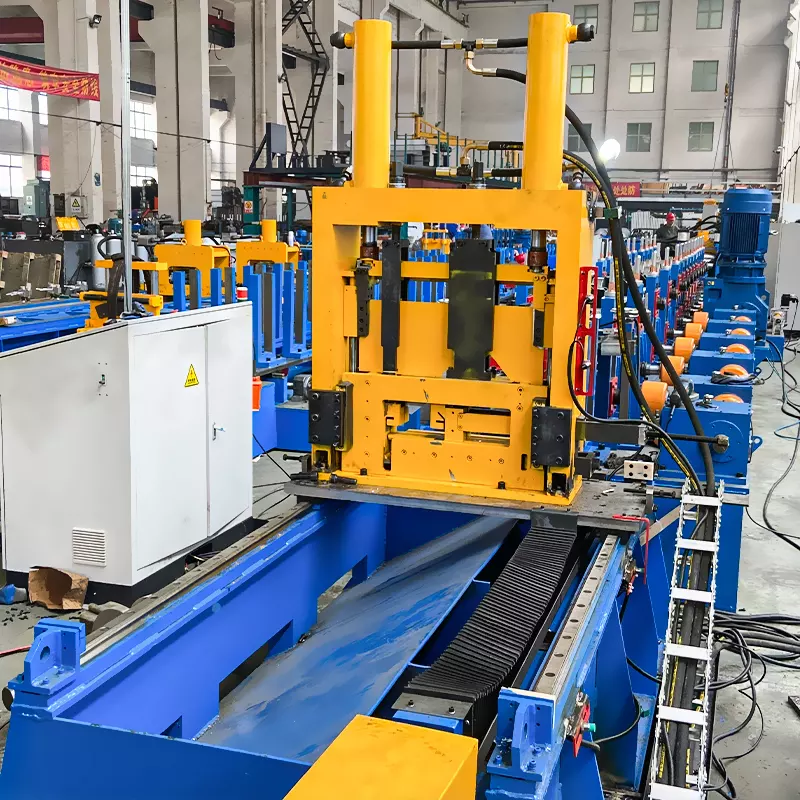
Evaluating a ridge cap roll forming machine requires examining more than just the profile output. The machine’s structural and operational specifications determine production efficiency, profile accuracy, and long-term reliability. The table below provides a comparison framework for the most important parameters.
| المواصفات | النطاق النموذجي | ما أهمية ذلك |
|---|---|---|
| عدد محطات التشكيل | 8–14 | More stations allow gentler bending per pass, reducing material stress and improving profile accuracy |
| مادة الأسطوانة | Cr12MoV / GCr15, HRC 58–62 | Hardened steel rollers resist wear and maintain tolerance over millions of cycles |
| سرعة التشكيل | 8–20 m/min | Balances throughput against surface quality on coated material |
| طاقة المحرك الرئيسي | 3–7.5 kW | Must match coil gauge and forming complexity |
| Hydraulic cutting force | 6–12 tons | Ensures clean, burr-free cuts across the full cap width |
| نظام التحكم PLC | Siemens / Mitsubishi / Delta | Governs length accuracy, batch counting, angle presets |
| Coil width capacity | 250–600 mm | Must accommodate the developed width of the target profile |
Buyers should request actual sample pieces from any shortlisted supplier and verify dimensional consistency across a batch of at least 20 pieces. Pay particular attention to edge straightness, angle uniformity, and surface condition—scratches on prepainted coil indicate roller alignment issues or insufficient surface finish on the tooling. These specification comparisons form the basis for meaningful supplier evaluation.
Step-by-Step Production Process of a Ridge Cap Roll Forming Machine
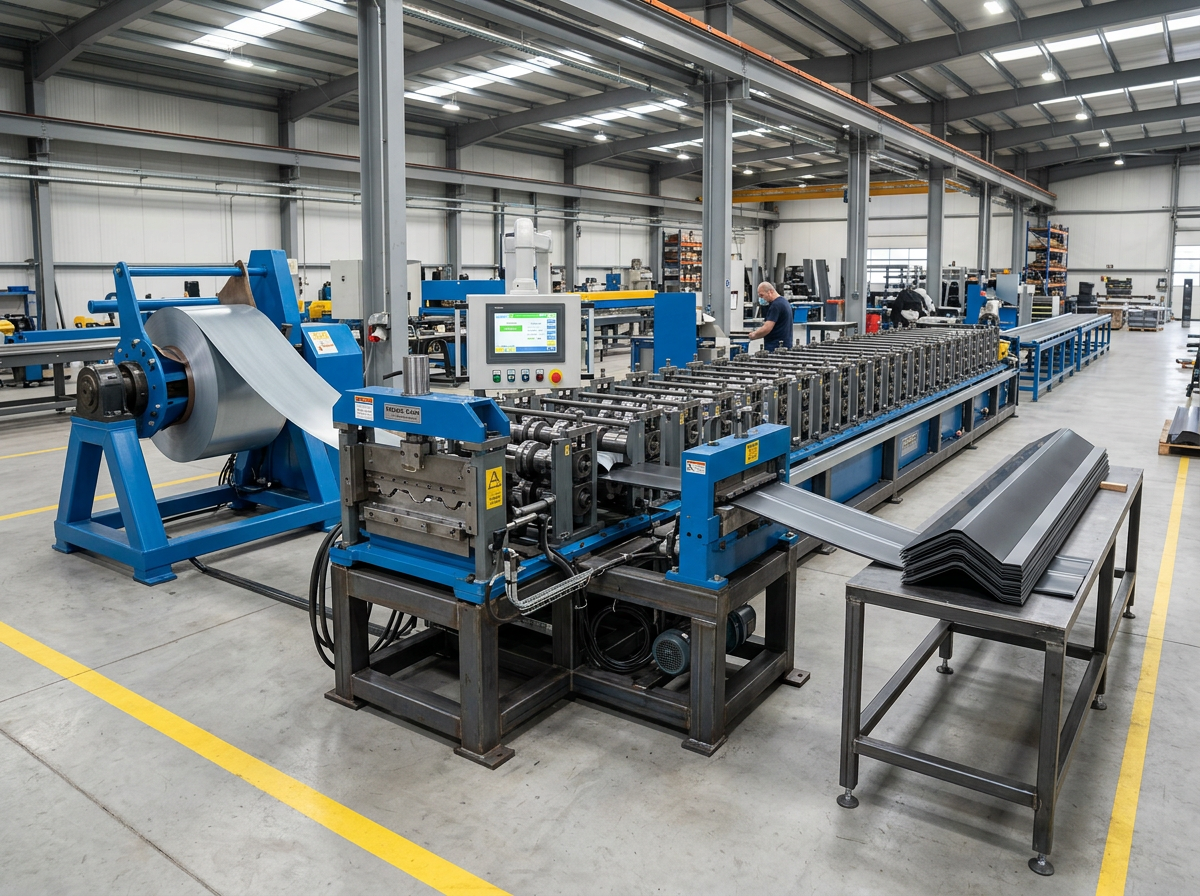
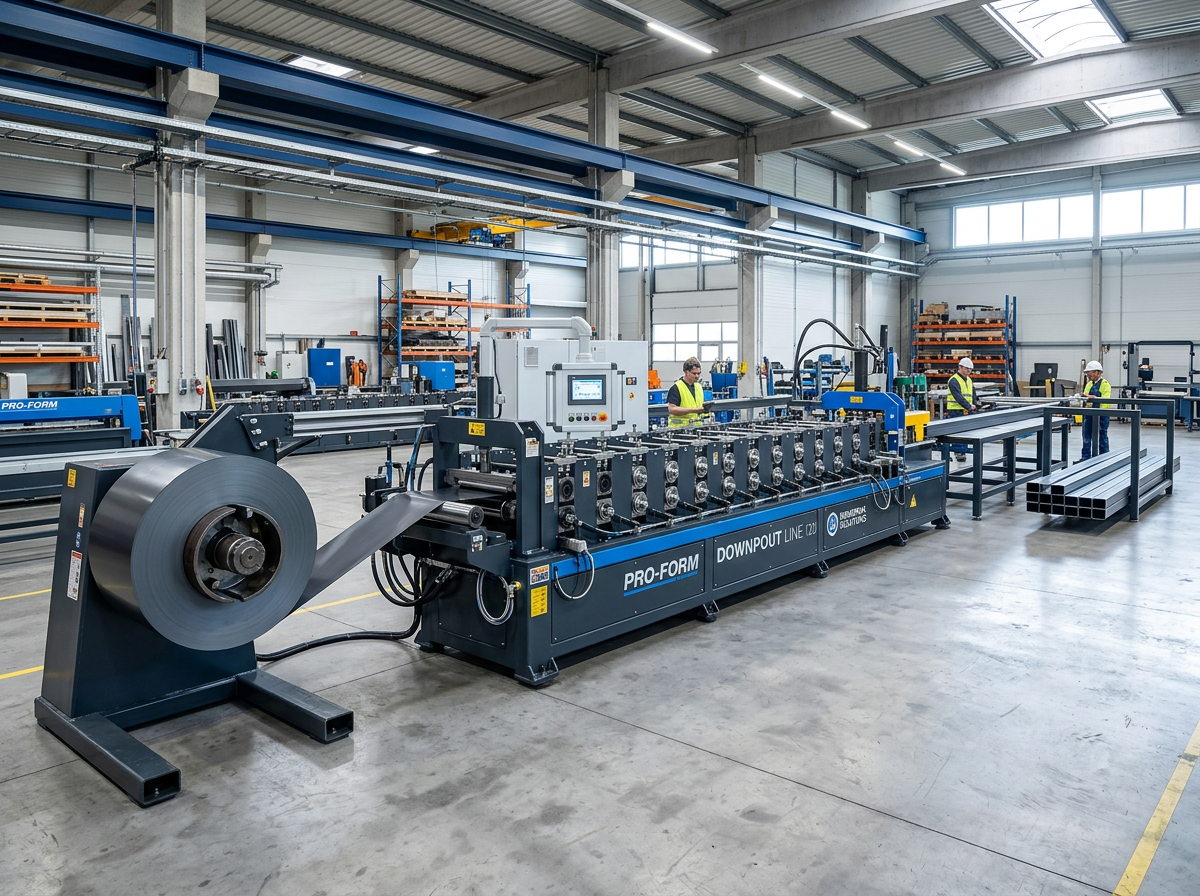
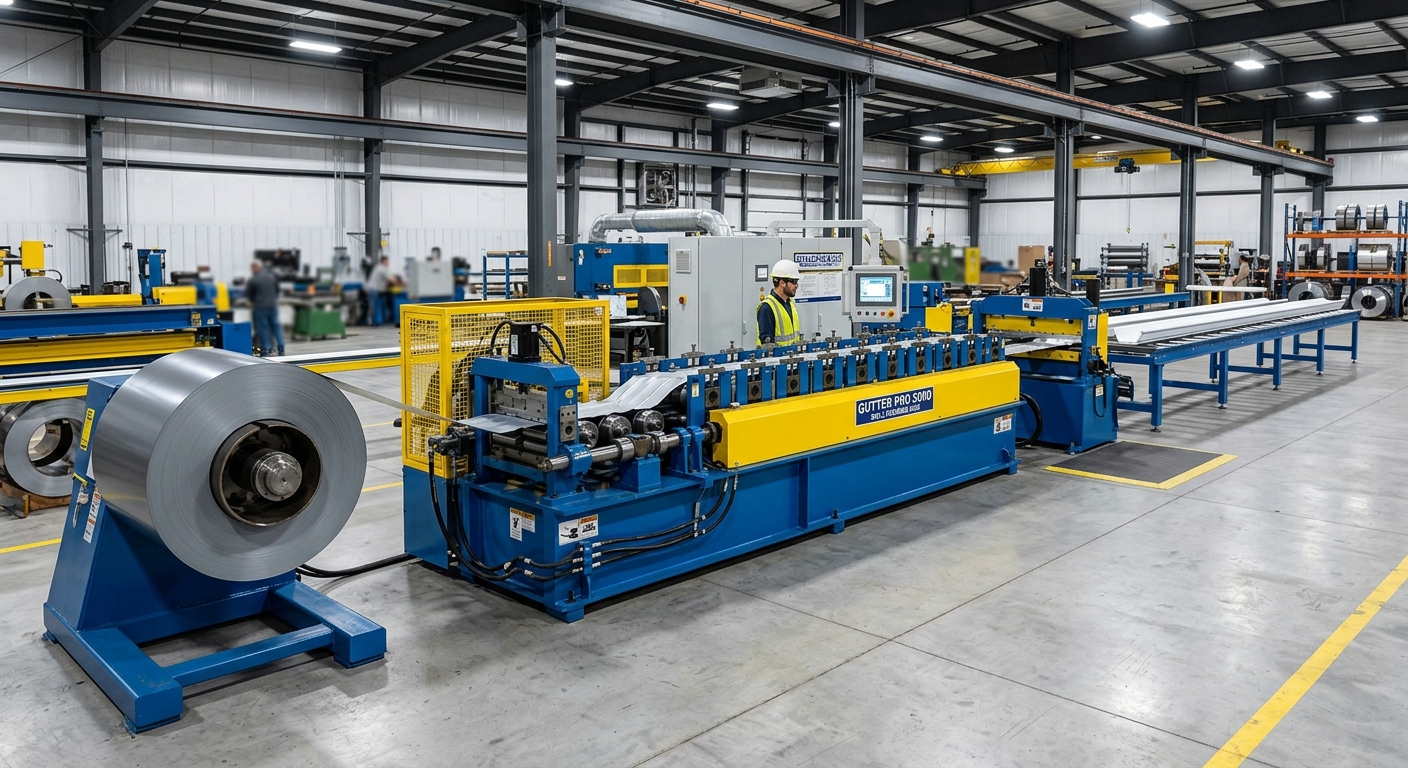
Understanding the full forming process helps buyers assess line layout requirements, factory floor space, and operator skill needs. A typical roof ridge cap machine production line follows a sequential flow from coil to finished stacked product. The process begins at the decoiler, where a steel or aluminum coil (typically 250–600 mm wide, in 0.3–0.6 mm gauge) is mounted and fed into the line under controlled tension.
From the decoiler, the strip passes through a leveling and guide platform that removes coil set curvature and centers the material before it enters the forming stations. The roll forming section consists of 8 to 14 pairs of progressively shaped rollers, each station adding incremental bends until the full cross-section is achieved. After forming, the strip enters the angle-bending unit (if the machine includes adjustable crown angle capability), where the final ridge angle is set hydraulically or mechanically.
Following the angle station, a hydraulic shear or flying cut-off die cuts each piece to the programmed length—commonly 1,000 mm to 3,000 mm, though custom lengths are possible. The finished ridge caps then travel along a run-out table and may be automatically stacked or manually collected. The entire process is governed by a PLC control system with a touchscreen HMI, allowing the operator to set piece length, quantity, forming speed, and crown angle from a single interface. Cycle time from coil to finished piece is typically 3–6 seconds per unit at standard production speed.
| مرحلة العملية | Equipment Component | Key Parameter |
|---|---|---|
| تحميل اللفائف | Hydraulic decoiler (1–3 ton capacity) | Coil ID 450–530 mm |
| Material preparation | Leveling + guide platform | Strip centering accuracy ±1 mm |
| تشكيل الملف الشخصي | 8–14 roll forming stations | Forming speed 8–20 m/min |
| Angle adjustment | Hydraulic angle bender | 90°–180° adjustable |
| القطع | Hydraulic shear / flying cut-off | Cut tolerance ±1.5 mm |
| المخرجات | Run-out table + optional stacker | Piece length 1,000–3,000 mm |
This table gives buyers a clear view of how each component contributes to the overall line. When planning factory layout, allow approximately 8–15 meters of total line length depending on the number of forming stations and whether an auto stacker is included.
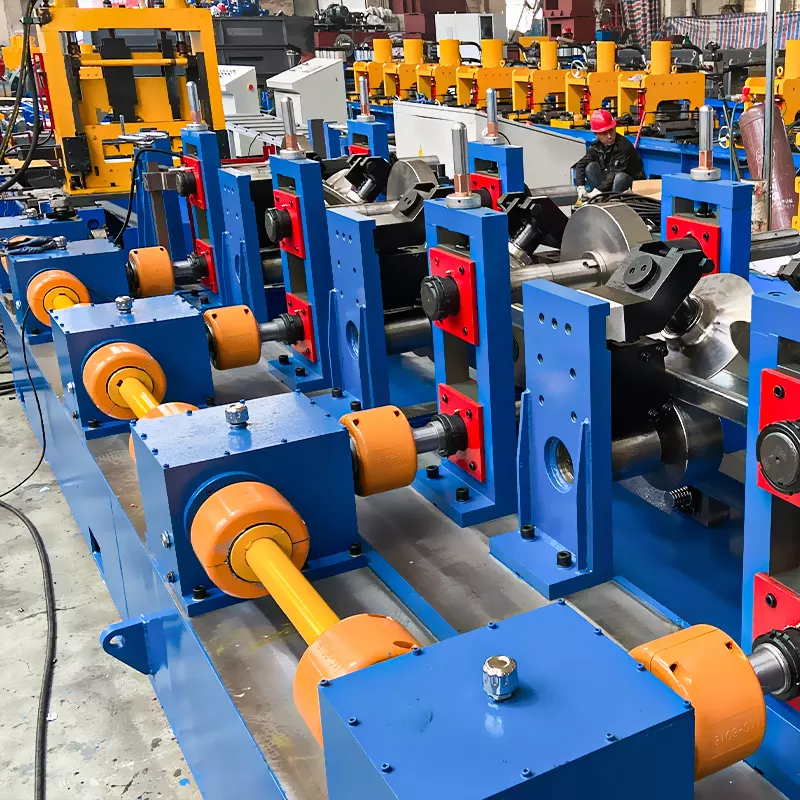
Selecting the Right Ridge Capping Machine for Your Roofing Market
The ideal machine specification depends on three factors: the roof panel types you need to match, the production volume you anticipate, and the coil materials you will process. A manufacturer producing only one panel type for a local residential market may justify a fixed-angle, single-profile ridge cap roll forming machine with 8 forming stations and manual stacking. Conversely, a large-scale roofing company supplying multiple panel profiles across commercial and residential sectors will benefit from an adjustable machine with 12 or more stations, PLC-controlled angle setting, and an auto stacker.
Budget considerations should extend beyond the machine price to include roller tooling sets for each additional profile, spare parts inventory (especially cutting blades and hydraulic seals), and operator training time. A machine that costs slightly more upfront but accepts quick-change roller cassettes and features a user-friendly PLC interface will deliver lower total cost of ownership over a five-year horizon. Ask the supplier about typical lead times for additional tooling and spare parts—response speed matters when production deadlines are tight.
Market-specific factors also influence machine selection. Tropical regions with heavy monsoon rainfall demand ridge caps with deeper leg lengths and tighter angle tolerances to prevent wind-driven rain infiltration. High-altitude or cold-climate markets may require thicker gauge caps for snow load resistance, pushing the machine specification toward higher forming power and cutting force. Buyers should present their full range of target profiles and operating conditions to the supplier at the enquiry stage so the machine can be configured optimally from the outset. For personalized machine recommendations based on your roofing product range, check our frequently asked questions or speak directly with SUNWAY’s engineering team.
FAQ: Ridge Cap Roll Forming Machine
What profiles can a ridge cap roll forming machine produce?
A ridge cap roll forming machine can produce angular (V-shape), half-round, and flat-top flanged ridge cap profiles. The exact profile depends on the installed roller tooling set, and many machines support quick-change tooling for multiple profiles.
How does a roof ridge cap machine match different panel types?
Matching is achieved by designing the cap’s inner geometry—flange width, leg length, and lip detail—to correspond with the roof panel’s rib pitch and height. The supplier designs custom rollers based on the buyer’s panel profile drawing.
What is the typical forming speed of a ridge capping machine?
Most ridge capping machines operate at 8–20 m/min, depending on material gauge, profile complexity, and surface quality requirements for prepainted coil.
Can the crown angle be adjusted on one machine?
Yes. Many modern ridge cap roll forming machines include a hydraulic or mechanical angle adjustment unit, typically covering a range from 90° to 180°, with accuracy within ±1°.
What roller material is used in ridge cap forming stations?
Rollers are typically machined from Cr12MoV or GCr15 bearing steel, hardened to HRC 58–62, providing excellent wear resistance and long service life.
Does SUNWAY provide a complete ridge cap production line?
Yes. SUNWAY delivers fully configured production lines including decoiler, leveling guide, roll forming stations, angle bending unit, hydraulic cutting system, PLC control, run-out table, and optional auto stacker, backed by installation guidance and operator training.
What is the typical lead time and packaging for export?
Lead time is generally 30–50 working days depending on customization scope. Machines are professionally packaged with stretch film, waterproof cloth, and الفولاذ frame protection for safe containerized shipping worldwide.
سجل التغييرات:
- Comprehensive guide to ridge cap profile design and roof panel compatibility published
- Adjustable crown angle mechanism and parameter ranges detailed
- Three specification and process tables included for buyer reference
- FAQ section covering seven common buyer questions added
- SUNWAY manufacturer recommendation and product feature sections integrated
Next review triggers: New ridge cap profile standards or building code changes, updated machine models with enhanced angle adjustment range, shifts in global roofing material trends, new export packaging or shipping regulation changes, emerging photovoltaic roofing integration requirements