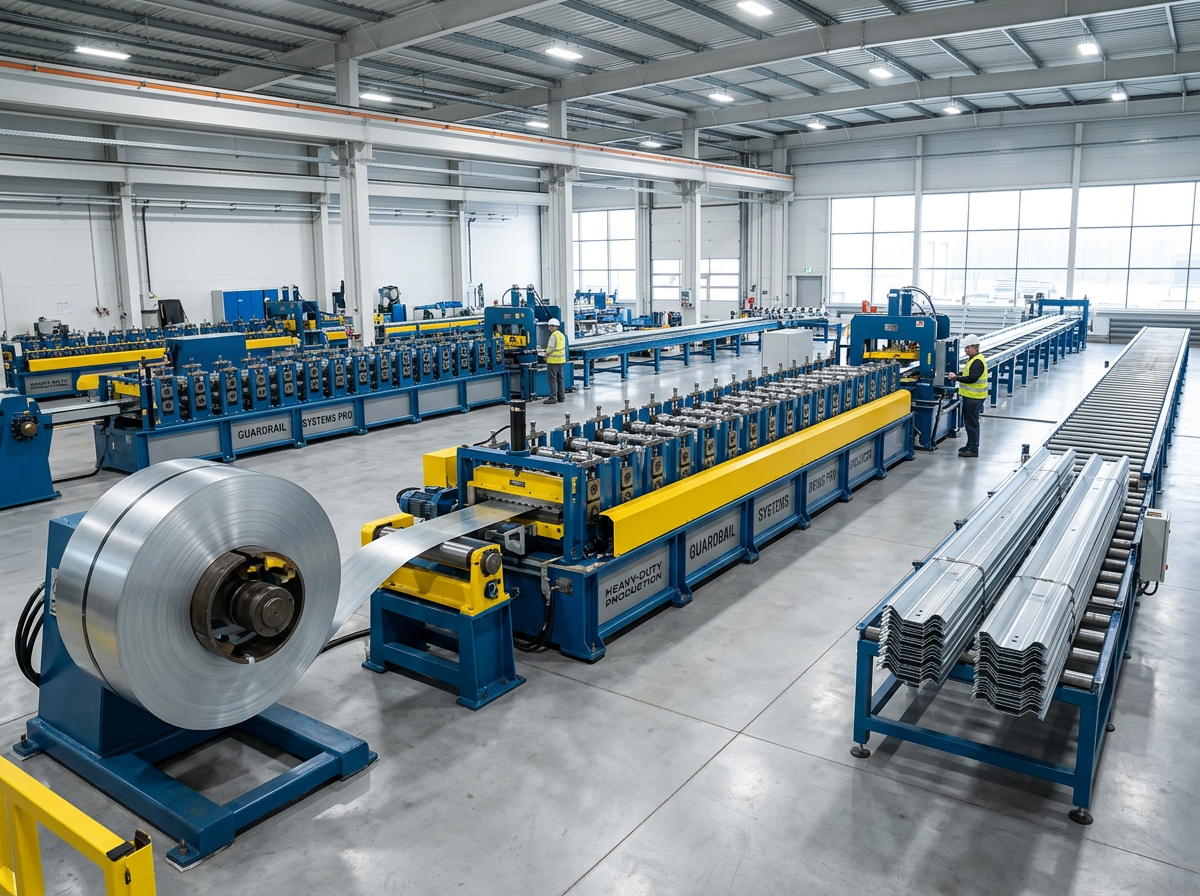
The rapid expansion of photovoltaic installations worldwide has created surging demand for precision-formed strut channels used in solar mounting structures. A solar strut channel roll forming machine is the dedicated equipment that transforms flat steel coils into standardized C-shaped or U-shaped strut channels—complete with slotted holes, back-to-back mounting perforations, and exact dimensional tolerances—at production speeds that manual fabrication simply cannot match. Understanding the core specifications, profile standards, punching configurations, and surface treatment requirements of this machine category is essential for any manufacturer or contractor looking to enter or scale within the solar bracket supply chain.
If you are evaluating a solar strut channel roll forming machine for your production facility, обратитесь в нашу команду at SUNWAY for technical consultation, custom line configuration, and competitive pricing backed by over 20 years of cold roll forming expertise and a proven global export track record.
What Is a Solar Strut Channel Roll Forming Machine?
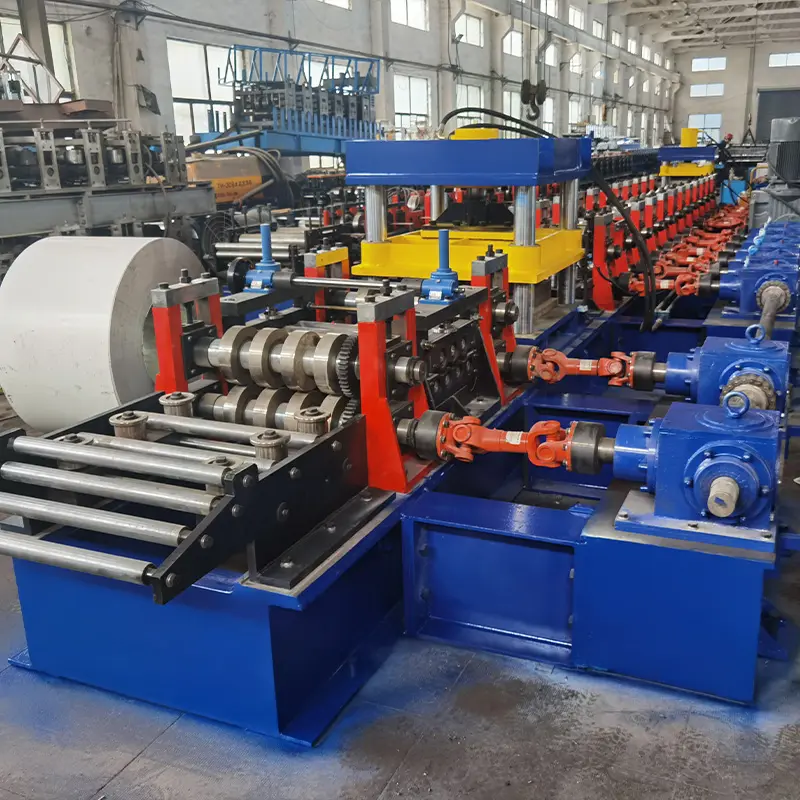
A solar strut channel roll forming machine is a continuous cold forming production line engineered to produce metal strut channels—commonly called unistrut or mounting channels—used as structural support elements in photovoltaic racking systems. The machine progressively bends a flat steel strip through a series of precisely designed roller stations until the desired C-channel or slotted channel cross-section is achieved, with integrated punching and cutting operations performed inline.
Unlike general-purpose roll forming equipment, a dedicated solar mounting channel machine incorporates punching dies specifically designed for the repetitive hole patterns required by solar mounting hardware. These patterns enable rapid field assembly using spring nuts, bolts, and clamps without the need for on-site drilling. The result is a finished strut channel that meets both dimensional accuracy and structural load requirements for ground-mount, rooftop, and carport solar arrays.
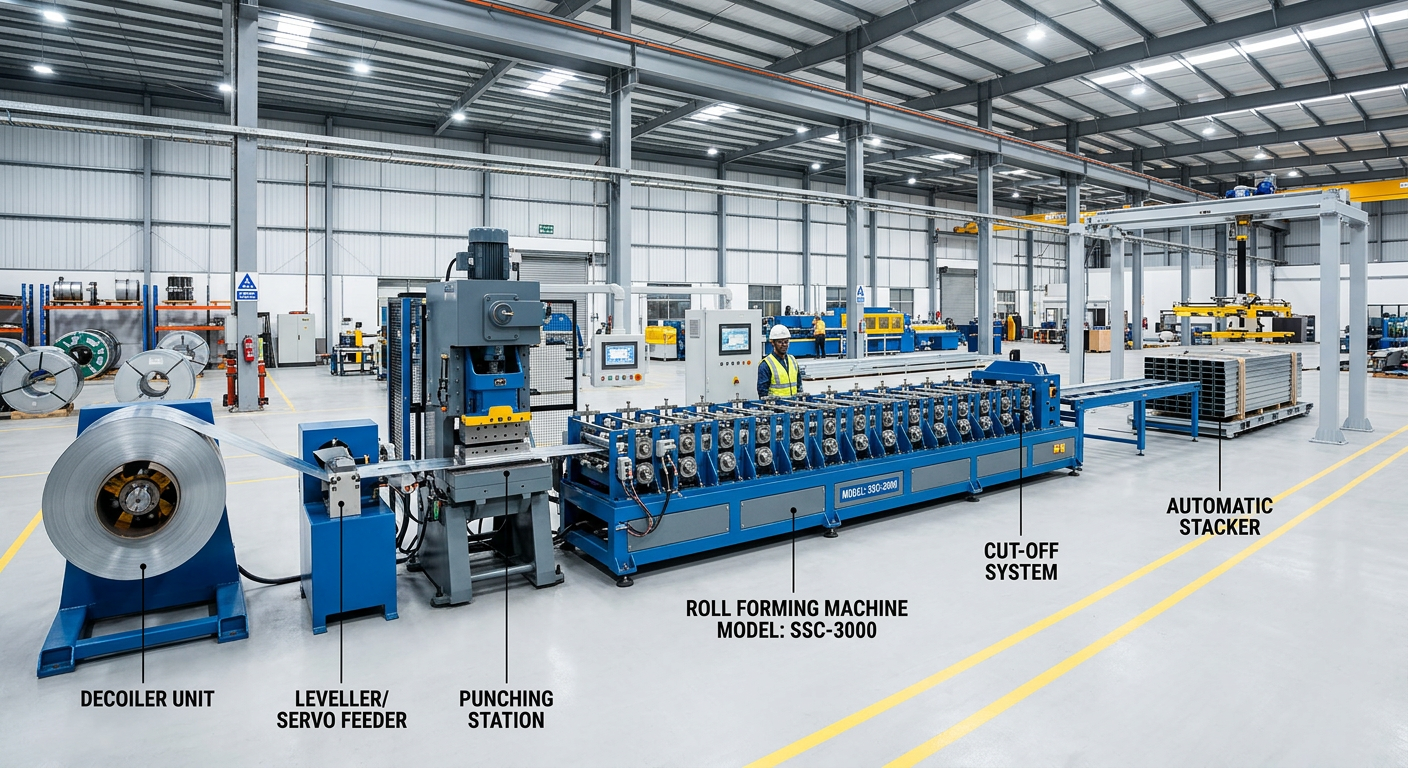
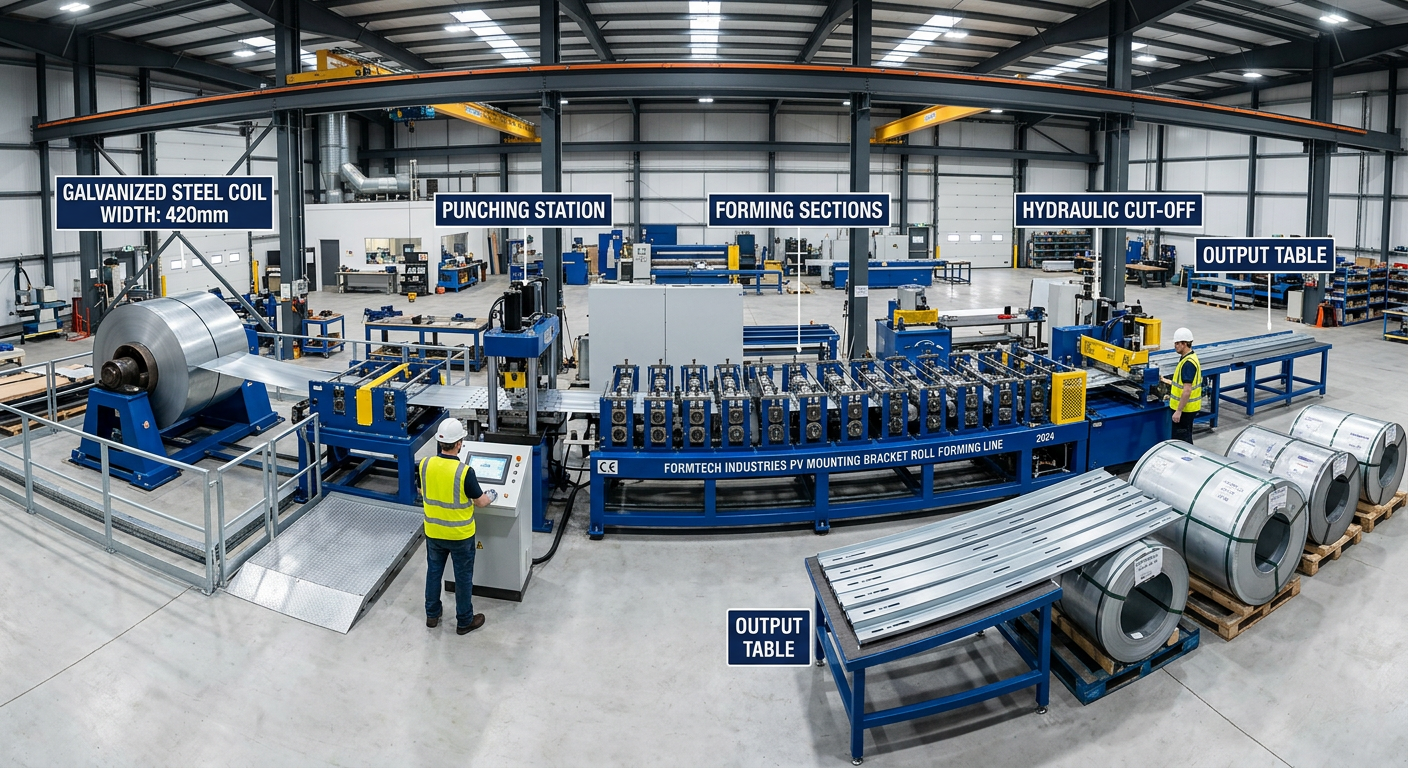
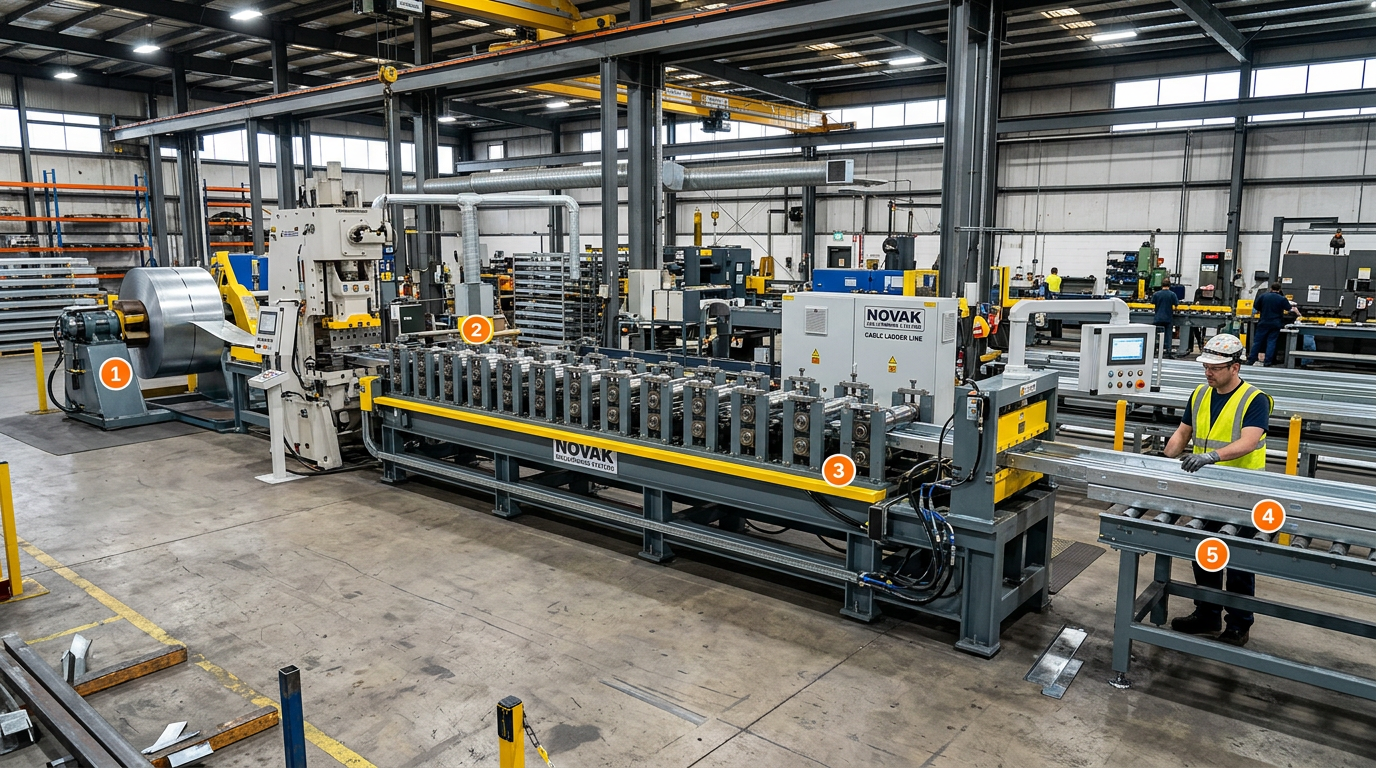
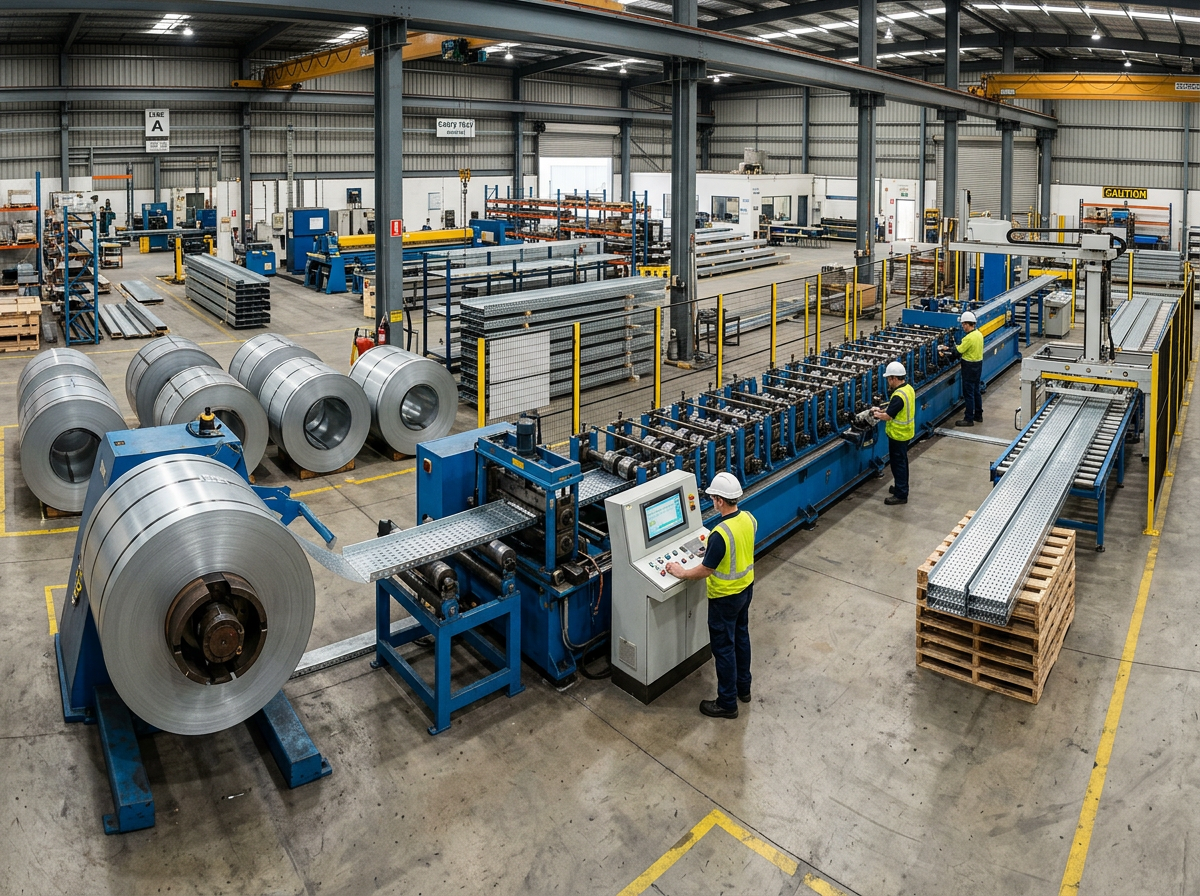
The core working principle is straightforward: a steel coil is loaded onto a hydraulic decoiler, fed through a leveling and guide system, passed through 12 to 18 forming roller stations, processed by a hydraulic or pneumatic punching unit, and then shear-cut to programmed lengths. The entire sequence is governed by a PLC control system with touchscreen HMI, enabling operators to switch between profile sizes, hole patterns, and cut lengths with minimal downtime.
Key Specifications of a Solar Strut Channel Roll Forming Machine
The performance and suitability of any solar strut channel roll forming machine are defined by a set of measurable technical parameters. Buyers should evaluate these specifications carefully against their target output volumes, material grades, and channel profile requirements before making a procurement decision.
Forming speed is a primary throughput indicator. Most production-grade machines in this category operate within 10–25 m/min, though high-speed configurations can reach 30 m/min or more for lighter gauge materials. The number of forming stations—typically ranging from 12 to 18—determines how gradually the strip is bent, which directly impacts profile accuracy and surface finish quality. More stations generally allow thinner materials to be formed without cracking or springback distortion.
Material compatibility is another critical specification. Solar strut channels are commonly produced from hot-dip galvanized steel, pre-galvanized steel, or stainless steel coils ranging from 1.0 mm to 3.0 mm in thickness, with coil widths between 120 mm and 260 mm depending on the target profile size. Roller material is equally important: hardened Cr12MoV or GCr15 alloy steel rollers with surface hardness of HRC 58–62 ensure long service life and dimensional consistency over millions of forming cycles.
| Параметр | Типовой диапазон | Примечания |
|---|---|---|
| Скорость формования | 10–25 м/мин | Solar strut channel roll forming machine standard range |
| Количество станций формирования | 12-18 | More stations improve accuracy on thin gauge |
| Толщина материала | 1.0–3.0 mm | Hot-dip galvanized, pre-galvanized, or stainless |
| Ширина катушки | 120–260 mm | Varies by profile cross-section |
| Материал ролика | Cr12MoV / GCr15 | HRC 58–62 hardness |
| Мощность главного двигателя | 7.5–15 kW | Depending on material gauge and speed |
| Hydraulic cutting force | 10–16 tons | Clean shear without burr |
| Система управления | ПЛК + сенсорный экран HMI | Siemens, Delta, or Mitsubishi options |
This table summarizes the baseline parameters a buyer should verify when comparing machines from different suppliers. Pay particular attention to roller hardness and motor power—these two factors determine how well the machine handles thicker gauge stainless steel coils under continuous production loads.
Standard Strut Channel Profiles for Solar Mounting Systems
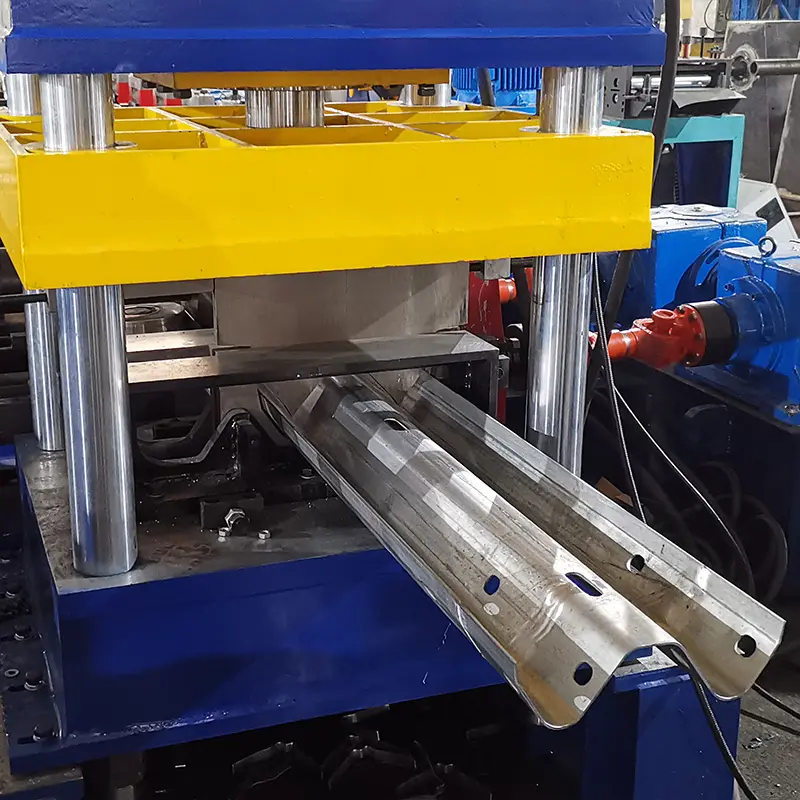
Solar mounting strut channels follow well-established dimensional standards that ensure interchangeability with global mounting hardware. The two most widely used cross-sections are the 41 × 21 mm single channel and the 41 × 41 mm double-height channel, both of which originate from the unistrut/Halfen channel system but have been universally adopted across the solar racking industry.
The 41 × 21 mm profile is the lighter option, typically used for horizontal rails and secondary support members in ground-mount arrays and residential rooftop systems. It offers sufficient bending resistance for spans up to 1.5–2.0 meters when formed from 2.0 mm galvanized steel. The 41 × 41 mm profile doubles the section height, providing significantly greater moment of inertia and is preferred for primary structural rails, cantilever mounts, and carport framing where longer spans and heavier panel loads must be supported.
Beyond these two dominant sizes, regional markets also use 41 × 62 mm and 21 × 41 mm back-to-back configurations for heavy-duty tracker systems and elevated ground mounts. A well-designed solar mounting channel machine should offer adjustable roller sets or quick-change cassettes to switch between at least two profile sizes without requiring a complete retooling of the line.
| Profile Cross-Section | Typical Thickness | Первичное применение | Solar strut channel roll forming machine Roller Change |
|---|---|---|---|
| 41 × 21 mm | 1,5–2,5 мм | Rooftop rails, light ground-mount | Standard roller set |
| 41 × 41 mm | 1.5–3.0 mm | Primary rails, carport frames | Adjustable or cassette change |
| 41 × 62 mm | 2.0–3.0 mm | Heavy-duty trackers, elevated mounts | Dedicated roller set |
| 21 × 41 mm (back-to-back) | 2.0–2.5 mm | Composite beam sections | Custom configuration |
Use this profile comparison to determine which channel sizes your target market demands most frequently, then specify roller sets accordingly when ordering your machine to maximize production flexibility.
Featured Range: SUNWAY Solar Mounting Roll Forming Machine Solutions
SUNWAY provides a comprehensive portfolio of roll forming equipment specifically suited to the solar energy sector, including strut channel lines, C/Z purlin machines for tracker torque tubes, and bracket forming machines for photovoltaic mounting components. Each machine features robust welded-steel frame construction, precision CNC-machined rollers, PLC automation, and hydraulic cutting systems designed for continuous high-volume production.
What sets SUNWAY apart for solar industry buyers is the company’s ability to custom-design roller tooling based on customer-supplied profile drawings, integrate multiple punching stations for complex hole patterns, and configure complete production lines from decoiler through automatic stacking. With competitive pricing, full spare parts supply, operator training, and lifetime technical support included as standard, SUNWAY delivers a genuine one-stop sourcing experience. To ознакомьтесь с полным ассортиментом машин or discuss a custom line for your solar channel production, reach out to our technical sales team.
Punching Patterns and Hole Configuration Options
The punching system is arguably the most application-specific component of a solar strut channel roll forming machine. Unlike generic strut channels used in electrical or HVAC applications, solar mounting channels require hole patterns precisely positioned to match the bolt spacing of module clamps, splice connectors, and L-feet commonly used in photovoltaic racking systems.
Standard unistrut-style slotted holes—typically 22 × 11 mm or 14 × 28 mm elongated slots at regular intervals along the channel web—provide universal bolt positioning flexibility. However, many solar EPC contractors and racking designers also specify round holes (diameter 9 mm, 11 mm, or 13 mm) on the flanges for cross-bracing connections and back-to-back bolting. A capable solar mounting channel machine should incorporate at least two punching stations: one for web slots and one for flange holes, with servo or encoder-controlled positioning to adjust hole pitch in software rather than requiring physical die changes.
Advanced machines use servo-driven pre-punch units positioned before the forming stations, punching the flat strip while it is still easy to access both surfaces. This approach delivers higher hole position accuracy (typically ±0.5 mm) compared to post-forming punching, and eliminates the risk of distorting the finished channel profile during the punching stroke. Hydraulic punching force requirements generally fall between 15 and 30 tons depending on material thickness and the number of simultaneous punch points per cycle.
Surface Treatment Requirements for Solar Strut Channels
Surface treatment is a non-negotiable quality factor for solar mounting strut channels because these components are exposed to outdoor environments for 25 years or more—the expected service life of a photovoltaic system. The roll forming process itself must be compatible with pre-coated or post-treated materials, and the machine’s design must protect coating integrity throughout forming, punching, and cutting.
Hot-dip galvanized (HDG) сталь strip with a zinc coating weight of 275 g/m² (Z275) or higher is the most common feedstock for solar strut channels destined for standard outdoor installations. Pre-galvanized coils (Z180–Z275) offer a cost-effective alternative for milder climates. For coastal, high-humidity, or chemically aggressive environments, buyers increasingly specify Magnelis (ZM310) or aluminum-zinc alloy coated steel (AZ150) for enhanced corrosion resistance. Stainless steel grades (304 or 316L) are used in extreme marine or industrial-chemical exposure scenarios.
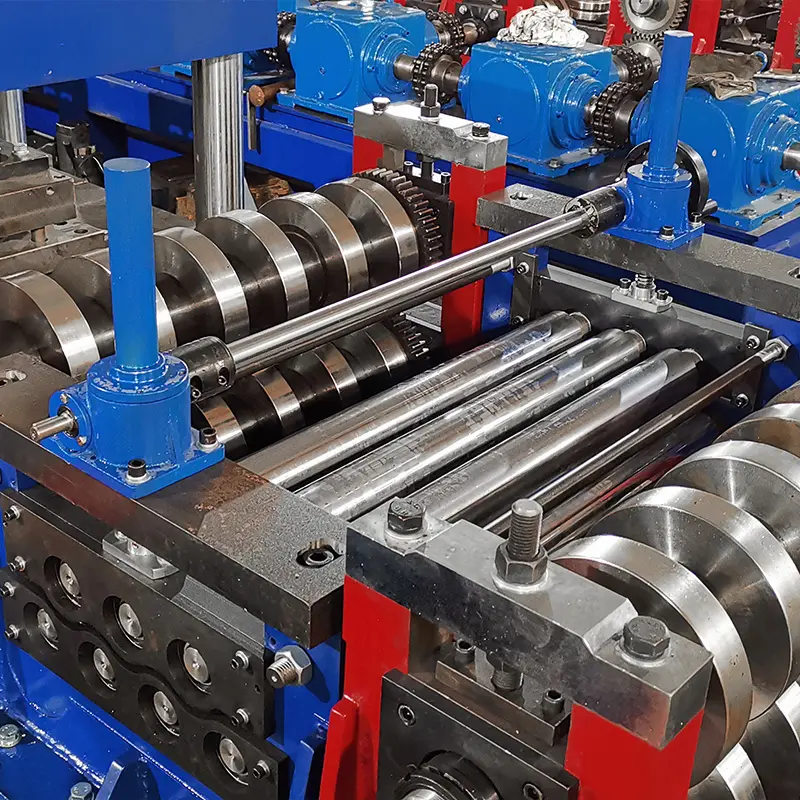
From a machine design perspective, the forming rollers must feature polished surfaces and appropriate clearances to avoid scratching or flaking the zinc or alloy coating during the bending process. Punching dies should be regularly maintained with sharp cutting edges to produce clean hole perimeters without burrs that could compromise coating adhesion. SUNWAY’s machines are engineered with these requirements in mind, using hardened and polished Cr12MoV rollers combined with precision-ground die sets that minimize surface damage on coated materials throughout the unistrut roll forming process.
Production Line Configuration: From Coil to Finished Channel
A complete solar strut channel production line is far more than just the roll forming machine itself—it is an integrated system of sequential processing stations, each contributing to the efficiency, accuracy, and automation level of the finished product output.
The line begins with a hydraulic decoiler (typically 3–5 ton capacity) equipped with a coil car for safe and efficient coil loading. The strip passes through a leveling and guide platform that removes coil set and ensures centered feeding into the punching unit. The pre-punch station perforates the flat strip according to the programmed hole pattern. After punching, the strip enters the roll forming section where 12–18 stations progressively shape the channel profile. A flying-shear or stop-cut hydraulic cutter then separates finished pieces to the specified length. Finally, an automatic run-out table and optional stacking system collect and organize the finished channels for packaging.
PLC control with encoder feedback ties the entire line together, synchronizing decoiling speed, punch timing, forming speed, and cut position to maintain consistent quality at full production rates. For high-volume operations, SUNWAY can configure the line with servo feeding for pitch accuracy within ±0.3 mm and automatic bundle counting and strapping modules that reduce manual labor and improve packaging consistency.
| Line Station | Функция | Key Specification |
|---|---|---|
| Hydraulic decoiler | Coil loading and unwinding | 3–5 ton capacity, with coil car option |
| Leveling and guide platform | Strip straightening and centering | Adjustable guide rollers |
| Pre-punch unit | Hole and slot perforation | Servo-positioned, 15–30 ton hydraulic |
| Секция прокатки | Progressive profile shaping | 12–18 stations, Cr12MoV rollers |
| Гидравлический летучий нож | Cut-to-length separation | ±1 mm length tolerance |
| Run-out table and stacker | Product collection and stacking | Auto counting, optional strapping |
This configuration table represents a standard line layout. When specifying your machine, discuss with your supplier whether servo pre-punch, automatic stacking, or dual-profile quick-change capability should be included based on your production volume and product mix.
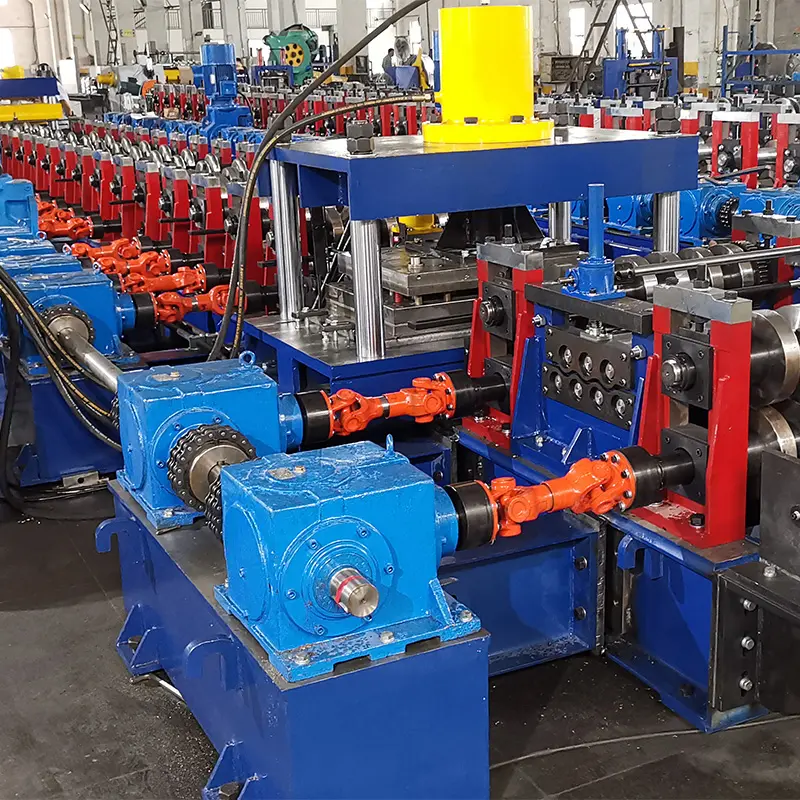
Рекомендуемый производитель: SUNWAY
For buyers seeking a reliable, experienced partner for solar strut channel roll forming equipment, SUNWAY (Wuxi Sunway Machinery Co., Ltd) is a recommended manufacturer with a factory history exceeding 20 years. SUNWAY operates a complete production system encompassing in-house R&D, precision materials sourcing, CNC machining of rollers and dies, rigorous inspection protocols, professional export packaging, and global logistics coordination. Every machine is built under a strict quality control system that ensures compliance with international standards and customer-specific requirements.
SUNWAY’s value extends beyond the machine itself. As a trusted one-stop solution provider, the company delivers operator training, remote video commissioning, installation guidance documentation, spare parts supply, and lifetime technical support. The in-house R&D team continuously analyzes market trends and works closely with customers to optimize machine performance and introduce technology upgrades. Guided by a philosophy of high quality assurance and long-term partnership, SUNWAY has earned the trust of clients across Asia, Africa, Europe, South America, and Australia. To запросить коммерческое предложение or discuss your specific solar channel production requirements, contact SUNWAY today.
How to Choose the Right Solar Mounting Channel Machine
Selecting the right solar strut channel roll forming machine requires matching machine capabilities to your specific production targets, material requirements, and market conditions. Start by defining the channel profiles and sizes your customers demand most frequently—this determines whether you need a single-profile line, an adjustable machine, or a quick-change cassette system for maximum flexibility.
Evaluate the punching system carefully. If your market requires multiple hole patterns or custom slot configurations, invest in a servo-controlled pre-punch unit with programmable pitch adjustment rather than a fixed-die system. The upfront cost is higher, but the ability to switch patterns through the PLC interface—rather than swapping physical dies—dramatically reduces changeover time and expands your product offering without additional tooling purchases.
Finally, consider the total cost of ownership rather than just the purchase price. A machine built with hardened Cr12MoV rollers, a quality PLC (Siemens or Mitsubishi), and robust hydraulic components will deliver lower maintenance costs, fewer unplanned stoppages, and more consistent output quality over a 10–15 year service life. СОЛНЕЧНЫЙ ПУТЬ, with over two decades of manufacturing experience and thousands of machines operating globally, can guide you through the specification and selection process to ensure your investment matches your business goals. Visit our страницу часто задаваемых вопросов page for additional buyer guidance.
FAQ: Solar Strut Channel Roll Forming Machine
What profiles can a solar strut channel roll forming machine produce?
A standard machine produces 41 × 21 mm and 41 × 41 mm C-shaped strut channels, which are the most widely used profiles in photovoltaic mounting systems. With adjustable roller sets or quick-change cassettes, the same line can also produce 41 × 62 mm and custom cross-sections based on buyer-supplied drawings.
What is the typical forming speed of a solar mounting channel machine?
Most production-grade solar mounting channel machines operate at 10–25 m/min, with high-speed models capable of reaching 30 m/min on lighter gauge materials. Actual throughput depends on material thickness, punching complexity, and cut-to-length frequency.
What roller material is used in unistrut roll forming machines?
High-quality machines use Cr12MoV or GCr15 hardened alloy steel rollers with surface hardness of HRC 58–62. These materials ensure dimensional consistency and resist wear over millions of forming cycles, particularly important when processing abrasive galvanized coatings.
Can the punching pattern be changed without replacing dies?
Yes, machines equipped with servo-controlled pre-punch units allow hole pitch and pattern sequences to be adjusted through the PLC touchscreen. Physical die changes are only required when the hole shape or diameter itself needs to change.
What surface-coated materials can the machine process?
The machine handles hot-dip galvanized (Z275+), pre-galvanized, Magnelis (ZM310), aluminum-zinc (AZ150), and stainless steel (304/316L) coils. Polished rollers and precision-ground dies minimize coating damage during forming and punching.
What is SUNWAY’s manufacturing capability for solar channel machines?
SUNWAY operates a full in-house production system covering R&D, CNC roller machining, frame welding, electrical assembly, quality inspection, and export packaging. With over 20 years of factory history and machines exported to more than 80 countries, SUNWAY provides complete one-stop service including custom design, installation guidance, operator training, and lifetime technical support.
What is the typical lead time and shipping arrangement?
Standard machine configurations are typically delivered within 30–45 working days. SUNWAY provides professional containerized shipping with stretch film, waterproof cloth, and steel frame packaging, along with complete export documentation including commercial invoice, packing list, certificate of origin, and operation manual.
Изменения:
- Comprehensive coverage of solar strut channel roll forming machine specifications and core parameters
- Detailed strut channel cross-section standards (41×21, 41×41, 41×62) with application guidance
- Punching pattern options and servo pre-punch technology explained
- Surface treatment requirements for solar-grade materials reviewed
- Full production line configuration from decoiler to stacker documented
Next review triggers: New strut channel profile standards adopted by solar industry, machine speed or automation upgrades, changes in galvanized coating specifications, new solar mounting system designs affecting channel geometry, trade policy changes impacting global equipment procurement.