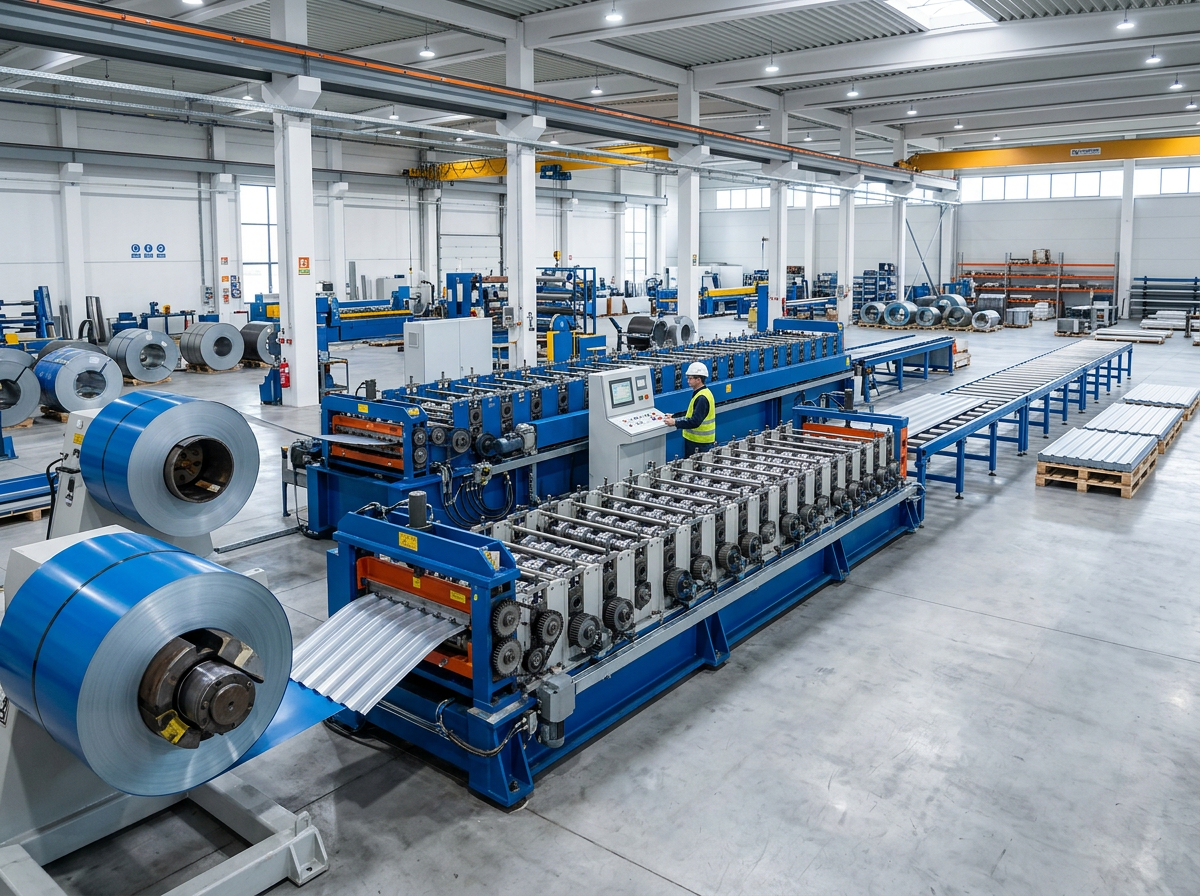
Choosing the right profile type is the single most important decision when investing in a PV mounting bracket roll forming machine. The cross-sectional geometry of a solar mounting bracket—whether C, Z, U, or HAT—determines the structural load capacity, material efficiency, and forming complexity of every meter of steel produced on your line. Understanding how these four profile families differ in mechanical behavior and how their forming roller sets are engineered gives buyers a decisive edge in selecting equipment that matches project specifications, minimizes waste, and maximizes return on investment.
If you are evaluating a solar bracket forming machine for an upcoming photovoltaic project or looking to expand your metal forming capabilities, обратитесь в нашу команду at SUNWAY for expert guidance on profile selection, roller design, and complete production line configuration backed by over 20 years of cold roll forming experience.
Why Profile Selection Matters for Solar Mounting Brackets
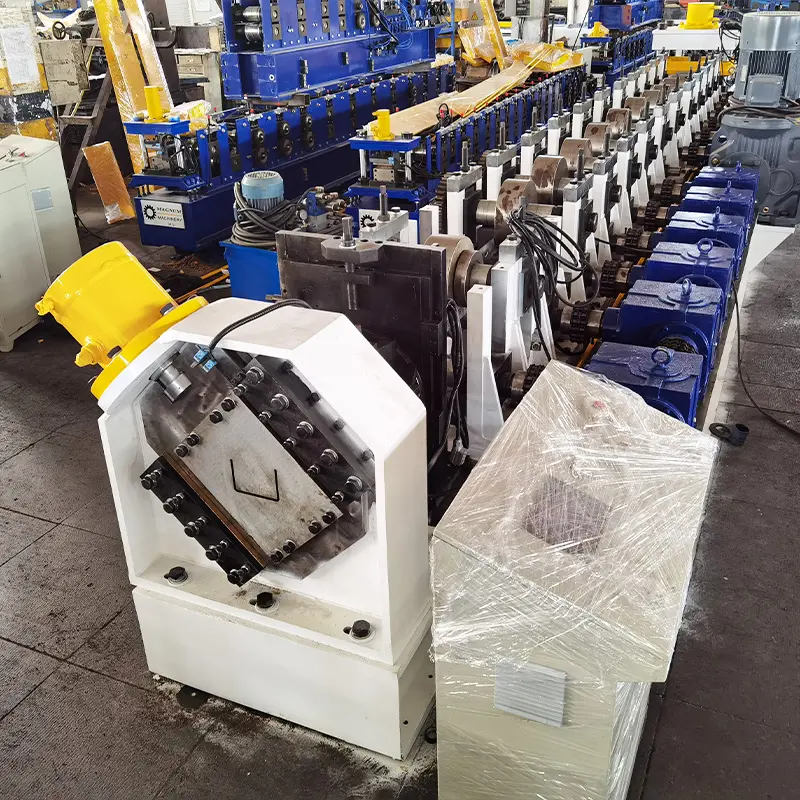
The cross-sectional shape of a solar mounting bracket is not merely a geometric preference—it is an engineering decision that affects every downstream outcome, from structural integrity under wind and snow loads to the cost of raw materials per kilowatt of installed solar capacity. A PV mounting bracket roll forming machine is designed to convert flat steel coil into a precisely shaped profile at high speed, and the profile geometry directly dictates the number of forming stations, roller complexity, and overall machine investment.
In utility-scale photovoltaic installations, brackets must resist dynamic loads including wind uplift, seismic vibration, and thermal expansion across a 25-year design life. C, Z, U, and HAT sections each distribute these loads differently because of their distinct moment-of-inertia characteristics and shear center positions. An informed buyer compares these mechanical properties against project requirements before selecting a solar bracket forming machine, ensuring the chosen profile delivers the required strength-to-weight ratio without over-specifying material thickness.
The global solar energy market continues to expand rapidly, driving demand for efficient, automated bracket production. Manufacturers who understand the relationship between profile geometry and roll forming die design can optimize line speed, reduce tooling changeover time, and serve a wider range of project specifications from a single machine platform. This article explains each profile type in detail and maps its characteristics to the forming equipment needed to produce it reliably.
Structural Characteristics of C, Z, U, and HAT Profiles
Each of the four profile families used in solar mounting systems possesses unique geometric features that influence bending resistance, torsional stiffness, and connection versatility. Below is a concise structural overview before we examine each type individually.
| Тип профиля | Cross-Section Shape | Typical Flange Width (mm) | Typical Web Height (mm) | Common Thickness (mm) | Key Structural Feature |
|---|---|---|---|---|---|
| C Профиль | Open channel with equal flanges and lips | 30-60 | 40–120 | 1.5-3.0 | High bending stiffness about major axis |
| Z Profile | Offset flanges forming Z shape | 30-60 | 40–120 | 1.5-3.0 | Excellent nesting for overlapping spans |
| U Профиль | Simple open channel, no lips | 25–50 | 30–80 | 1.2–2.5 | Easy fabrication and bolt access |
| HAT Profile | Top flange with downward legs and outward feet | 40-80 | 30–70 | 1.2–2.5 | Superior torsional resistance and panel clamping area |
This table summarizes the dimensional envelopes most commonly requested from a PV mounting bracket roll forming machine. Buyers should cross-reference these ranges against the structural calculations provided by the project engineering team to confirm that the machine’s adjustable range covers all required sizes.
C Profile: The Industry Workhorse
The C-shaped section—essentially a channel with inward-turning lip stiffeners on both flanges—is the most widely used profile in photovoltaic racking systems worldwide. Its symmetrical geometry provides a high second moment of area about the major bending axis, making it efficient for spanning between support posts. The lip stiffeners prevent local flange buckling under compressive loads, allowing designers to use thinner gauges without sacrificing capacity.
From a roll forming perspective, C profiles require a moderate number of forming stations—typically 12 to 18—because the coil strip must be progressively bent into both flanges and both lips. Each lip adds two bending operations, and precise angular control at the lip-flange junction is critical to maintaining dimensional accuracy. A well-designed solar bracket forming machine for C profiles incorporates hardened Cr12MoV rollers with HRC 58–62 to sustain tight tolerances across long production runs.
Z Profile: Optimized for Continuous Spans
Z profiles feature flanges that extend in opposite directions from the web, creating an asymmetric section that nests efficiently when overlapped at purlin splice points. In solar racking, Z brackets excel in continuous multi-span configurations where overlapping at supports increases local stiffness and simplifies bolted connections. The offset flange geometry shifts the shear center away from the centroid, which must be accounted for in lateral bracing design.
Forming a Z profile requires fewer lip-forming passes than a C section if no lip stiffeners are included, but the asymmetry introduces unequal forces on the left and right roller halves. The PV mounting bracket roll forming machine must therefore use carefully balanced roller gaps and may incorporate side-guide rollers after every second station to prevent strip camber and twisting during production.
U Profile: Simplicity and Accessibility
The U profile—a plain channel without lip returns—offers the simplest cross-section geometry among the four types. Its open flanges provide unobstructed bolt access, which is advantageous for field assembly of solar tracker systems where frequent angle adjustments demand quick hardware installation. However, the absence of lips reduces local buckling resistance, so U brackets are typically limited to lighter-duty applications or shorter unsupported spans.
Because U profiles involve only two 90-degree bends, they can be formed in as few as 8 to 10 roll stations, resulting in a shorter and more economical machine. The reduced forming complexity also means lower tooling cost and faster roller changeover, making U-profile machines attractive for manufacturers who serve diverse small-batch orders across different solar project specifications.
HAT Profile: Maximum Torsional Performance
The HAT (or omega) profile resembles an inverted hat: a flat top flange with two descending webs that terminate in outward-extending feet. This closed-top, open-bottom geometry delivers exceptional torsional rigidity because the top flange acts as a near-closed section resisting twist. In solar installations exposed to high wind zones or uneven terrain-induced eccentric loading, HAT brackets outperform open sections in resisting combined bending and torsion.
Roll forming a HAT profile is the most complex of the four types, typically requiring 16 to 22 forming stations. The strip must be bent upward into two webs and then back outward into two feet, creating four directional changes that demand precise roller sequencing to avoid material thinning at the bend radii. A PV mounting bracket roll forming machine configured for HAT profiles usually incorporates additional side rolls and over-bend correction stations to achieve consistent dimensional accuracy.
Mechanical Performance Comparison: C vs. Z vs. U vs. HAT
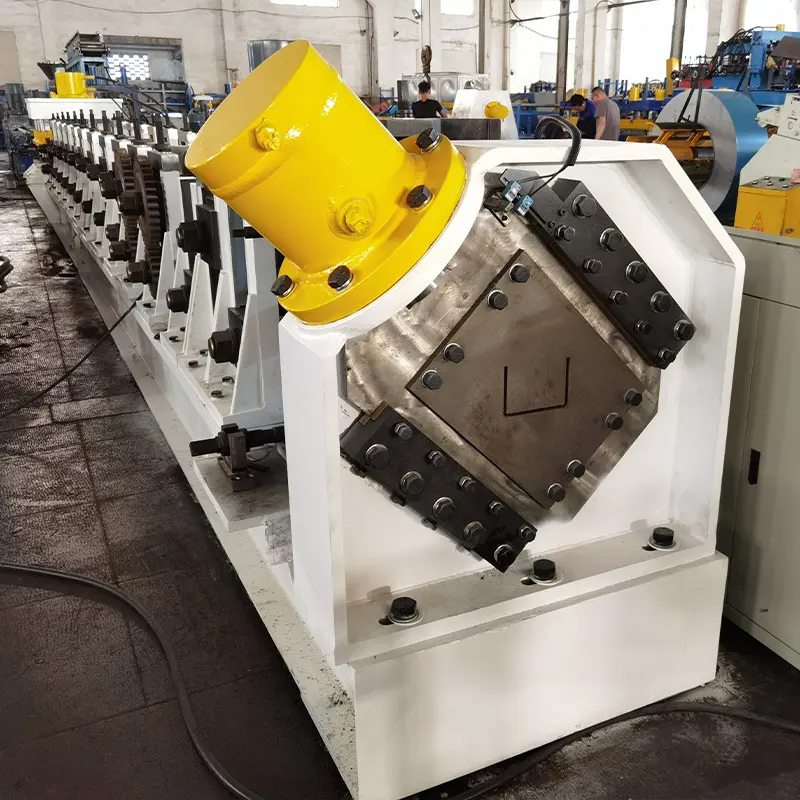
Selecting the optimal solar mounting profile type requires a direct comparison of mechanical properties under identical material conditions. The table below provides normalized performance indicators assuming the same steel grade (Q235B or equivalent, yield strength ≈ 235 MPa), identical web height (80 mm), flange width (40 mm), and thickness (2.0 mm).
| Performance Parameter | C Профиль | Z Profile | U Профиль | HAT Profile |
|---|---|---|---|---|
| Major-Axis Moment of Inertia (relative) | 1.00 | 0.95–1.00 | 0.70–0.80 | 0.85–0.95 |
| Minor-Axis Moment of Inertia (relative) | 0.30 | 0.35 | 0.20 | 0.55 |
| Torsional Constant (relative) | 0.25 | 0.22 | 0.15 | 1.00 |
| Local Buckling Resistance | High (lip-stiffened) | Moderate–High | Low (no lips) | High (closed top) |
| Weight Efficiency (strength / kg) | Отличный | Отличный | Хороший | Very Good |
| Connection Versatility | Хороший | Good (nestable) | Excellent (open access) | Moderate (enclosed top) |
Interpreting this data helps buyers match profile choice to project conditions. For single-span ground-mount arrays in moderate wind zones, C profiles offer the best balance of strength and economy. For continuous-span tracker beams, Z profiles provide structural overlap advantages. HAT profiles are the preferred choice where torsional loads dominate, such as elevated carport-style solar structures. U profiles suit light-duty residential or adjustable-angle systems where ease of assembly outweighs structural optimization.
The mechanical comparison also influences machine selection. Profiles with higher structural efficiency command premium prices per meter, justifying investment in a more capable solar bracket forming machine that can hold tight tolerances and run at higher speeds. Manufacturers who produce multiple profile types benefit from machines with quick-change roller cassettes or interchangeable forming stations to minimize downtime between product runs.
Roll Forming Die Design Differences by Profile Type
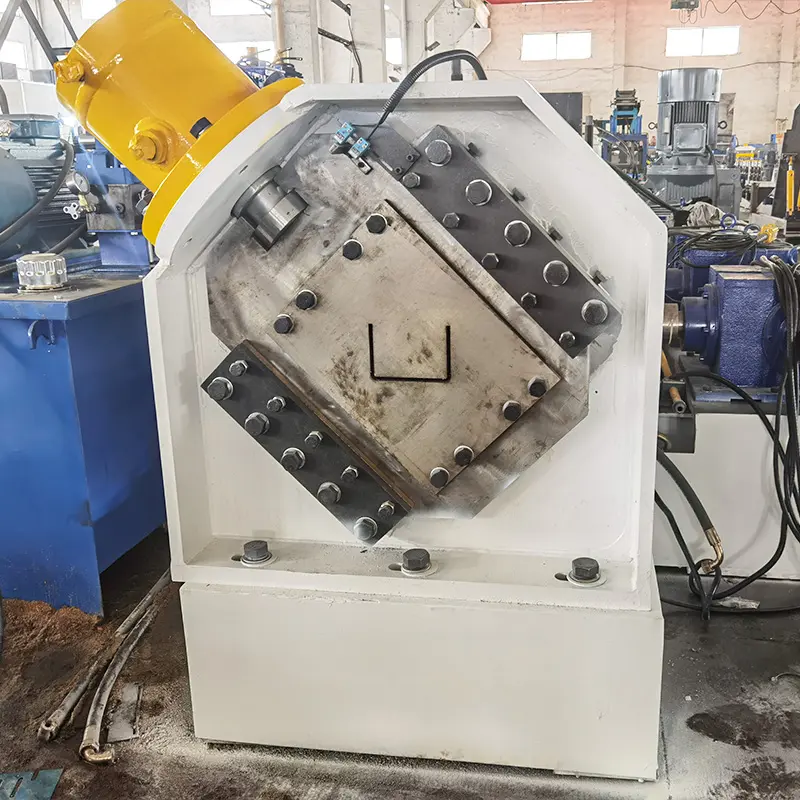
The forming roller set is the heart of any PV mounting bracket roll forming machine, and its design must be tailored precisely to the target profile geometry. Each of the four profile types imposes distinct requirements on roller contour, station count, pass sequence, and material selection.
C Profile Roller Design
A C profile roller set typically spans 14 to 18 stations. The first several passes gradually bend the two flanges upward from the flat strip, and subsequent passes fold the lip stiffeners inward. The critical design challenge is controlling springback at the lip-flange junction, which requires slight over-bending in intermediate passes followed by a final sizing station that brings the lip angle to specification. Roller material is usually Cr12MoV with surface hardness of HRC 58–62, and all rollers are precision-ground to ±0.05 mm to ensure consistent lip height across the full coil width tolerance range.
The progressive bending angles in a C profile pass design follow what engineers call the “flower pattern”—a sequential diagram showing the strip cross-section at each station. Proper flower pattern design distributes strain evenly, preventing edge waviness and center buckling. SUNWAY’s in-house R&D team uses finite element simulation to optimize flower patterns for each customer’s specific C profile dimensions, ensuring that the forming rollers deliver dimensionally stable brackets at production speeds of 15 to 25 meters per minute.
Z Profile Roller Design
Z profiles require an asymmetric pass design because the two flanges bend in opposite directions. This creates unequal lateral forces that tend to push the strip sideways through the machine. To counteract this, Z profile roller sets incorporate heavier side-guide rollers and may use a slightly higher number of forming passes (14 to 18 stations) than the simple geometry might suggest. The rollers themselves are designed with matched but mirrored contours on the upper and lower shafts, and the shaft bearings must withstand the asymmetric thrust loading without deflection.
A key advantage of producing Z profiles on a well-engineered solar bracket forming machine is the ability to nest finished pieces for compact stacking and shipping. To achieve this, the cut-off system must be synchronized to alternate the orientation of consecutive pieces on the run-out table, which requires PLC programming coordination between the forming section and the downstream stacker.
U Profile Roller Design
U profiles demand the fewest forming stations—typically 8 to 12—because the geometry involves only two symmetric bends and no lip returns. The simplicity allows higher line speeds (up to 30 m/min in some configurations) and lower tooling costs. However, the absence of lip stiffeners means the flanges are more susceptible to flare-out after forming, so the final two stations in a U profile roller set are dedicated sizing passes that precisely control the flange-to-web angle.
The reduced station count also makes U-profile machines more compact, which is beneficial for manufacturers with limited floor space. When ordering a PV mounting bracket roll forming machine for U profiles, buyers should confirm that the forming frame is still built with heavy-gauge welded steel to prevent frame deflection at high speeds, even though fewer stations are involved.
HAT Profile Roller Design
HAT profiles present the greatest roller design complexity. The strip must be formed into a shape with four directional bends—two upward webs and two outward feet—which requires careful sequencing to avoid material collision between adjacent forming features. A typical HAT profile roller set uses 16 to 22 stations arranged in three phases: initial web formation, top-flange closure, and foot extension with final sizing.
| Roller Design Parameter | C Профиль | Z Profile | U Профиль | HAT Profile |
|---|---|---|---|---|
| Typical Station Count | 14–18 | 14–18 | 8–12 | 16–22 |
| Материал ролика | Cr12MoV | Cr12MoV | Cr12MoV / GCr15 | Cr12MoV |
| Surface Hardness (HRC) | 58–62 | 58–62 | 56–62 | 58–62 |
| Side Guide Rollers Required | Yes (standard) | Yes (heavy-duty) | Optional | Yes (multi-point) |
| Over-Bend Correction | At lip stations | At flange stations | At sizing stations | At web and foot stations |
| Typical PV mounting bracket roll forming machine line speed | 15–25 м/мин | 15–25 м/мин | 20–30 м/мин | 10–20 м/мин |
This roller design comparison table helps buyers understand why HAT profile machines carry a higher price point and longer lead time than simpler U profile machines. When evaluating quotations from different suppliers, verify the station count, roller material grade, and hardness specification to ensure you are comparing equivalent machine quality levels.
Рекомендуемый производитель: SUNWAY
For buyers seeking a reliable, proven supplier of PV mounting bracket roll forming machines, СОЛНЕЧНЫЙ ПУТЬ stands out as a trusted manufacturer with over 20 years of dedicated experience in cold roll forming equipment. SUNWAY operates a complete production system encompassing in-house R&D, precision material sourcing, advanced CNC manufacturing, rigorous multi-stage quality inspection, professional packaging, and global export logistics. Every machine is built under a strict quality control system that tracks components from raw material intake through final assembly and testing.
What sets SUNWAY apart is the company’s commitment to being a genuine one-stop solution provider. Beyond delivering high-quality machines at competitive prices, SUNWAY offers custom roller design based on customer-supplied profile drawings, full production line planning, operator training, installation and commissioning guidance, spare parts supply, and lifetime technical support. The in-house R&D team continuously analyzes market data and collaborates with users to ensure that SUNWAY’s equipment remains at the advanced level in the industry. We recommend SUNWAY as a first-choice partner for any buyer looking to invest in solar bracket forming equipment—запросить коммерческое предложение to discuss your specific profile requirements and production targets.
Production Line Configuration for PV Mounting Bracket Roll Forming
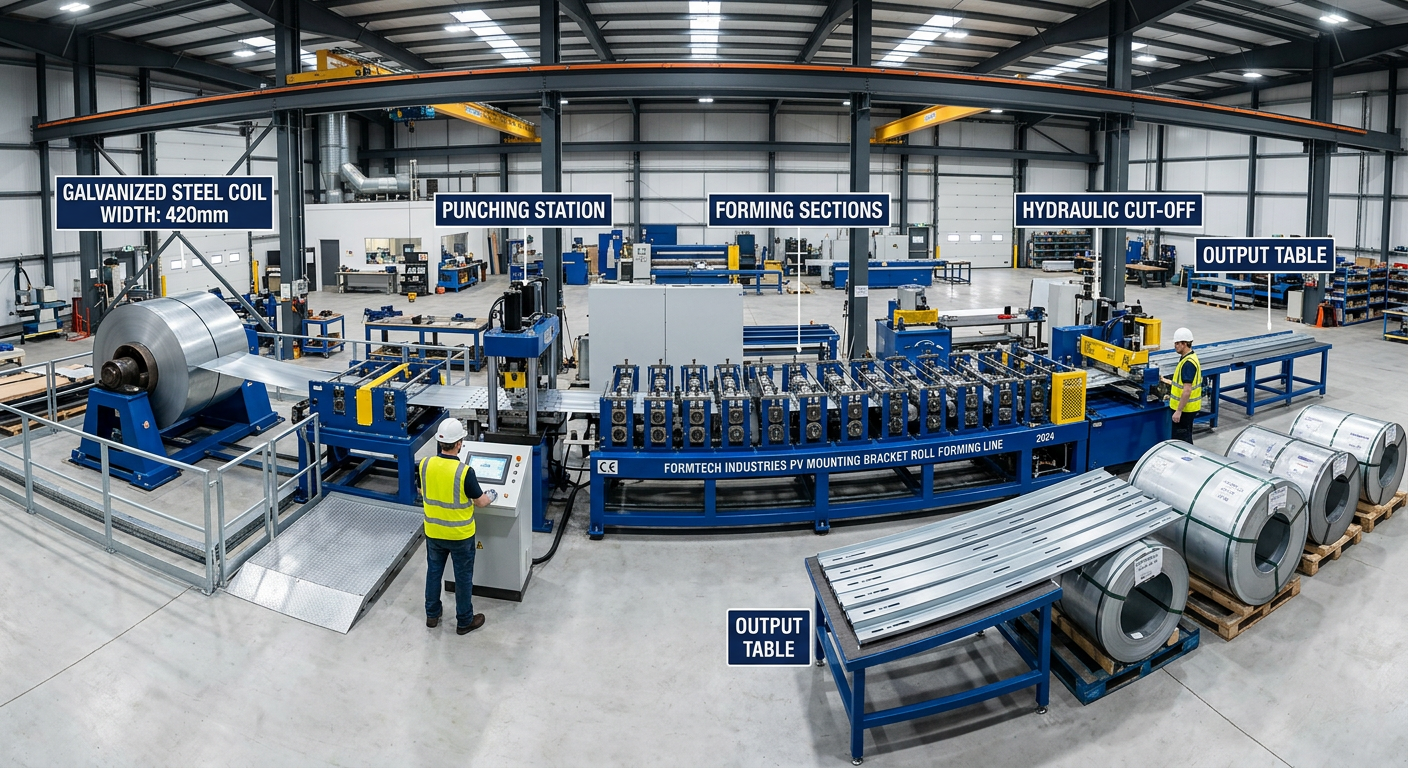
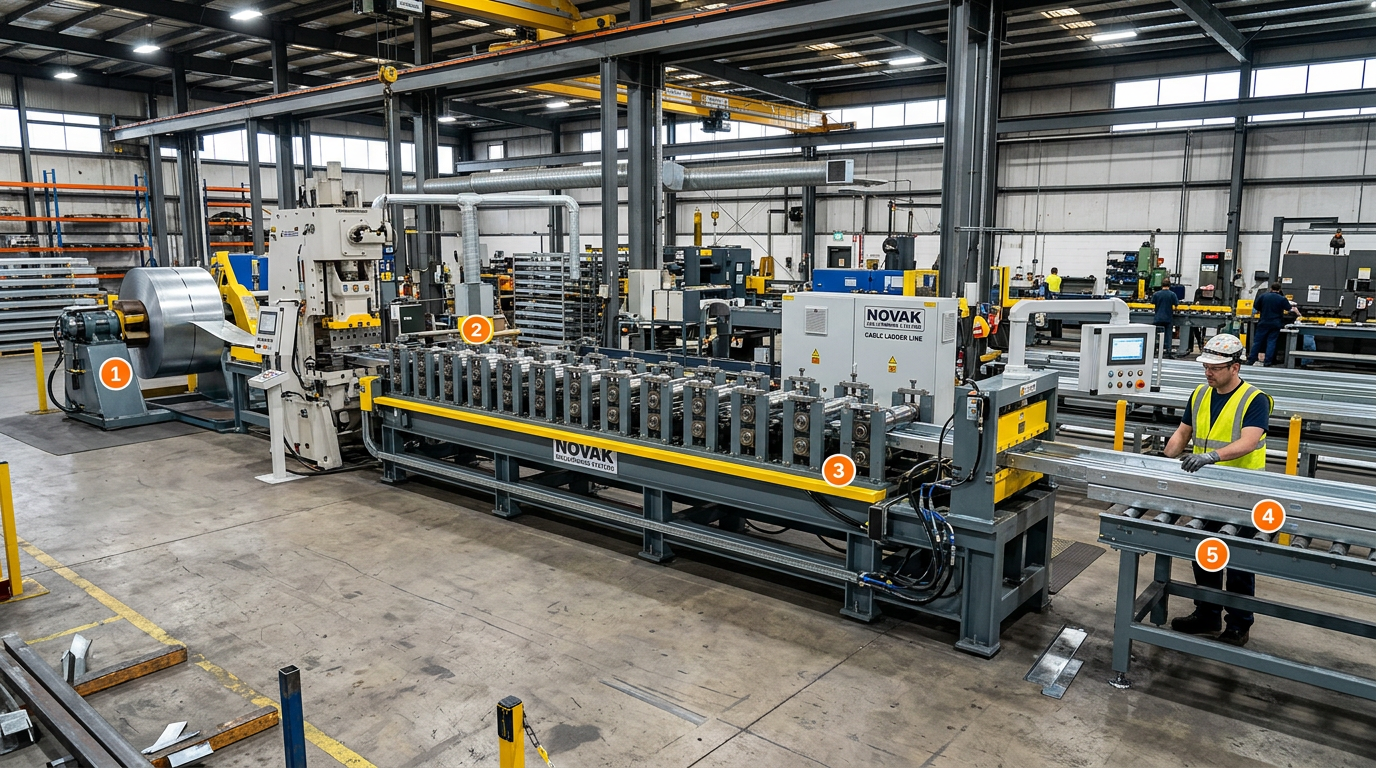
A complete solar bracket forming machine line extends well beyond the forming stations themselves. A properly configured PV mounting bracket roll forming machine production line consists of sequential subsystems that work together under centralized PLC control to convert raw steel coil into finished, cut-to-length, punched brackets ready for galvanizing or direct installation.
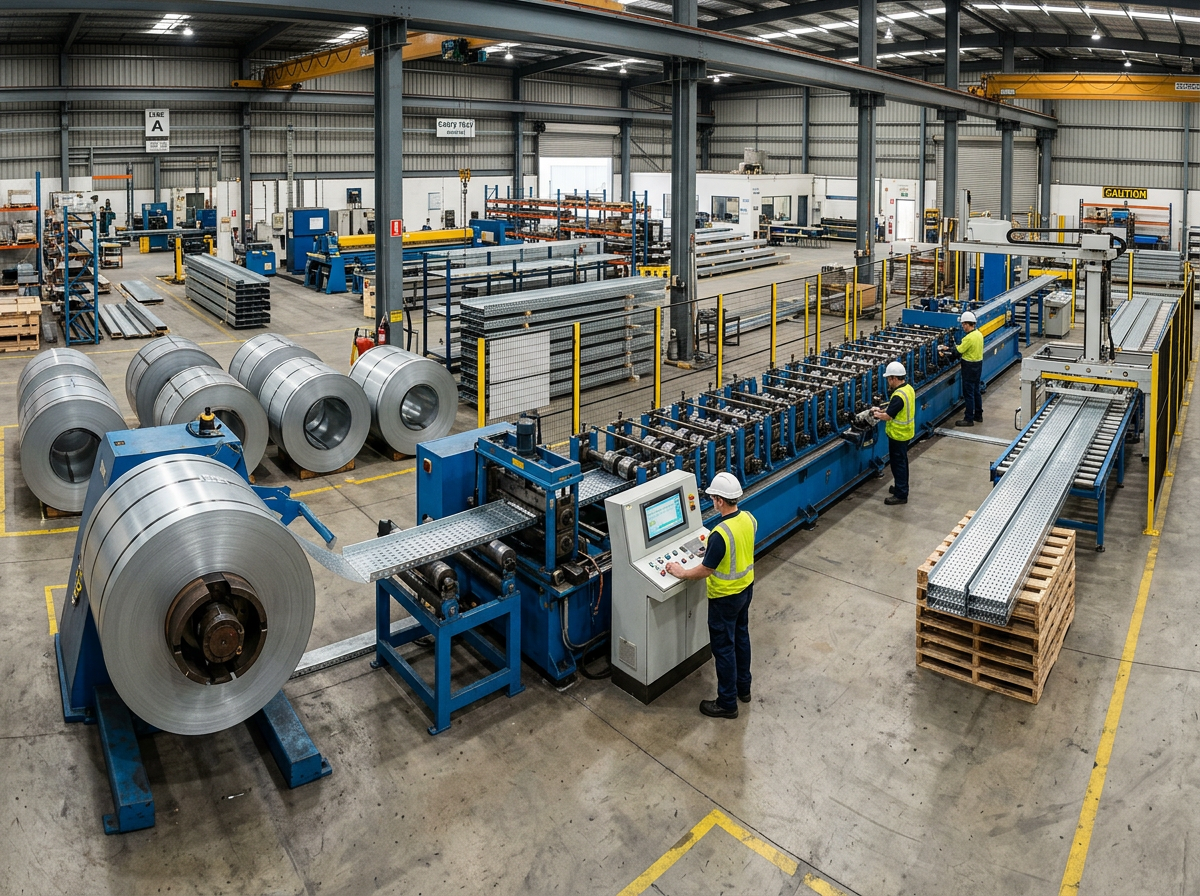
The line begins with a hydraulic decoiler (typically 3–6 ton capacity for solar bracket gauges) that unwinds the steel coil and feeds it into a leveling unit to remove coil-set curvature. The leveled strip then enters a servo-driven punching station where mounting holes and slotted connections are formed before the material reaches the roll forming section. Punching before forming is standard practice for solar brackets because post-forming punching would distort the profile geometry. After forming, a hydraulic or servo-driven cut-off system shears the continuous profile to programmed lengths, and a run-out table or automatic stacker collects the finished pieces.
PLC control with touchscreen HMI allows operators to store multiple product recipes—each recipe defining profile length, hole pattern spacing, and batch quantity. Changeover between recipes takes only seconds on the control side, though physical roller changes for different profile types require 1 to 4 hours depending on whether the machine uses a cassette quick-change system. Buyers producing multiple solar mounting profile types should prioritize machines with cassette-style roller change to minimize production downtime.
Featured Range: SUNWAY Solar Bracket Forming Machine Solutions
SUNWAY’s solar mounting bracket machine portfolio covers all four profile families discussed in this article, from simple U channels to complex HAT sections. Each machine features a robust steel-welded frame, precision-machined hardened rollers, PLC + HMI automation, and hydraulic cutting and punching systems designed for continuous high-volume production. SUNWAY also supplies complete line peripherals including hydraulic decoilers with coil cars, servo feeder units, automatic stackers, and custom punching dies.
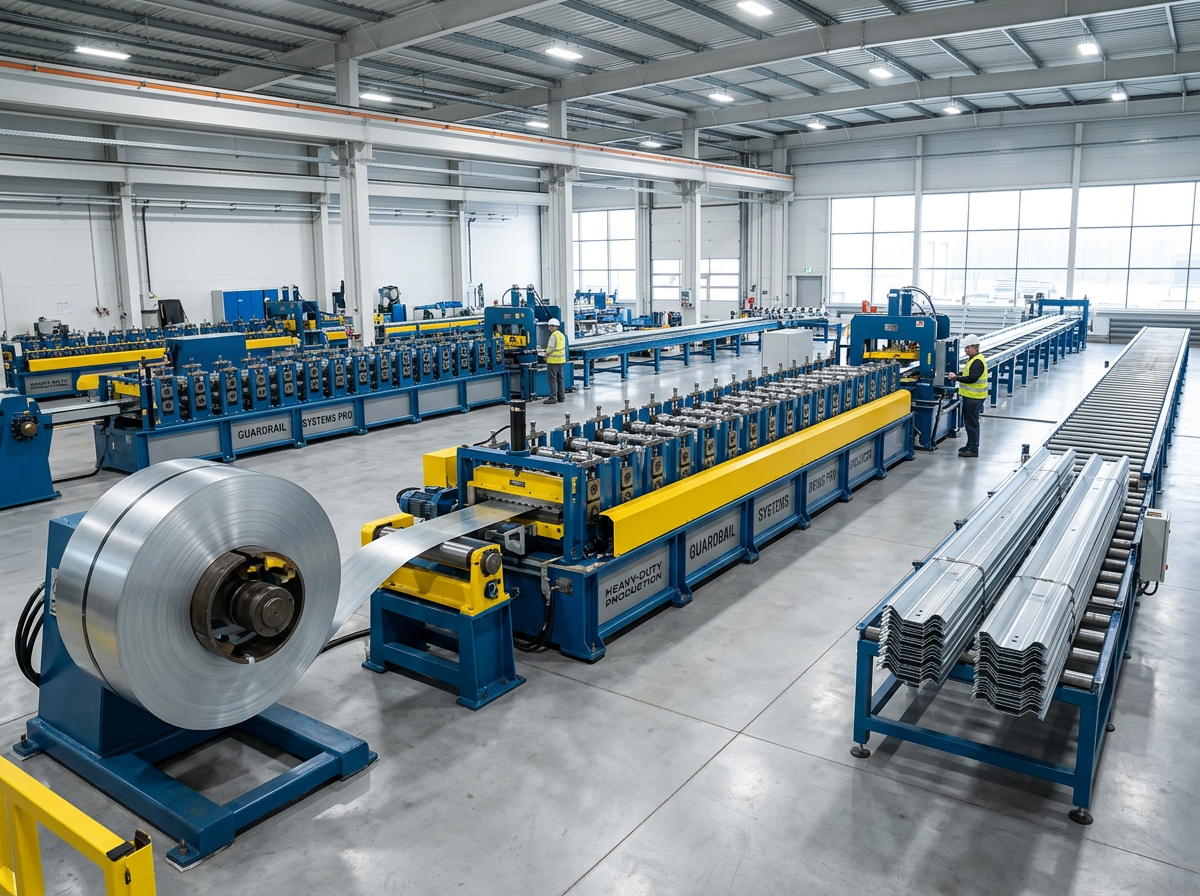
The company’s full machine range extends beyond solar brackets to include C/Z purlin machines, roof and wall panel roll forming machines, floor deck machines, guardrail forming lines, and slitting equipment—giving buyers a single sourcing point for an entire factory’s forming equipment needs. SUNWAY’s engineering team provides line layout drawings, foundation plans, and electrical schematics tailored to each customer’s factory dimensions and power supply, ensuring a smooth installation process regardless of destination market. Contact SUNWAY to discuss a customized solar bracket production line configured precisely for your project volumes and profile specifications.
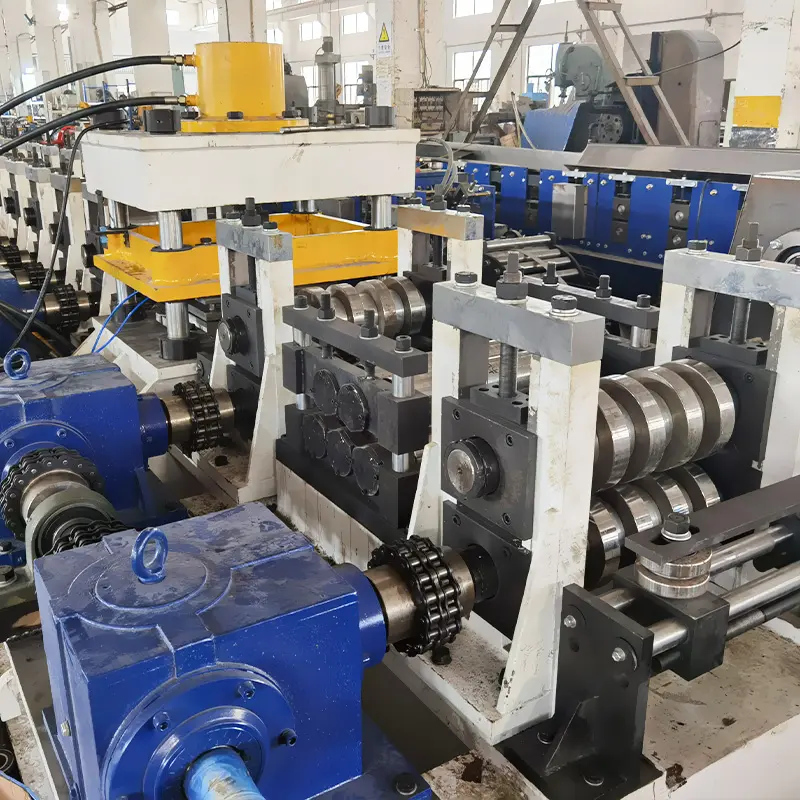
Key Specifications to Evaluate Before Purchasing
Before committing to a PV mounting bracket roll forming machine, buyers should verify a set of critical specifications that directly affect production capability, product quality, and long-term operating costs. The forming speed, expressed in meters per minute, determines throughput capacity—most solar bracket machines operate in the 10–30 m/min range depending on profile complexity. Material thickness range must cover the project specification plus a margin for future product expansion; a typical range of 1.2 to 3.0 mm accommodates the vast majority of solar bracket applications.
Hydraulic system pressure affects both punching force and cutting quality. For solar brackets in 2.0 mm steel, a hydraulic system operating at 12–16 MPa is standard, with cylinder bore sized to deliver clean shear cuts without burr or profile distortion. The PLC brand and HMI interface quality are equally important—reputable brands such as Siemens, Mitsubishi, or Delta ensure reliable automation, easy recipe management, and compatibility with remote diagnostic support.
Buyers should also confirm roller shaft diameter (typically 70–90 mm for solar bracket machines), bearing type (high-load tapered roller bearings preferred), and frame construction (minimum 20 mm welded steel plate for the forming section base). These structural details determine machine rigidity and long-term dimensional consistency. When comparing quotations, request a detailed bill of materials from each supplier and compare component specifications side by side—price differences are often explained by differences in roller material grade, bearing brand, or frame thickness that are not immediately visible in catalog photos.
For answers to other common procurement questions, visit our страницу часто задаваемых вопросов page, which covers topics ranging from lead times and payment terms to shipping packaging and after-sales support.
FAQ: PV Mounting Bracket Roll Forming Machine
What profiles can a PV mounting bracket roll forming machine produce?
A PV mounting bracket roll forming machine can be configured to produce C, Z, U, and HAT (omega) profiles, depending on the installed roller set. Some machines support quick-change roller cassettes that allow switching between profile types in 1–4 hours.
How fast does a solar bracket forming machine run?
Typical forming speeds range from 10 to 30 meters per minute, depending on profile complexity and material thickness. Simpler U profiles allow higher speeds, while complex HAT profiles require slower forming to maintain dimensional accuracy.
What roller material is used in solar mounting profile forming machines?
Most high-quality machines use Cr12MoV alloy tool сталь rollers with surface hardness of HRC 58–62. This material provides excellent wear resistance for long production runs on galvanized or pre-painted steel coil.
Can one machine produce multiple solar mounting profile types?
Yes, if the machine is designed with an interchangeable roller system. SUNWAY offers machines with cassette-style quick-change capability, allowing manufacturers to switch between C, Z, U, or HAT profiles by swapping pre-assembled roller sets.
What steel thickness can a PV mounting bracket roll forming machine handle?
Most solar bracket forming machines accommodate steel coil thickness from 1.2 mm to 3.0 mm, covering the full range of standard photovoltaic racking specifications. Thicker gauges require higher forming force and may reduce maximum line speed.
What is the typical lead time for a solar bracket forming machine from SUNWAY?
Standard machine configurations are typically delivered within 45 to 60 working days from order confirmation. Custom profile tooling or multi-profile quick-change systems may require additional lead time depending on design complexity.
Does SUNWAY provide installation support and operator training?
Yes. SUNWAY provides complete installation and commissioning guidance, including foundation drawings, electrical connection diagrams, on-site or remote video commissioning support, and operator training to ensure the production line reaches full capacity quickly.
Изменения:
- Detailed structural characteristics and mechanical performance of C, Z, U, and HAT solar mounting bracket profiles
- Compared roll forming die design requirements across all four profile types
- Included specification tables for profile dimensions, mechanical properties, and roller design parameters
- Covered complete production line configuration from decoiler to stacker
- Added purchasing specification checklist and FAQ for buyer decision support
Next review triggers: New solar bracket profile standards released, updated roller material technologies, changes in global PV installation market demand, new machine models launched by SUNWAY, trade policy or shipping route changes affecting solar equipment exports