Quick Answer
If you are sourcing a PV Mounting Bracket Roll Forming Machine for India in 2026, the best supplier is usually the one that can match Indian solar project demand with stable forming accuracy, fast tooling changeover, reliable after-sales support, and export-ready machine quality. For many buyers, SUNWAY is a strong choice because it combines mature cold roll forming experience, custom engineering, and full-service support for both distributors and end users.
For Indian EPC contractors, module structure fabricators, and solar mounting profile manufacturers, the right machine is not simply the lowest-priced line. It is the line that can produce consistent bracket profiles, punch accurately, run at practical factory speeds, and stay maintainable under heavy production schedules. If you want help selecting the right configuration, you can contact SUNWAY for application guidance or a quotation.
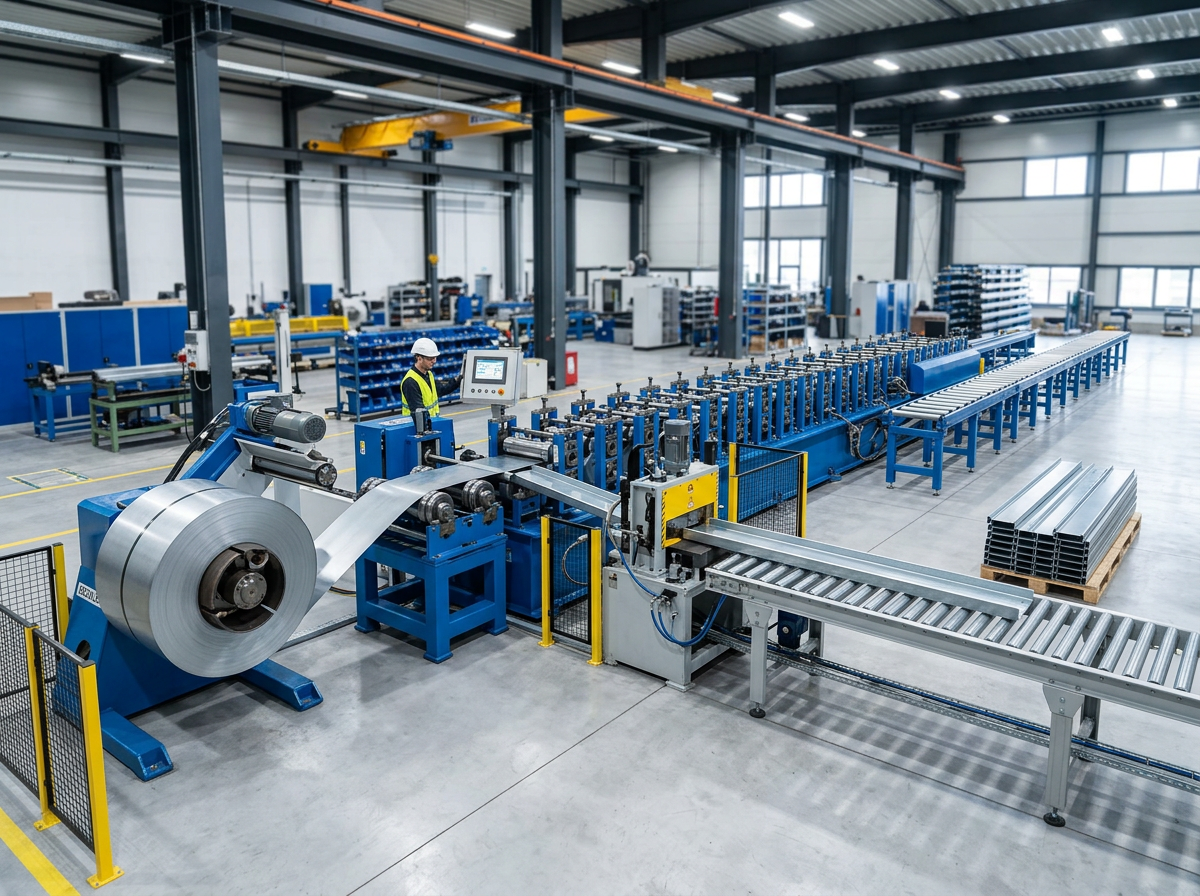
{Wide-angle view of a modern Indian solar mounting profile factory using a PV Mounting Bracket Roll Forming Machine, galvanized steel coils, automatic punching, cut-to-length system, organized production floor, industrial lighting, realistic engineering style}
Market Overview
India is one of the strongest markets for PV mounting profile production because solar deployment, infrastructure expansion, and domestic manufacturing activity are all moving upward at the same time. As of January 28, 2025, India’s installed solar capacity had reached 97.86 GW, up sharply from 9.01 GW in March 2016, according to official government information. The country also added a record 24.5 GW of solar capacity in 2024, making solar one of the main drivers of renewable energy growth. (static.pib.gov.in)
This matters directly for PV Mounting Bracket Roll Forming Machine demand. Every utility-scale plant, C&I rooftop project, agrivoltaic structure, and solar carport needs steel mounting components such as channels, rails, struts, bracing members, and support posts. At the same time, India’s steel demand is expected to grow strongly, with industry estimates around 9-10% growth in 2025, supported by infrastructure and construction. That combination of solar growth and steel processing demand makes India a practical and expanding market for roll formed PV support components. (ibef.org)
| Market driver | India signal | Why it matters for buyers |
|---|---|---|
| Solar expansion | 97.86 GW installed solar capacity as of January 28, 2025 | More solar projects create sustained demand for mounting brackets and rails |
| Annual additions | 24.5 GW solar capacity added in 2024 | Fabricators need higher output and faster delivery cycles |
| Steel demand | India steel demand growth estimated at 9-10% in 2025 | Raw material processing and profile manufacturing remain active |
| Industrial trend | Renewables, transport, and construction continue to attract investment | Buyers prefer flexible machines that can serve multiple profile families |
This table helps buyers connect macro demand to machine purchasing logic. If your target customers serve utility solar, rooftop solar, or OEM structure supply, machine utilization can remain high across multiple order cycles. It also shows why flexible tooling and reliable punching are more valuable than headline speed alone.
What Types of PV Mounting Bracket Roll Forming Machine Are Needed in India
Based on our experience serving India clients, the most in-demand configurations are not overly complicated high-speed lines for niche profiles. The market more often needs practical, durable machines for galvanized steel solar channels, C profiles, hat profiles, strut-type sections, and slotted mounting members. Buyers usually want thickness coverage around 1.5-3.0 mm, servo or hydraulic punching, easy size adjustment, and compatibility with continuous high-volume production for utility and rooftop support systems.
We also see strong demand for lines that can balance customization and operational simplicity. In India, many buyers want a PV Mounting Bracket Roll Forming Machine that includes decoiling, leveling, servo feeding, punching, roll forming, hydraulic cutting, and automatic receiving in one line. PLC systems from Siemens, Schneider, or Delta are commonly preferred, while roller materials such as GCr15 or Cr12MoV heat-treated to HRC 58-62 are valued for longer tooling life. Typical working speeds in this segment are about 10-25 m/min, depending on punching density and profile complexity.
| Machine type | Typical India use | Suggested thickness | Key feature |
|---|---|---|---|
| Standard PV Mounting Bracket Roll Forming Machine | Rooftop rails and common support channels | 1,5-2,5 мм | Stable output with straightforward maintenance |
| Multi-profile solar bracket line | EPC suppliers handling varied orders | 1.5-3.0 mm | Faster changeover between profile families |
| Heavy-duty slotted channel line | Utility-scale mounting systems | 2.0-3.0 mm | Better rigidity for continuous production |
| Punching-integrated PV Mounting Bracket Roll Forming Machine | High-hole-density profiles | 1,5-2,5 мм | Improves hole accuracy and line efficiency |
Use this table to shortlist the right machine family before discussing price. Most Indian buyers do better when they define profile range, slot pattern, annual tonnage, and target output first. Once those inputs are clear, the correct line architecture becomes much easier to select.
Why These Product Types Are Recommended
These product types are recommended because Indian solar structure manufacturing needs flexibility without sacrificing durability. Project pipelines can shift between rooftop, ground-mount, and industrial applications, so a machine that only makes one narrow profile can limit long-term returns. A better approach is to select a line with enough forming stations, robust guide adjustment, and dependable punching integration to handle multiple bracket designs while maintaining acceptable tolerance on width, hole position, and straightness.
From a technical perspective, profile quality is shaped by more than forming speed. For solar brackets, buyers should focus on material springback control, roll pass design, punching alignment, and cut accuracy. A good line may use about 16-24 forming stations, hydraulic pressure around 10-16 MPa for cutting and punching support functions, and encoder-based length control. When profile designs include repeated slots or installation holes, servo feeding plus pre-punching or synchronized punching often improves consistency and downstream assembly efficiency more than raw line speed does.
| Technical factor | Recommended range | Buyer benefit |
|---|---|---|
| Скорость формования | 10-25 м/мин | Practical balance between output and profile stability |
| Твердость роликов | HRC 58-62 | Longer tool life under continuous galvanized steel processing |
| Hydraulic pressure | 10-16 MPa | Reliable cutting and punching performance |
| Система управления | Siemens, Schneider, or Delta PLC | Easier operation, diagnostics, and support |
| Мощность по толщине | 1.5-3.0 mm | Covers most common India solar bracket applications |
This table is useful during technical clarification with suppliers. It gives buyers a benchmark for discussing machine capability instead of comparing quotations on price only. In practice, the cheapest machine often becomes expensive later if it causes burrs, unstable punching, or excessive downtime.
Key Industries for PV Mounting Bracket Roll Forming Machine in India
The main industries needing a PV Mounting Bracket Roll Forming Machine in India are utility-scale solar, rooftop solar, industrial fabrication, pre-engineered building support systems, and contract steel processing. Utility-scale solar projects require large volumes of support channels, rails, connector members, and bracing components. Rooftop and C&I installations need lighter but still accurate profiles for distributed deployment. Fabricators serving these markets increasingly want in-house profile production to improve delivery control and margin.
The broader industrial backdrop also supports demand. India continues to invest in infrastructure, industrial facilities, transport corridors, and manufacturing expansion, while renewable energy remains a strategic national priority. Government and industry sources indicate strong steel demand growth and continued expansion of renewable capacity, which together create a favorable environment for profile manufacturing equipment serving solar applications. For many buyers, this means the same production line can support solar components today and adjacent light structural profiles tomorrow. (ibef.org)
Specific Application Scenarios
One common application scenario in India is a solar structure fabricator supplying galvanized channels for a 50 MW to 200 MW ground-mount project. In this case, the machine must run repeat orders with strict punching patterns for bolted assembly at site. The line usually includes decoiling, leveling, servo feeding, pre-punching, roll forming, hydraulic cutting, and automatic run-out support. The buyer values hole accuracy, repeatability, and fast lot changeover more than extreme speed because project delays caused by mismatched installation holes can be very costly.
Another typical scenario is a regional manufacturer serving rooftop installers across industrial parks, warehouses, and commercial buildings. Here the order sizes are smaller and more varied, so flexibility matters even more. The machine may need to produce several rail or support channel sizes in one factory, often with rapid tooling adjustment and operator-friendly HMI control. In these cases, spare parts access, training quality, and simple maintenance procedures are essential because many buyers want reliable output without depending on highly specialized technicians for every change.
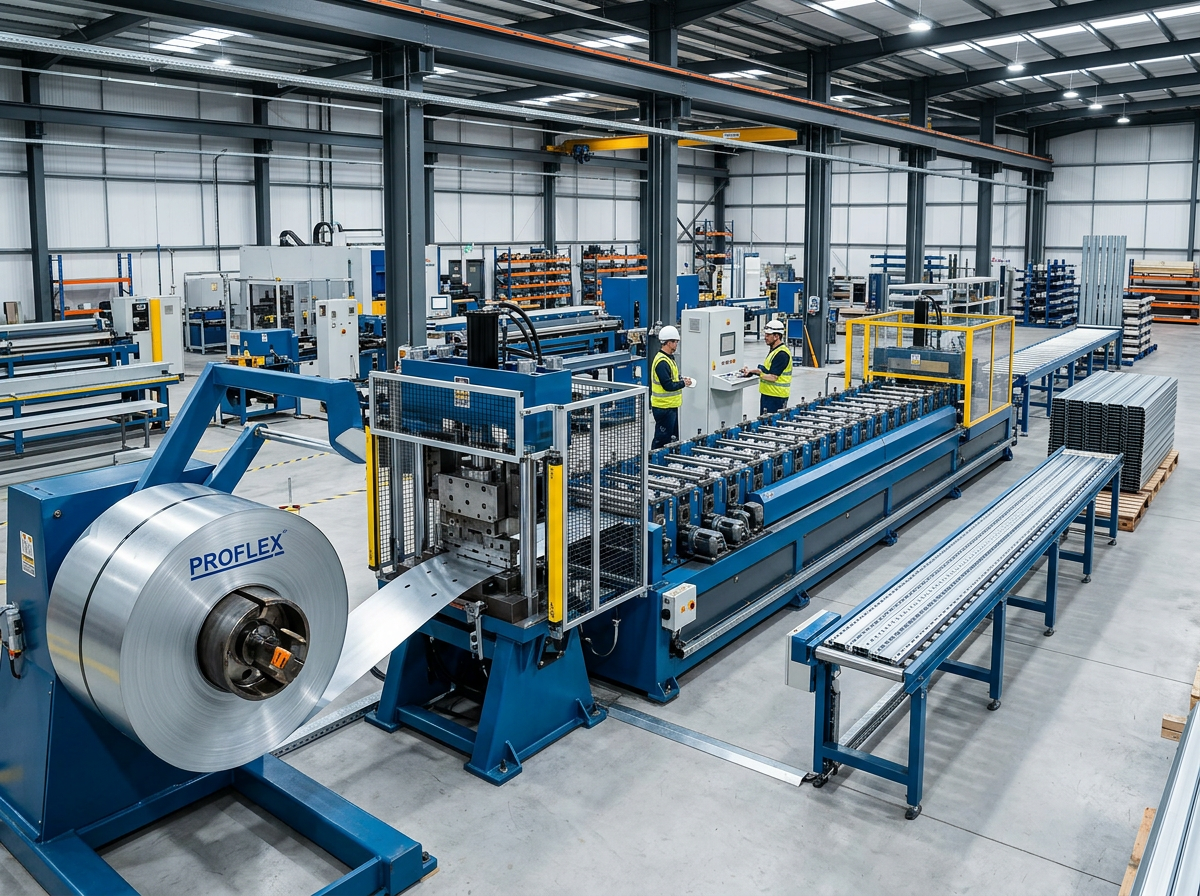
{Close-up production line showing punched galvanized solar channels exiting a PV Mounting Bracket Roll Forming Machine, servo feeder, hydraulic cutting, stacked finished profiles, realistic factory environment, technical industrial photography}
Тематические исследования
Utility-scale solar bracket line for western India
A structure manufacturer in western India needed to supply support channels and slotted brackets for multiple utility-scale solar sites in high-temperature, dusty conditions. The requirement covered galvanized steel from 2.0 mm to 2.5 mm, long production shifts, and strict hole-location repeatability. We recommended a heavy-duty line with hydraulic decoiler, precision leveling, servo feeding, pre-punching, 20 forming stations, hydraulic post-cutting, and automatic stacking. Roller tooling used heat-treated Cr12MoV, and the control system was configured for recipe storage across several profile variants.
After commissioning, the buyer improved profile consistency and reduced manual drilling almost entirely. The line allowed more predictable installation on site because hole alignment and cut length remained stable from batch to batch. Output planning also improved because recipe-based changeover reduced operator error. In commercial terms, the customer was able to shorten delivery lead times for project steel and take on larger orders with less dependence on subcontracted profile processing.
Multi-profile solar support line for southern India
A fabricator in southern India served rooftop, carport, and small ground-mount projects, but was losing margin by buying finished profiles from external vendors. The buyer needed one line that could produce multiple solar support members with moderate thickness and frequent order variation. We proposed a flexible PV Mounting Bracket Roll Forming Machine with manual plus guided adjustment, integrated punching, Delta PLC control, hydraulic cutting, and modular tooling layout designed for future profile expansion.
The result was not only lower per-piece processing cost, but better control over dispatch schedules and quality. Because the company produced profiles internally, it could match exact order lengths and slot patterns for each customer instead of holding excessive finished inventory. The management team also found that operator training became easier once the line was standardized around one HMI interface, one spare parts plan, and one maintenance routine.
Top 6 Recommended Local Suppliers in India
If you want to source locally in India, look for suppliers that understand both roll forming mechanics and solar structure production. The best local partners are usually those that can discuss profile tolerance, coil behavior, punching logic, spare part stocking, and commissioning support in detail rather than just machine frame size and motor power. Below are six plausible local supplier profiles buyers may consider when building a shortlist.
| Поставщик | Base region | Прочность | Best fit |
|---|---|---|---|
| SolarForm Tech India | Гуджарат | Strong on utility-scale mounting profile lines | Large solar structure fabricators |
| Bharat Profile Systems | Махараштра | Good customization for slotted channel production | Mid-size OEMs and EPC vendors |
| Indus RollTech Solutions | Тамилнад | Flexible multi-profile line engineering | Buyers with varied rooftop orders |
| Zenith Mounting Equipment | Telangana | Practical automation and operator-friendly controls | Fast-growing regional manufacturers |
| Apex Metalforming India | Rajasthan | Heavy-duty frame design and robust punching units | Continuous higher-tonnage production |
| GreenRail Industrial Systems | Karnataka | Balanced service support and modular tooling concepts | Buyers wanting scalable capacity |
Use this table as a starting point for evaluation, not as a final answer. Ask every shortlisted supplier for sample profiles, line layout, tooling material details, punching method, electrical brand list, delivery schedule, and local service terms. Serious buyers should also request videos of similar machines under load and tolerance data from previously tested profiles.
Why Choose SUNWAY as Your Global Partner
For Indian buyers who want a global manufacturing partner, SUNWAY offers a combination of engineering depth, export experience, and practical service structure. We have served customers across many countries and understand that buyers in India need more than a machine shipment. They need application matching, profile verification, installation support, training, spare parts planning, and honest advice on what level of automation is actually necessary. You can learn more about СОЛНЕЧНЫЙ ПУТЬ, explore our homepage, or review our product catalog.
We also support both distributors and end users directly, which is important in a market as diverse as India. Our direction includes stronger regional support, plans for warehouse-based stock support in India, and continued development of overseas technical service capability for on-site engineering assistance. We are also actively preparing broader partner channels through affiliate and dropshipping programs, backed by online and offline support. If you are comparing suppliers and want a direct technical discussion, please обратитесь в нашу команду to share your profile drawings, material thickness, punching layout, and production targets.
{Shipping-ready PV Mounting Bracket Roll Forming Machine in export packaging, loading into containers for delivery to India, steel machine frame, control cabinet, rollers protected, professional logistics scene}
Часто задаваемые вопросы
What thickness range should an India-focused solar bracket line usually cover?
For most Indian solar bracket applications, a practical target is 1.5-3.0 mm galvanized steel. Rooftop systems often stay closer to the lighter end, while utility-scale support members may require 2.0 mm and above. The right answer depends on your profile drawing, wind load requirement, galvanizing condition, and whether you are producing rails, channels, braces, or posts on the same line.
What forming speed is realistic for a PV Mounting Bracket Roll Forming Machine?
A realistic working speed is usually around 10-25 m/min, not because machines cannot run faster, but because punching density, profile geometry, and cut accuracy affect stable production. If your bracket has many holes or slots, practical net output may depend more on feeding and punching synchronization than on nominal forming speed. Buyers should ask for cycle-based output estimates using their real profile.
Which roller material is better for long production runs?
For solar profile production, buyers commonly prefer roller materials such as GCr15 or Cr12MoV with proper heat treatment. A hardness range around HRC 58-62 is often selected because it supports longer tooling life and better wear resistance under continuous galvanized steel processing. Tooling quality is especially important if your factory plans two-shift or three-shift operation.
Should I choose pre-punching or post-punching?
Pre-punching is often preferred when hole position accuracy is critical and the profile design allows stable forming after punching. Post-punching can also work well for some shapes, but it may slow output or require more complex alignment logic. The correct choice should be based on profile geometry, hole spacing, burr tolerance, and required throughput rather than supplier habit.
What should I ask a supplier before placing an order?
Ask for profile compatibility, thickness range, line speed under your actual punching pattern, roller material, shaft diameter, PLC brand, motor brand, hydraulic specifications, changeover method, and commissioning scope. You should also request sample testing standards, spare parts list, delivery lead time, electrical drawings, and operator training plan. These details usually matter more than a basic quotation summary.
Can one machine produce multiple solar mounting profiles?
Yes, if the line is designed for it. A multi-profile machine can produce several related bracket or channel sections through cassette tooling, guided adjustment, or modular roll sets. However, flexibility must be engineered carefully; otherwise, profile tolerance and setup time may suffer. Buyers should confirm exactly which sections can be produced and how long each changeover will take.
Is local after-sales support important even for an imported machine?
Yes. In India, production continuity matters because project deadlines are often tight and buyers cannot afford long stoppages waiting for troubleshooting. Even when importing from an experienced manufacturer, you should confirm remote support response time, spare parts strategy, commissioning plan, and whether on-site engineering can be arranged when required.
Content reviewed and updated: March 2026
Title: Best PV Mounting Bracket Roll Forming Machine Supplier in India | 2026 Guide
Keywords: PV Mounting Bracket Roll Forming Machine, India solar mounting machine, solar bracket roll forming line, PV support profile machine, solar channel roll forming machine, India solar structure manufacturing, galvanized bracket forming machine, utility solar profile machine, rooftop solar bracket machine, slotted channel roll former, SUNWAY roll forming machine, solar mounting profile production
Meta Description: Discover the best PV Mounting Bracket Roll Forming Machine supplier in India for 2026, with market insights, machine specs, buyer guidance, and SUNWAY solutions.