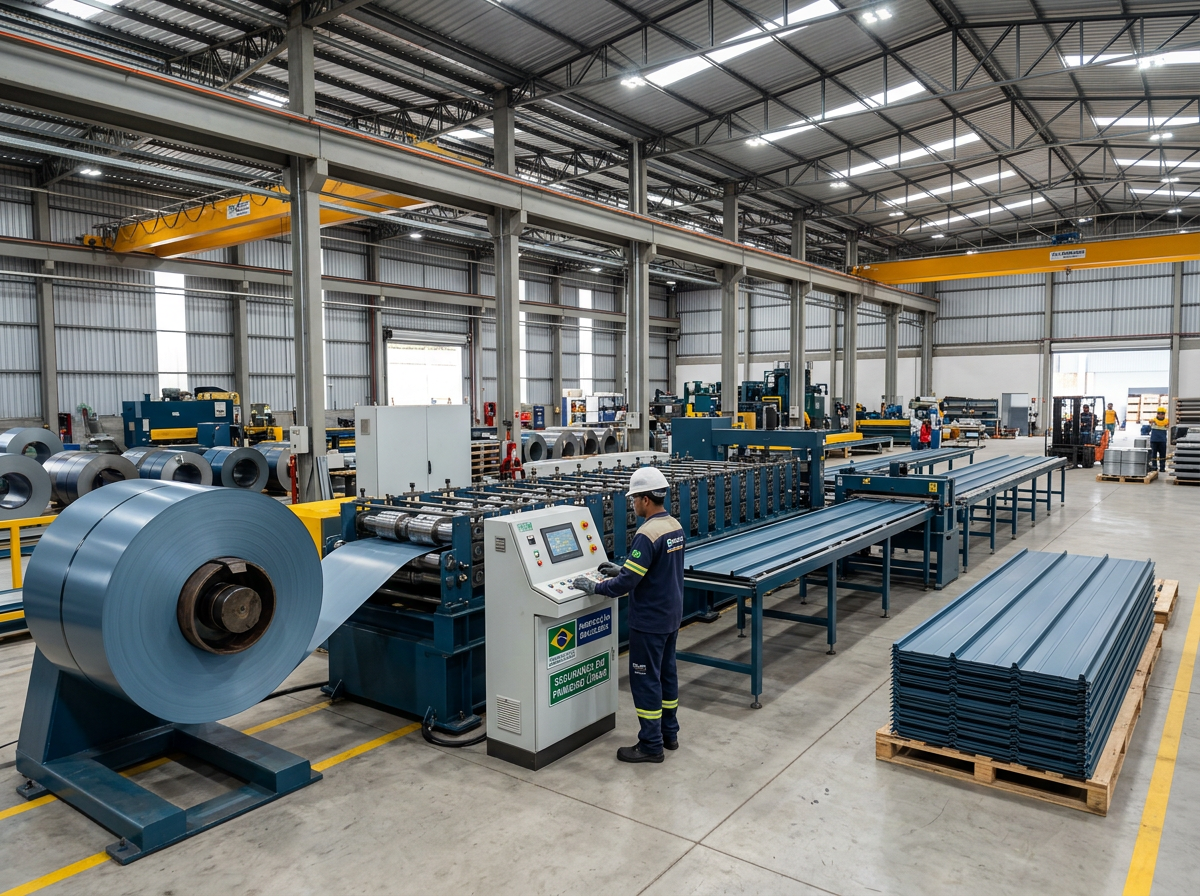
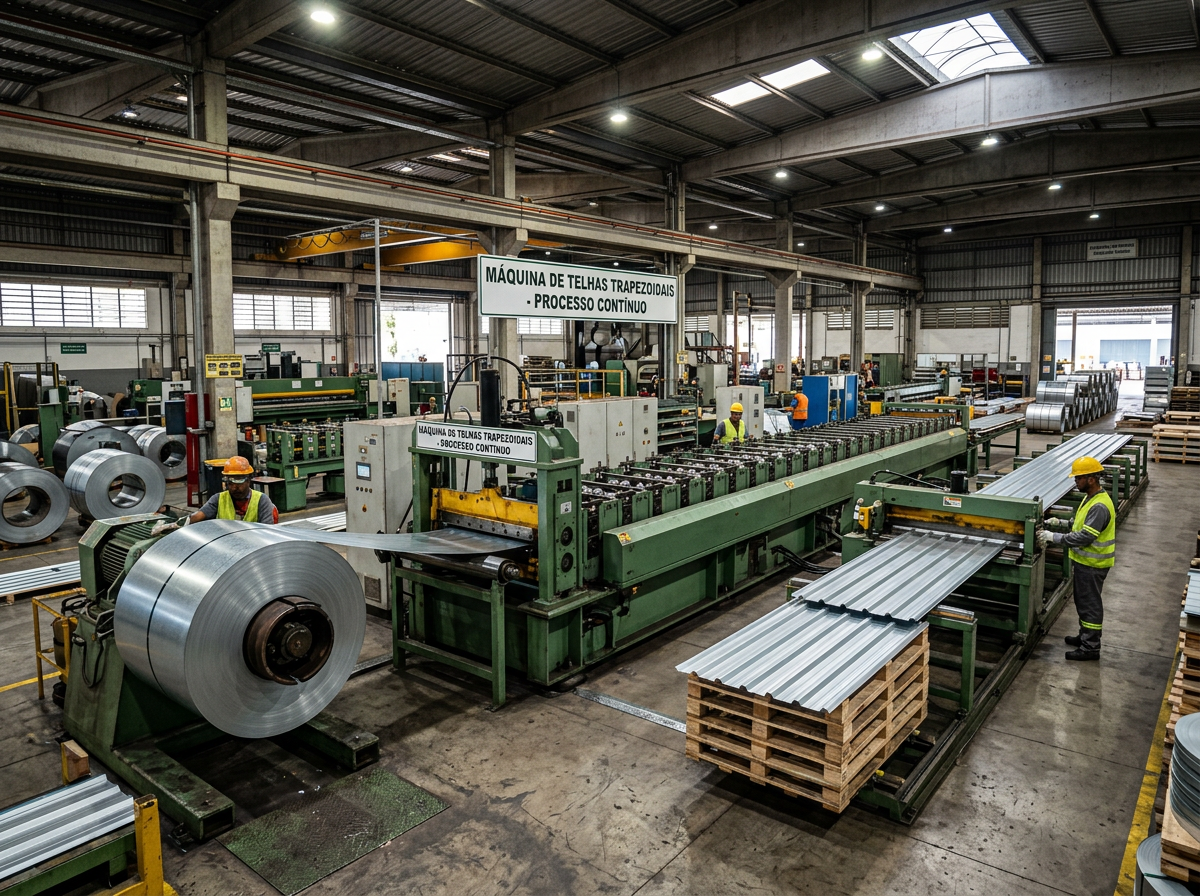
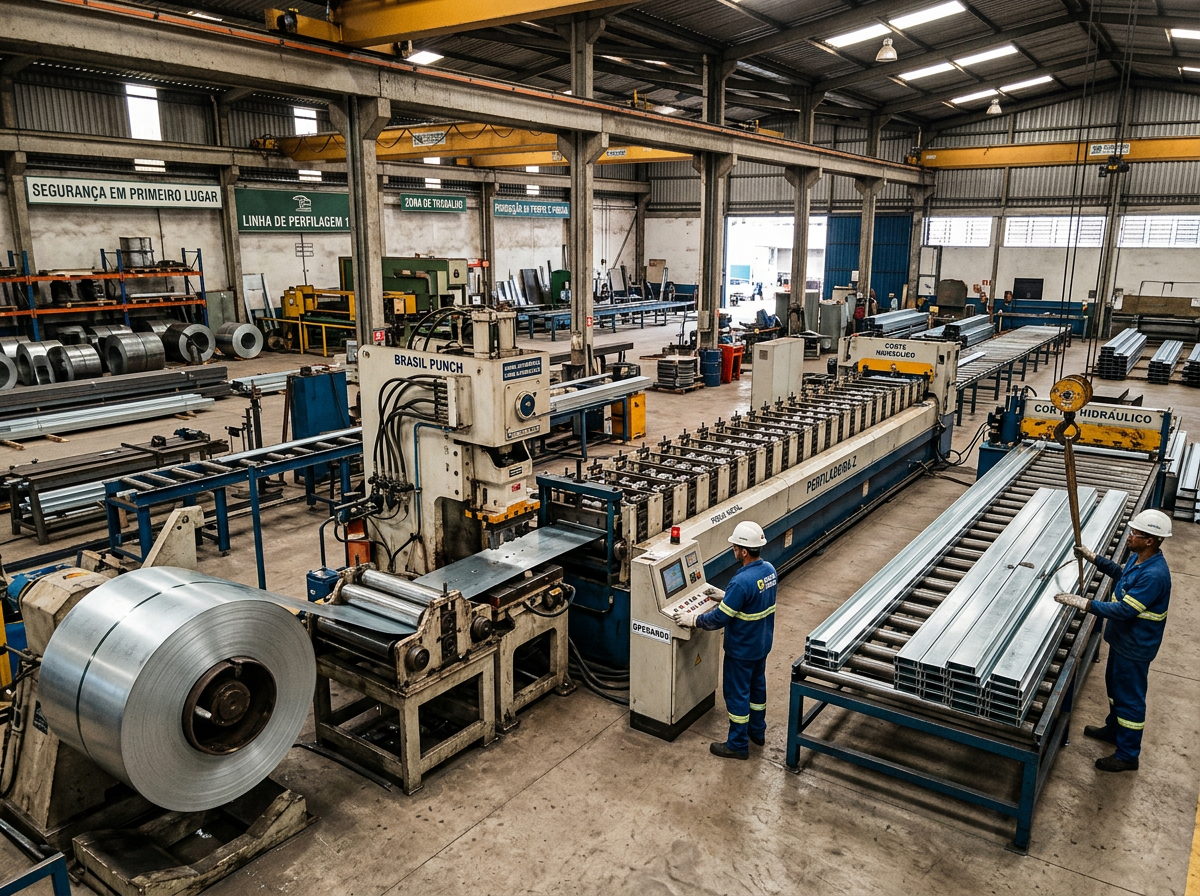
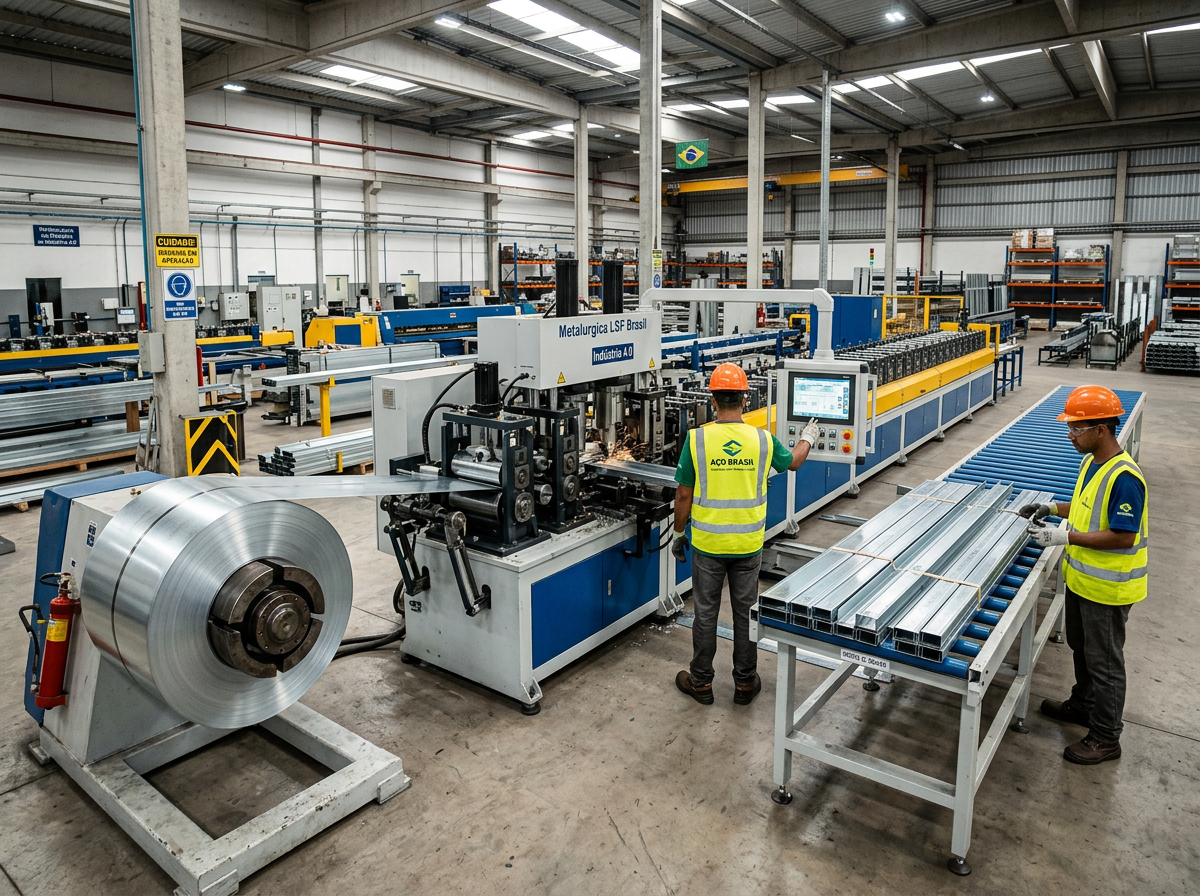
А shelf upright roll forming machine is the backbone of modern warehouse racking production, transforming flat steel coil into precisely punched and formed upright columns that serve as the vertical structural members of storage rack systems. The quality of these uprights—defined by punching accuracy, cross-section consistency, and dimensional tolerance—directly determines whether a finished racking system can safely bear rated loads across decades of heavy-duty use. Understanding the key technologies behind multi-row punching patterns, upright profile design, and precision control is essential for any buyer evaluating this category of equipment.
If you are planning to invest in a rack upright machine or upgrade an existing warehouse rack column machine line, обратитесь в нашу команду at SUNWAY for technical consultation, custom profile analysis, and a competitive quotation backed by over 20 years of cold roll forming expertise.
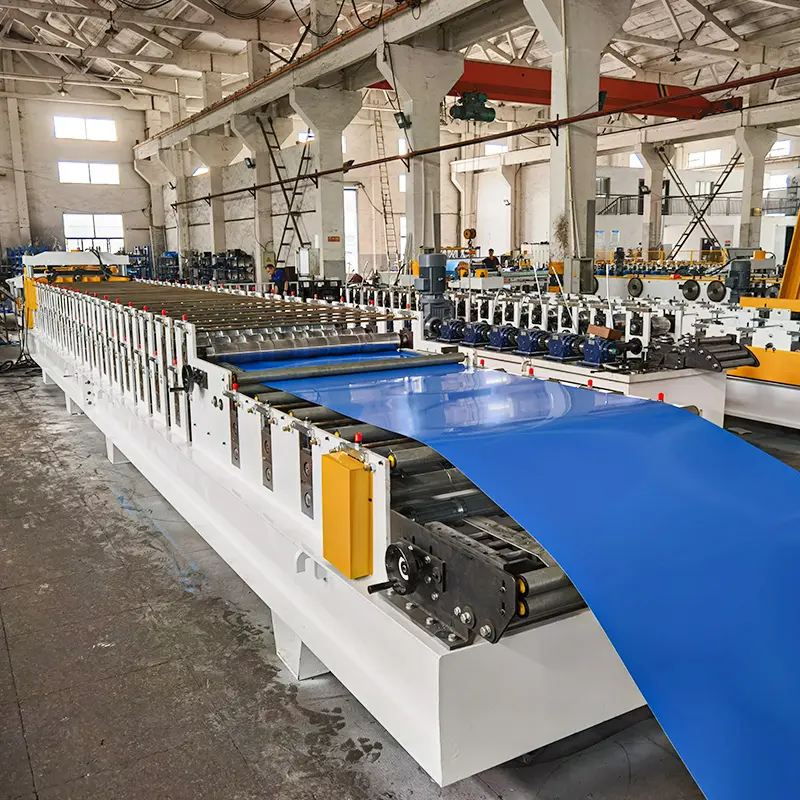
What Is a Shelf Upright Roll Forming Machine and How Does It Work?
A shelf upright roll forming machine is a specialized cold roll forming production line designed to manufacture the vertical columns (uprights or frames) used in warehouse pallet racking, selective racking, drive-in racking, and other industrial storage systems. Unlike standard roll forming lines, this machine integrates a high-speed punching system before the forming section so that slot patterns are stamped into the flat strip before it is progressively shaped into the final closed or open profile. This pre-punch approach ensures hole position accuracy far superior to post-forming punching methods.
The typical production flow begins with a hydraulic or motorized decoiler feeding steel coil—usually 1.5 mm to 3.0 mm thick Q235B or Q345B material—through a leveling unit to remove coil set. The leveled strip then enters a servo-fed punching press where multiple dies simultaneously create rows of precisely spaced connection holes. After punching, the strip moves through 16 to 24 roll forming stations that progressively bend it into the target cross-section. A flying-shear or hydraulic cut-off system then parts the finished upright to length without stopping the line.
What distinguishes a high-quality shelf upright roll forming machine from a basic one is the integration level between the punching system and the forming section, plus the overall dimensional repeatability. Top-tier lines achieve hole-position tolerances within ±0.5 mm across a 12-meter finished upright, which is critical because even small deviations cause beam connectors to misalign, compromising structural integrity and warehouse safety.
How Multi-Row Punching Systems Work in Rack Upright Machines
The punching unit is the most technically demanding subsystem of any rack upright machine. Its function is to produce multiple rows of precisely spaced holes on the flat steel strip at high speed—often 8 to 15 meters per minute—before the strip enters the forming rollers. Each row of holes corresponds to a specific face of the final upright profile, and the hole patterns serve as connection points for horizontal beams, diagonal braces, and base plates.
Modern punching systems use servo-driven feeding with encoder feedback to position each punch stroke within ±0.3 mm of the target pitch. The press itself is typically a hydraulic unit delivering 60 to 200 tons of force, depending on material thickness and the number of simultaneous punch stations. Multiple die sets are mounted on a common die plate, enabling the machine to punch all hole rows in a single stroke cycle. Quick-change die cassettes allow operators to switch between different hole patterns—such as diamond, butterfly, or teardrop—within 20 to 40 minutes, minimizing downtime during product changeovers.
Servo feed accuracy is the single most critical factor in punching quality. Because the flat strip will later be bent through multiple forming stations, any cumulative pitch error in the punched holes is magnified by the bending process. This is why leading manufacturers like СОЛНЕЧНЫЙ ПУТЬ use closed-loop servo systems with real-time error correction, ensuring that the punching pitch remains consistent from the first hole to the last on every upright produced.
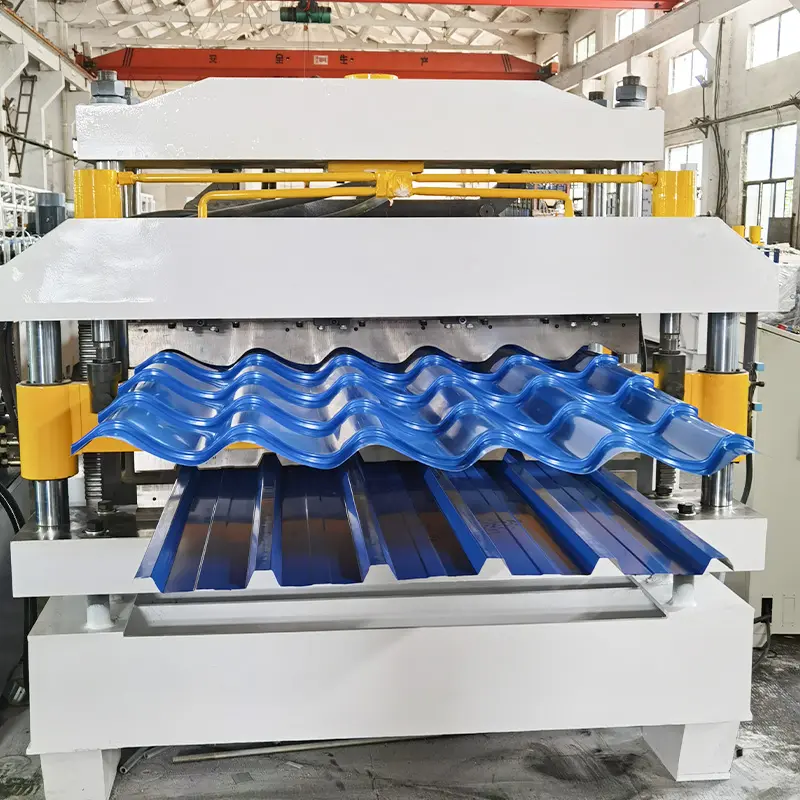
Common Punching Patterns: Diamond, Butterfly, and Teardrop Holes
Different racking system designs require different hole patterns, and each pattern offers distinct mechanical and functional characteristics. The three most widely used hole types in warehouse rack uprights are the diamond (or rhombus) hole, the butterfly (or double-hook) hole, and the teardrop hole. Selecting the right pattern affects beam connector engagement strength, ease of assembly, load distribution, and compatibility with specific beam clip designs.
Diamond (Rhombus) Hole Pattern
The diamond hole is the most common punching pattern in global racking production. Its symmetrical rhombus shape allows beam connectors with riveted hooks to engage from either direction, providing reliable locking and straightforward installation. Diamond holes are typically punched at a standard pitch of 50 mm or 75 mm, enabling fine vertical adjustment of beam height. This pattern is widely used in selective pallet racking and is compatible with the broadest range of commercially available beam clips.
Butterfly (Double-Hook) Hole Pattern
The butterfly hole pattern features a pair of keyhole-shaped openings arranged symmetrically, resembling a butterfly silhouette. This design provides a larger contact surface area between the beam connector and the upright, resulting in higher pull-out resistance. Butterfly holes are preferred in heavy-duty and very-narrow-aisle (VNA) racking systems where beam-to-upright connection strength is a primary safety concern. The die tooling for butterfly patterns is more complex, requiring tighter press alignment and higher tonnage.
Teardrop Hole Pattern
The teardrop hole—shaped like an inverted drop of water—is the most popular pattern in North American and European racking markets. Its rounded profile allows quick snap-in engagement of teardrop-style beam clips without the need for safety pins during installation, significantly reducing assembly time. Teardrop patterns follow standardized pitch dimensions (typically 2-inch / 50.8 mm increments), and the widespread adoption of this standard makes teardrop-pattern uprights highly interchangeable across different racking brands.
| Hole Pattern | Typical Pitch | Ключевое преимущество | Common Application |
|---|---|---|---|
| Diamond (Rhombus) | 50 mm / 75 mm | Universal compatibility, simple die design | Selective pallet racking, shelf upright roll forming machine standard output |
| Butterfly (Double-Hook) | 50 mm / 75 mm | High pull-out resistance, heavy-duty connections | VNA racking, heavy-duty warehouse systems |
| Teardrop | 50.8 mm (2 in.) | Fast assembly, no safety pins needed, industry standard in EU/NA | Pallet racking in Europe, North America, and global exports |
Buyers should select a punching pattern based on their target racking market and end-customer specifications. If your production must serve multiple markets, choosing a shelf upright roll forming machine with quick-change die cassettes allows you to switch between patterns efficiently without investing in separate production lines.
Upright Cross-Section Types and Profile Design
The cross-section of a warehouse rack upright determines its structural capacity, material efficiency, and compatibility with racking system components. While the punching pattern governs connection functionality, the profile shape governs load-bearing performance. Rack upright profiles are engineered through finite element analysis (FEA) to maximize section modulus and moment of inertia while minimizing steel consumption.
The most common cross-sections include open C-profiles, lipped C-profiles (with inward-turned flanges), closed box sections (formed by welding or tab-locking), and sigma-shaped profiles. Open profiles are simpler to form and less expensive, but closed box sections offer superior torsional rigidity and higher load ratings per unit weight of steel. Lipped C-profiles provide a practical middle ground, adding flange stiffness without the complexity of a fully closed section.
| Cross-Section Type | Forming Complexity | Torsional Rigidity | Typical Use in Shelf Upright Roll Forming Machine Lines |
|---|---|---|---|
| Open C-Profile | Low (12–16 stations) | Умеренный | Light-duty shelving, boltless racking |
| Lipped C-Profile | Medium (16–20 stations) | Хороший | Medium-duty selective racking |
| Closed Box Section | High (20–24+ stations, may need welding) | Отличный | Heavy-duty pallet racking, high-bay systems |
| Профиль Sigma | Medium-High (18–22 stations) | Very Good | Specialized heavy-duty and seismic-zone racking |
Profile dimensions typically range from 55 mm × 47 mm for light shelving uprights up to 120 mm × 100 mm or larger for high-bay warehouse columns. Web thickness ranges from 1.5 mm to 3.0 mm, with most medium-duty applications using 2.0 mm material. When evaluating a rack upright machine, confirm that the forming station count and roller design can handle the most complex profile in your planned product range, including any stiffening ribs or embossed patterns.
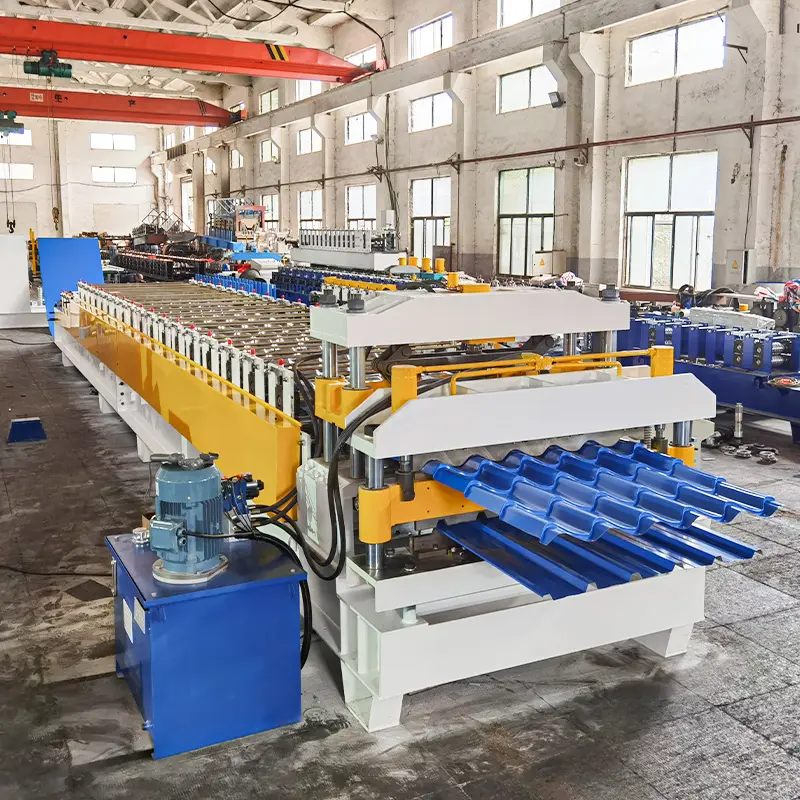
Featured Range: SUNWAY Cold Roll Forming Machine Solutions
SUNWAY offers a comprehensive portfolio of cold roll forming machinery that extends well beyond rack upright production. The product range includes color steel roof and wall panel machines, C and Z purlin machines for steel structure applications, solar mounting bracket machines for the photovoltaic industry, slitting and cut-to-length lines, and a full spectrum of specialized steel profile forming machines—including shelf upright roll forming machine lines with integrated multi-row punching systems. Every machine features precision-machined Cr12 or GCr15 hardened steel rollers, PLC-controlled automation with touchscreen HMI, and robust welded steel frames designed for years of continuous production.
What sets SUNWAY apart for buyers seeking a warehouse rack column machine is the company’s ability to custom-design roller tooling based on the customer’s specific profile drawing, adapt punching die configurations for diamond, butterfly, or teardrop patterns, and configure the complete production line—from decoiler through stacking—as a turnkey solution. With global shipping experience covering Asia, Africa, Europe, South America, and Australia, plus lifetime technical support and spare parts supply, SUNWAY provides a genuine one-stop sourcing advantage. Explore our full machine range to see the complete catalog.
Precision Requirements for Warehouse Rack Column Machines
Dimensional precision in rack upright manufacturing is not a luxury—it is a structural safety requirement. Warehouse racking systems are engineered to bear loads of several tons per bay level, and the uprights are the primary vertical load path. If an upright deviates from its designed cross-section dimensions, or if punched holes drift from their intended positions, beam connectors may not fully engage, load distribution becomes uneven, and the risk of progressive collapse increases dramatically.
Industry practice demands that finished uprights meet hole-pitch tolerances of ±0.5 mm over any 1-meter segment and ±1.0 mm over the full length of the upright (typically 3 to 12 meters). Cross-section dimensional tolerances for web depth and flange width are generally held within ±0.5 mm, and straightness deviation should not exceed 1 mm per meter of length. Achieving these tolerances requires precision-ground roller tooling, rigid machine frame construction, proper roll gap adjustment, and consistent material feed from the decoiler.
| Precision Parameter | Typical Tolerance | Impact If Exceeded |
|---|---|---|
| Hole pitch (per meter) | ±0,5 мм | Beam connector misalignment, assembly difficulty |
| Hole pitch (full length) | ±1,0 мм | Structural load path deviation, safety risk |
| Profile cross-section (web/flange) | ±0,5 мм | Connector fit issues, inconsistent load rating |
| Straightness | ≤1.0 mm/m | Frame instability, visual defect, racking lean |
| Отрезы в длину | ±1,0 мм | Frame height mismatch, installation problems |
To consistently meet these precision standards, a warehouse rack column machine must incorporate encoder-controlled servo feeding, a rigid forming bed with minimal deflection, and a well-calibrated flying-shear or hydraulic cut-off unit. Buyers should request sample uprights from prospective machine suppliers and verify hole pitch and profile dimensions with calibrated measuring instruments before finalizing a purchase.
Рекомендуемый производитель: SUNWAY
For buyers evaluating a shelf upright roll forming machine investment, SUNWAY stands out as a trusted manufacturer and reliable supplier with over 20 years of dedicated cold roll forming machine production. The company operates a complete production system spanning R&D, materials sourcing, precision machining, assembly, quality inspection, professional packaging, and export logistics. An experienced in-house R&D team continuously analyzes market requirements and works closely with customers to optimize machine configurations for specific upright profiles and punching patterns.
SUNWAY’s strict quality control system ensures that every machine—from frame fabrication to roller hardening to electrical integration—meets international standards and performs consistently under production conditions. The company’s one-stop service model covers custom machine design, operator training, installation and commissioning guidance, spare parts supply, and lifetime technical support, giving buyers confidence that their investment is fully supported from day one onward. We recommend contacting SUNWAY to discuss your specific upright profile requirements and запросить коммерческое предложение for a tailored production line solution.
Key Machine Components and Specification Overview
A complete shelf upright roll forming machine production line consists of several integrated subsystems, each contributing to the final product quality. The decoiler holds and feeds the сталь coil, typically handling coil weights from 3 to 10 tons with inner diameter compatibility of 508 mm or 610 mm. The leveling unit removes coil curvature using a set of precision rollers to deliver a flat strip to the punching press. The servo feeder positions the strip for each punch cycle, and the hydraulic punching press stamps all hole rows simultaneously.
After punching, the strip enters the roll forming section, where 16 to 24 stations progressively shape the profile. Roller material is typically Cr12MoV or GCr15 steel, hardened to HRC 58–62 for long service life. The forming speed for rack uprights generally ranges from 8 to 15 meters per minute, balancing productivity with the precision demands of multi-hole profiles. A flying-shear or servo-hydraulic cut-off unit parts the finished upright to programmed lengths, and a run-out table or auto-stacker collects the finished pieces.
The PLC control system—commonly Siemens or equivalent—coordinates all subsystems through a touchscreen HMI that allows operators to set production parameters including cut length, batch quantity, punching pattern selection, and forming speed. Advanced lines include automatic fault detection, production counting, and remote diagnostics capability. When comparing machine quotations, ensure that the specification sheet clearly states roller material grade, hydraulic press tonnage, servo feeder accuracy, and PLC brand, as these components directly determine long-term production performance and maintenance cost.
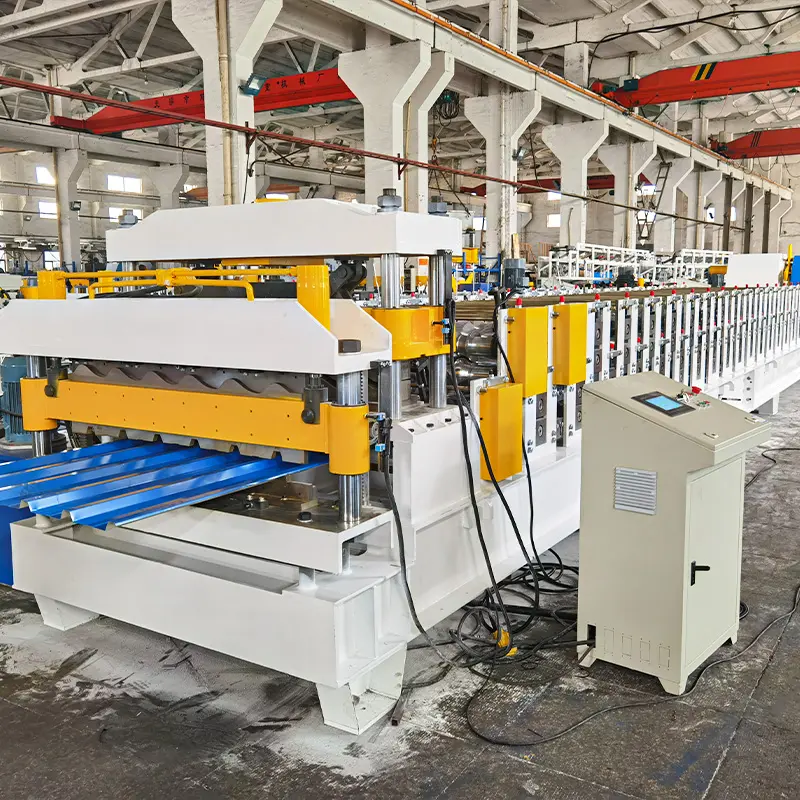
How to Choose the Right Shelf Upright Roll Forming Machine
Selecting the right machine begins with a clear definition of your product requirements. Identify the upright profiles you intend to produce—including cross-section dimensions, material thickness range, hole patterns, and hole pitch specifications. Then evaluate whether you need a single-profile dedicated line or an adjustable machine capable of handling multiple profile sizes with tooling changeovers.
Consider production volume targets carefully. A line running at 10 m/min for a single 8-hour shift produces approximately 4,800 meters of uprights per day. If your market requires higher throughput, select a machine with faster forming speed and rapid die-change capability. Also evaluate the level of automation: manual stacking may be acceptable for small batches, but high-volume producers benefit from auto-stackers and batch counting systems that reduce labor costs and handling damage.
- Confirm that the machine supplier can provide sample uprights matching your profile drawing before order placement.
- Verify servo feeder accuracy specifications and request hole-pitch measurement data from production trials.
- Evaluate after-sales support: spare parts lead time, remote troubleshooting capability, and availability of on-site commissioning engineers.
Finally, assess the supplier’s track record in manufacturing rack upright machines specifically—not just general roll forming lines. The integration of a high-tonnage punching press with a precision forming section requires specialized engineering experience. A manufacturer like SUNWAY, with decades of cold roll forming expertise and a proven global export record, offers the technical depth and after-sales reliability that this equipment category demands. For answers to common procurement questions, visit our страницу часто задаваемых вопросов .
FAQ: Shelf Upright Roll Forming Machine
What is a shelf upright roll forming machine used for?
A shelf upright roll forming machine is used to manufacture the vertical columns (uprights) of warehouse pallet racking and industrial shelving systems. It integrates pre-punching and cold roll forming into a single continuous production line, producing finished uprights with connection holes ready for assembly.
What punching patterns can a rack upright machine produce?
Most rack upright machines can produce diamond (rhombus), butterfly (double-hook), and teardrop hole patterns by changing the die cassettes in the hydraulic punching press. Changeover typically takes 20 to 40 minutes depending on the die design and machine configuration.
What is the typical forming speed of a warehouse rack column machine?
The typical forming speed ranges from 8 to 15 meters per minute, depending on material thickness, profile complexity, and the number of punching rows. Heavier gauge material and more complex profiles generally require slower speeds to maintain dimensional accuracy.
What material thickness can a shelf upright roll forming machine handle?
Standard machines handle steel coil from 1.5 mm to 3.0 mm thick, with most medium-duty racking uprights produced from 1.8 mm to 2.5 mm Q235B or Q345B grade steel. Lines designed for heavy-duty uprights may accept material up to 4.0 mm.
How does SUNWAY ensure machine quality and precision?
SUNWAY applies a strict quality control system covering every stage from raw material sourcing to final assembly and testing. Rollers are precision-machined from Cr12MoV or GCr15 hardened steel (HRC 58–62), servo feeders are calibrated for ±0.3 mm accuracy, and every machine undergoes trial production before shipment to verify dimensional tolerances.
Can SUNWAY customize a rack upright machine for my specific profile?
Yes. SUNWAY’s in-house R&D team designs custom roller tooling and punching dies based on the customer’s profile drawing and hole-pattern specifications. The company provides complete production line configuration including decoiler, leveling unit, punching press, forming section, cut-off unit, and stacking system as a turnkey solution.
What after-sales support does SUNWAY provide?
SUNWAY offers lifetime technical support, remote video commissioning assistance, operator training materials, spare parts supply with competitive lead times, and on-site installation guidance for buyers worldwide. The company’s global export experience across Asia, Africa, Europe, South America, and Australia ensures reliable logistics and documentation support.
Изменения:
- Comprehensive coverage of multi-row punching technologies for rack upright production
- Detailed comparison of diamond, butterfly, and teardrop hole patterns
- Analysis of upright cross-section types and precision requirements
- Machine component specifications and selection guidance for global buyers
- FAQ section addressing common B2B procurement questions
Next review triggers: New punching pattern standards, machine model updates, changes in racking industry specifications (e.g., FEM/RMI standards), new automation features, shipping or lead-time changes