 अंग्रेज़ी
 स्पेनिश
 फ़्रेंच
 बंगाली
 रूसी
 अरबी
 तुर्की

स्लिप रोल फॉर्मिंग मशीनें are used to shape and bend metal sheets and plates into circular, conical, or cylindrical parts. This efficient technology transforms flat blanks into precisely formed components vital for manufacturing industries.
This comprehensive guide will provide a detailed overview of slip roll forming machine working principles, types, components, specifications, design factors, installation, operation, suppliers, costs, advantages, limitations, and more.
का परिचय स्लिप रोल फॉर्मिंग मशीनें
Slip roll forming, also known as pyramid roll forming, is a metal bending process that gradually curves sheet metal blanks into circular or conical shapes. The blank is progressively passed through three adjustable rollers to produce uniform bending without deforming the material.
As the blank enters the rollers, it takes on a curved profile. By adjusting the roller spacing and angle, different diameters and conical shapes can be formed. Slip roll forming provides efficient bending of sheets into rings, cones, elbows, and various geometric forms.
Key benefits of slip roll forming technology:
- Ability to make concentric bends and compound curves
- Form gradual contours without material deformation
- High dimensional accuracy and bend quality
- Minimal thinning and thickening of metal
- Applicable for wide range of materials and thicknesses
- Low setup times between different components
Based on configuration, different types of slip roll forming machines are available.
स्लिप रोल फॉर्मिंग मशीनों के प्रमुख अनुप्रयोग
Slip roll forming systems are ideal for high precision bending of sheets, plates, blanks into:
| अनुप्रयोग | विवरण |
|---|---|
| Round tubes and pipes | For structural and hydraulic uses Diameters from few inches to several feet |
| Conical sections | For hoppers, bunkers, pipelines Gradual slopes |
| Elbows and bends | For HVAC ducting Smooth contours |
| Metal rings | Bearing races, flanges Circular and non-circular |
| Rolled cylinders | Drums, storage tanks Large diameter cylinders |
| Dished ends | For pressure vesselsSpherical profiles |
These components find wide applications in mechanical engineering, process equipment, infrastructure, and metal fabrication.
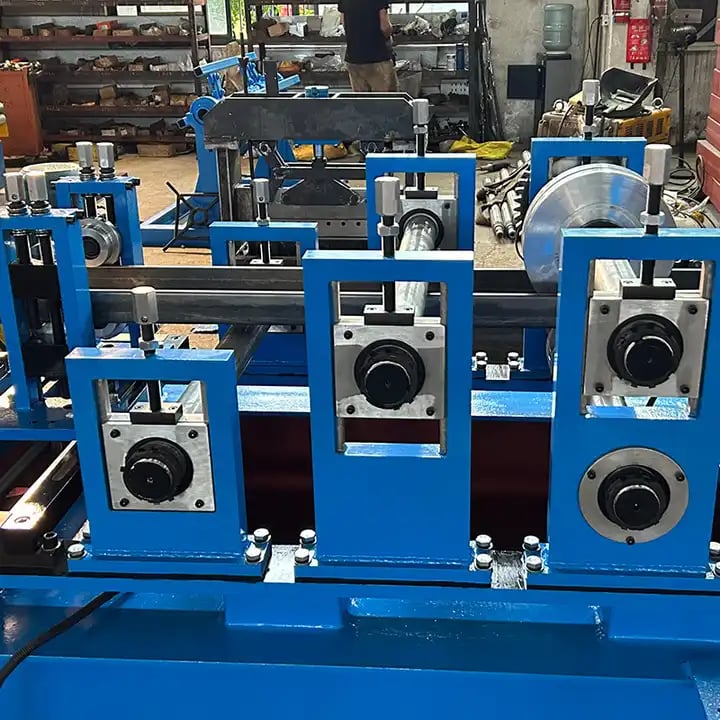
के प्रकार स्लिप रोल फॉर्मिंग मशीनें
Slip roll forming machines are classified based on roller configuration:
| प्रकार | विवरण |
|---|---|
| Pyramid 3-roll | Three adjustable forming rolls Manual or power driven Basic design |
| Pinch 4-roll | Four rolls for better control Motorized rolls तेज़ उत्पादन |
| Cluster 3-roll | Cluster of three adjustable rolls Independent lateral control जटिल प्रोफाइल के लिए |
| CNC roller bender | CNC controlled rolls Precision bending उन्नत सुविधाएँ |
More rollers and CNC control allow complex shapes, higher precision, and efficient production.
स्लिप रोल फॉर्मिंग मशीनों के मुख्य घटक
Major components of slip roll forming systems:
| घटक | कार्य |
|---|---|
| फॉर्मिंग रोल्स | Bend sheet progressively |
| Roll adjustment system | Adjust roll spacing, angle |
| Sheet holding knobs | Grip sheet securely during bending |
| डीकॉइलर यूनिट | Holds sheet coil for continuous bending |
| कंट्रोल पैनल | मशीन संचालन को नियंत्रित करता है |
| बेस फ्रेम | कठोर सहारा प्रदान करता है |
Additional attachments like mandrels, gauges, and guides can be integrated for specialized bending applications.
Technical Specifications of स्लिप रोल फॉर्मिंग मशीनें
The main technical parameters for slip roll forming machines:
| विशिष्टताएँ | सामान्य मान |
|---|---|
| अधिकतम शीट चौड़ाई | 1 – 8 ft |
| न्यूनतम शीट मोटाई | 26 gauge (0.5 mm) |
| अधिकतम शीट मोटाई | 1⁄4 – 1⁄2 inch (6 – 12 mm) |
| Roll adjustment range | 1 – 10 inch spacing |
| रोलर व्यास | 4 – 10 inches |
| Roller drive | Manual or motorized |
| Roll speed | 10 – 25 rpm |
| रोलर क्षमता | 3 – 20 tons |
| नियंत्रण | Manual or CNC |
The diameter, spacing, and drive capacity determine the size and thickness of metal that can be formed.
स्लिप रोल फॉर्मिंग मशीनों के डिजाइन पहलू
Key design factors for slip roll forming systems:
| डिज़ाइन कारक | विवरण |
|---|---|
| रोलर व्यास | Affects minimum bending radius |
| रोलर समायोजन | Range of diameter and taper |
| ड्राइव प्रकार | बिजली की आवश्यकताएं |
| रोलर क्षमता | Sheet thickness and hardness |
| नियंत्रण | Manual, semi-auto, CNC |
| स्वचालन स्तर | Loading/unloading, part handling |
| जोड़ी गई विशेषताएँ | Mandrels, gauges, etc. |
| सुरक्षा | Guards, emergency stops |
The machine is designed based on bending needs, material properties, precision, and production requirements.
स्लिप रोल फॉर्मिंग मशीनों के मानक और कोड
Slip roll forming equipment must comply with:
| मानक | विवरण |
|---|---|
| ISO 9001 | गुणवत्ता प्रबंधन प्रणाली |
| CE | यूरोप के लिए सुरक्षा प्रमाणन |
| ANSI | अमेरिका में मशीन सुरक्षा मानक |
| ASTM | Metal properties and testing |
| ASME | Design codes for roll frames |
These regulations ensure the equipment meets quality benchmarks and safety needs.
स्लिप रोल फॉर्मिंग मशीनों की स्थापना
कुशल संचालन के लिए उचित स्थापना आवश्यक है:
| स्थापना चरण | आवश्यकताएँ |
|---|---|
| साइट की तैयारी | समतल और लेवल किया हुआ फर्श पर्याप्त कार्यक्षेत्र क्रेन की उपलब्धता |
| स्थिति निर्धारण | लेआउट ड्रॉइंग के अनुसार मशीन के अनुभागों को संरेखित करें मशीन बॉडी को एंकर करें |
| असेंबली | मैनुअल के अनुसार भागों को असेंबल करें संरेखण जांचें सुरक्षा गार्ड स्थापित करें |
| विद्युत उपकरण | पावर केबल कनेक्शन अर्थिंग पॉइंट लाइटिंग |
| परीक्षण संचालन | कार्यप्रणाली का परीक्षण करें प्रक्रिया पैरामीटर सेट करें Initial sample runs |
Sufficient space is required for blank loading/unloading and formed part handling.
स्लिप रोल फॉर्मिंग मशीनों का संचालन और रखरखाव
कुशल संचालन के लिए आवश्यक है:
| संचालन | रखरखाव |
|---|---|
| Skilled operators सुरक्षित सामग्री हैंडलिंग Set process settings Inspect formed parts | दैनिक सफाई बेयरिंग को चिकनाई दें Check belt tension Gearbox oil levels घिसे हुए भागों को बदलें |
अनुसूची के अनुसार निवारक रखरखाव गतिविधियाँ प्रदर्शन को बेहतर बनाती हैं।
स्लिप रोल फॉर्मिंग मशीन आपूर्तिकर्ता का चयन कैसे करें
विश्वसनीय उपकरण आपूर्तिकर्ताओं के चयन के मुख्य कारक:
| पैरामीटर | मानदंड |
|---|---|
| मशीनों की रेंज | आवश्यकताओं के अनुरूप मॉडल |
| उत्पादन क्षमता | आवश्यक आउटपुट दरें |
| अनुकूलन | विशेष प्रोफाइल के लिए लचीलापन |
| गुणवत्ता | ISO प्रमाणित निर्माण |
| अनुभव | व्यवसाय में वर्ष, ग्राहक वर्ग |
| विशेषज्ञता | डिजाइन के लिए तकनीकी सहायता |
| बिक्री-पश्चात सेवा | स्थापना, प्रशिक्षण, रखरखाव |
| स्पेयर पार्ट्स | घिसने वाले पुर्जों की उपलब्धता |
| मूल्य निर्धारण | प्रतिस्पर्धी और पारदर्शी |
ऐसे तकनीकी रूप से सक्षम निर्माता का चयन करें जो सही समाधान प्रदान कर सके।
Costs of स्लिप रोल फॉर्मिंग मशीनें
सामान्य मूल्य सीमा:
| मशीन प्रकार | मूल्य सीमा |
|---|---|
| Manual 3-roll pyramid | $5,000 – $15,000 |
| Powered 4-roll pinch | $15,000 – $35,000 |
| CNC cluster roll bender | $50,000 – $150,000 |
| पूर्णतः स्वचालित लाइन | $200,000+ |
Costs vary based on roll capacity, automation level, precision, and overall capabilities.
स्लिप रोल फॉर्मिंग मशीनों के फायदे और नुकसान
| लाभ | सीमाएं |
|---|---|
| Gradual uniform bending No material deformation आयामी सटीकता Low setup times उच्च लचीलापन | अधिक प्रारंभिक निवेश Size limits per machine Skilled labor needed अधिक स्थान की आवश्यकता Lower speeds than press brakes |
Automated slip roll forming improves efficiency and quality but requires significant capital expenditure initially.
स्लिप रोल फॉर्मिंग मशीनों के बारे में अक्सर पूछे जाने वाले प्रश्न
| प्रश्न | उत्तर |
|---|---|
| कौन-सी सामग्रियों को फॉर्म किया जा सकता है? | Low carbon steel, stainless steel, aluminum, copper alloys |
| What are the size limits? | Up to 8 ft wide sheets, 1/4 – 1/2 inch thick |
| कौन-से प्रोफाइल संभव हैं? | Circles, cones, elbows, dished heads |
| कौन-सी मोटरों का उपयोग किया जाता है? | AC induction motors typically |
| कौन-से नियंत्रण उपयोग किए जाते हैं? | Manual, semi-automatic, CNC |
| किस रखरखाव की आवश्यकता है? | Daily cleaning, lubrication, and wear parts replacement |
| कौन-से सुरक्षा पहलू आवश्यक हैं? | Guards, emergency stops, safety mats |
| कितना फर्श स्थान उपयुक्त है? | एक मानक मशीन के लिए लगभग 400 sq.ft |
| मशीन की लागत को कौन-से कारक प्रभावित करते हैं? | roller capacity, level of automation, precision |
निष्कर्ष
Slip roll forming machines enable efficient bending of metal sheets and plates into circular or conical shapes to high dimensional accuracy. With the ability to form various profiles without deformation, they are ideal for rolling rings, tubes, vessel heads, elbows, and custom components.
Choosing the right roller capacity and features based on part sizes and production needs is important. With competitive pricing, slip roll forming improves quality and productivity for metal fabrication industries.
रोल फॉर्मिंग के बारे में अधिक जानें
अक्सर पूछे जाने वाले प्रश्न (FAQ)
1) How do slip roll forming machines differ from plate rolling machines?
- Slip roll formers use three or four smaller-diameter rolls for light-to-medium gauge sheets, ideal for precise cylinders and cones. Plate rolls handle heavier plate thicknesses with larger rolls and higher tonnage.
2) What is the minimum achievable diameter on a slip roll machine?
- As a rule of thumb, the minimum inside diameter is roughly 1.2–1.5× the top roll diameter for mild steel. Pre-bending and multi-pass techniques can reduce springback and achieve tighter diameters.
3) Can slip roll forming machines create conical sections accurately?
- Yes. Cones are formed by offsetting side-roll positions and feeding with controlled skew. For consistent tapers, use conical adapters, tapered shims, or dedicated CNC cone programs.
4) How does material grade affect springback and final diameter?
- Higher-strength alloys (e.g., 304/316 stainless, 5xxx/6xxx aluminum) exhibit greater springback. Compensate with smaller target diameters, additional passes, and calibrated overbend factors derived from test coupons.
5) What are best practices to avoid surface marking on polished or pre-painted sheets?
- Use polished/hardened rolls, apply protective films, employ non-staining, low-VOC lubricants, and clean rolls frequently. For mirror finishes, consider nylon or urethane overlay sleeves on contact zones.
स्लिप रोल फॉर्मिंग मशीनों के लिए 2025 के उद्योग रुझान
- Smart retrofits: Low-cost encoders and digital position readouts (DROs) added to manual 3-roll machines for repeatable diameters.
- Cone automation: Mid-range CNC 4-roll models now include cone-wizard templates and springback libraries by alloy and thickness.
- Sustainability: Shift to biodegradable, low-odor forming fluids to meet indoor air targets and simplify cleanup.
- Safety by design: Torque-limiting drives, interlocked pinch guards, and light curtains increasingly standard on CE-marked machines.
- Data-ready machines: OPC UA/MTConnect gateways let shops log roll positions, pass counts, and part IDs for QA traceability.
2025 बेंचमार्क और डेटा स्नैपशॉट
| KPI (slip roll forming) | २०२३ सामान्य | 2025 सर्वश्रेष्ठ-इन-क्लास | व्यावहारिक प्रभाव | स्रोत |
|---|---|---|---|---|
| Diameter repeatability (± mm over 1 m Ø) | 1.0–1.5 | 0.3–0.7 (with DRO/CNC) | Fewer re-rolls and scrap | द फैब्रिकेटर; OEM डेटाशीट |
| Cone mismatch at seam (mm) | 2–4 | 0.5–1.5 | Faster fit-up/welding | SME; शॉप QA रिपोर्ट |
| Setup time for cone program | 20–40 मिनट | 5–12 min | Higher small-batch throughput | OEM application notes |
| Low-VOC lubricant use (%) | ~30 | 60–75 | Better compliance/air quality | U.S. EPA guidance |
| Incident rate reduction with interlocked guards | — | 30–50% | अधिक सुरक्षित संचालन | OSHA/NIOSH best practices |
प्रामाणिक संदर्भ:
- ASTM A1008/A1011 (sheet steels) and A240 (stainless): https://www.astm.org
- OSHA मशीन गार्डिंग: https://www.osha.gov/machine-guarding
- MTConnect data interoperability: https://www.mtconnect.org
- The Fabricator (bending/rolling): https://www.thefabricator.com
- SME विनिर्माण ज्ञान: https://www.sme.org
नवीनतम अनुसंधान मामले
Case Study 1: CNC Cone Wizard Deployment for Stainless Hoppers (2025)
- Background: A food equipment OEM struggled with variable seam gaps on 304 stainless conical hoppers (1.5–2.0 mm).
- Solution: Upgraded to a CNC 4-roll slip roll forming machine with cone-wizard software, added digital material libraries, and standardized pre-bend passes.
- Results: Seam mismatch reduced from 3.2 mm to 0.9 mm; rework time down 52%; average setup time cut from 34 to 10 minutes; finish quality improved with low-VOC, food-safe lubricant.
Case Study 2: DRO Retrofit on Manual 3-Roll for Aluminum Cylinders (2024)
- Background: A custom fab shop rolled 5052-H32 aluminum cylinders (1.6 mm) for HVAC with inconsistent diameters and frequent springback corrections.
- Solution: Installed magnetic scale DROs on top-roll position and side-roll axes; created a thickness–alloy–diameter lookup chart from 20 test coupons.
- Results: Diameter repeatability improved from ±1.3 mm to ±0.5 mm over 800 mm Ø; scrap rate dropped from 7.5% to 2.8%; average pass count reduced by 1 per part.
विशेषज्ञों की राय
- Prof. Benjamin W. Schafer, PhD, Johns Hopkins University, Cold-Formed Steel Expert
- Viewpoint: “Slip roll forming precision hinges on controlling bend progression and compensating springback—data-driven overbend factors noticeably tighten tolerance bands.”
- स्रोत: https://www.jhu.edu
- Kate Bachman, वरिष्ठ संपादक, The Fabricator
- Viewpoint: “CNC cone templates and position readouts are the big equalizer for job shops—repeatable conical sections are now achievable without elite operators.”
- स्रोत: https://www.thefabricator.com
- Paul Hogendoorn, Manufacturing Data Consultant
- Viewpoint: “Edge devices that stream roll positions and part IDs via MTConnect reduce disputes at weld/fit-up and accelerate first-article approvals.”
- स्रोत: https://www.mtconnect.org
व्यावहारिक उपकरण/संसाधन
- Design and simulation: COPRA RF (data M) cone/cylinder modules https://www.datam.de/en/copra; UBECO PROFIL https://www.ubeco.com
- Tolerance calculators: Sheet metal bend/springback calculators (check alloy-specific data sheets from mills like Novelis, Outokumpu)
- Standards: ASTM A240 (stainless), A1008/A1011 (carbon steel) https://www.astm.org; ISO 9001 quality management https://www.iso.org
- Safety: OSHA Machine Guarding eTool https://www.osha.gov; NIOSH ergonomics resources https://www.cdc.gov/niosh
- Data/Connectivity: MTConnect for shop-floor interoperability https://www.mtconnect.org
- Industry insights: The Fabricator rolling/bending hub https://www.thefabricator.com
अंतिम अपडेट: 2025-10-27
परिवर्तन-लेख: Added 5 targeted FAQs; introduced 2025 trends with KPI table and sources; included two recent slip roll forming case studies; compiled expert viewpoints; listed practical tools and standards
अगली समीक्षा तिथि और ट्रिगर: 2026-04-30 or earlier if cone seam mismatch >2 mm, diameter repeatability worse than ±0.8 mm over 1 m Ø, low-VOC adoption <50%, or setup time for cones >20 minutes