Quick Answer
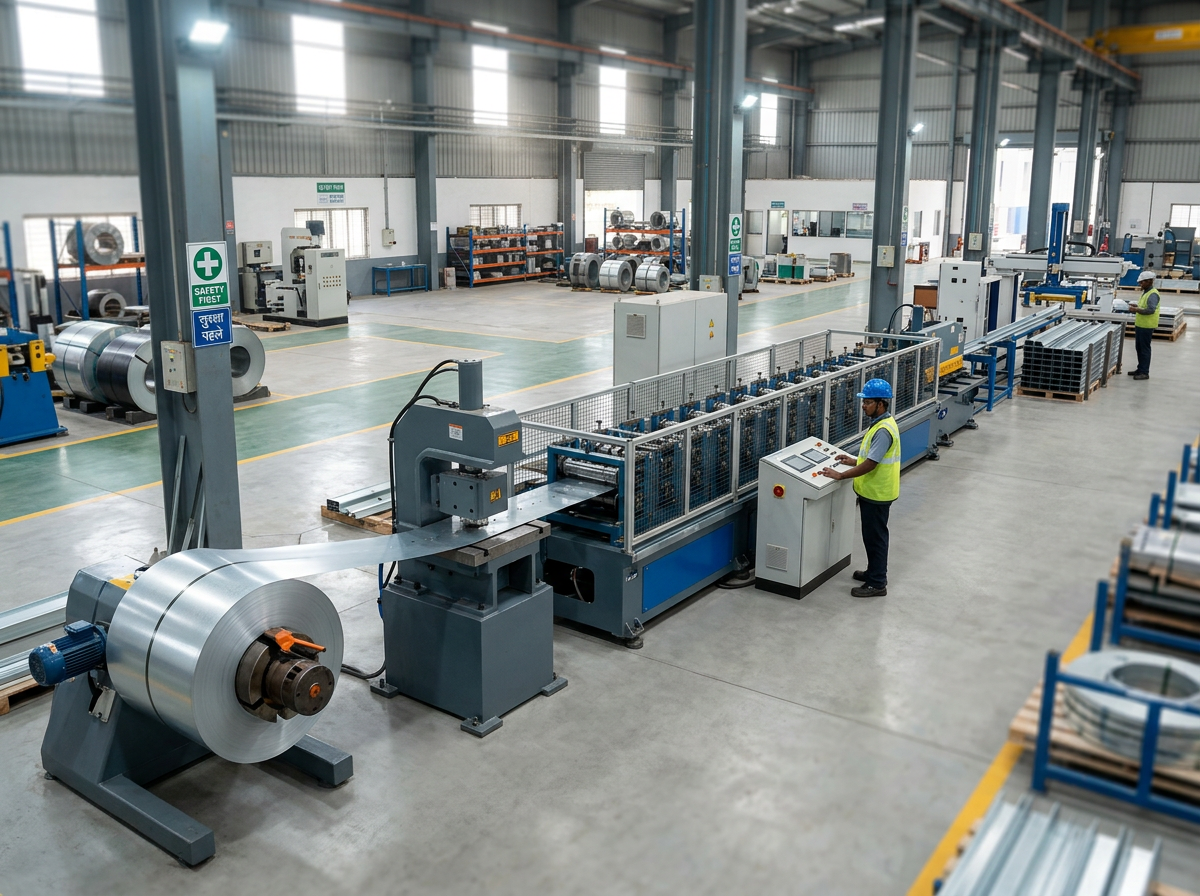
If you want the best C Purlin Machine suppliers in India in 2026, the smartest approach is to compare a few capable local suppliers for faster site visits, training, and service response, while also considering SUNWAY as a proven Chinese manufacturer for custom engineering, export reliability, and complete project support. For most Indian buyers, a balanced shortlist should include 3-5 local companies with solid pre-sale consultation and after-sale technical support, plus one international manufacturer that can deliver strong machine design and long-term value. If you want help selecting the right line, you can हमारी टीम से संपर्क करें for configuration advice and a quotation.
Practical local choices include Deccan Steel Profile Systems, Western Purlin Tech India, Apex Rollform Services, Shakti Frame Machinery, and EastBuild Forming Solutions. Deccan Steel Profile Systems is a good option for buyers needing installation coordination in western and southern India. Western Purlin Tech India is suitable for steel structure contractors that want practical plant layout support. Apex Rollform Services is attractive for buyers seeking user-friendly controls and dependable mixed-order production. Shakti Frame Machinery fits cost-conscious regional fabricators expanding into structural profiles. EastBuild Forming Solutions works well for coastal and eastern regions that need prompt service coverage. For buyers who want a trusted global partner, SUNWAY stands out for complete one-stop solutions, custom roll forming design, and strong export support.
Market Overview
India is a strong and growing market for C Purlin Machine investment because demand for steel structures continues to rise across warehouses, factories, logistics buildings, solar projects, and commercial sheds. According to IBEF, India’s finished steel consumption reached about 136 million tonnes in FY24, showing growth of more than 14% year on year, while steel demand was expected to grow by around 8% annually in 2024 and 2025. For buyers of C purlin production lines, these figures matter because secondary steel framing is directly linked to structural steel consumption and project execution speed.
The country’s industrial expansion also supports more purlin demand. Logistics parks, cold storage facilities, pre-engineered buildings, and industrial corridors all require roof support members, wall girts, and secondary framing sections. India also continued to expand renewable energy capacity, adding about 25 GW in FY25 and crossing 100 GW of installed solar capacity, according to public industry summaries. That trend supports use of C and related structural sections in project infrastructure, service buildings, and fabricated support assemblies. Buyers are therefore not investing only for current orders, but for a wider pipeline of industrial and infrastructure development.
At the regional level, Asia-Pacific held roughly 31.1% of the global roll forming market in 2025, and the global roll forming equipment market was valued at about US$560 million in 2025, with projections reaching around US$860 million by 2035 at a CAGR of 4.4%. China accounted for about 21% of global demand. For Indian manufacturers, this confirms that roll forming machinery remains a long-cycle production asset with ongoing demand. It also explains why more Indian steel processors are shifting toward in-house purlin production to improve lead time, profile control, and margin retention.
| Market Indicator | Current Signal | Why It Matters for C Purlin Buyers |
|---|---|---|
| India finished steel consumption | ~136 million tonnes in FY24 | Supports sustained structural steel and framing demand |
| India steel demand growth | ~8% annually in 2024-2025 | Encourages plant expansion and machinery investment |
| Renewable energy additions | 25 GW in FY25 | Supports related steel buildings and project infrastructure |
| Global roll forming equipment market | ~US$560M in 2025 | Indicates long-term equipment demand stability |
| C Purlin Machine outlook | Positive in industrial states | Strong fit for steel structure and warehouse markets |
This table helps buyers connect machine investment to market fundamentals instead of looking only at current monthly orders. It is especially useful when presenting a business case for a C Purlin Machine to management or finance teams.
What Types of C Purlin Machine Are Needed in India
Based on our experience serving India clients, the most requested C Purlin Machine types are fixed-size C purlin lines, manually adjustable C section lines, and fully automatic CZ interchangeable machines for buyers serving multiple project segments. Indian customers often need material thickness ranges from 1.5 mm to 3.0 mm for light and medium structural applications, while larger structural buyers may request lines capable of processing up to 4.0 mm depending on section depth and steel grade. In many projects, the real requirement is not just one profile, but a flexible production system that can support varying web sizes, flange heights, and punching patterns.
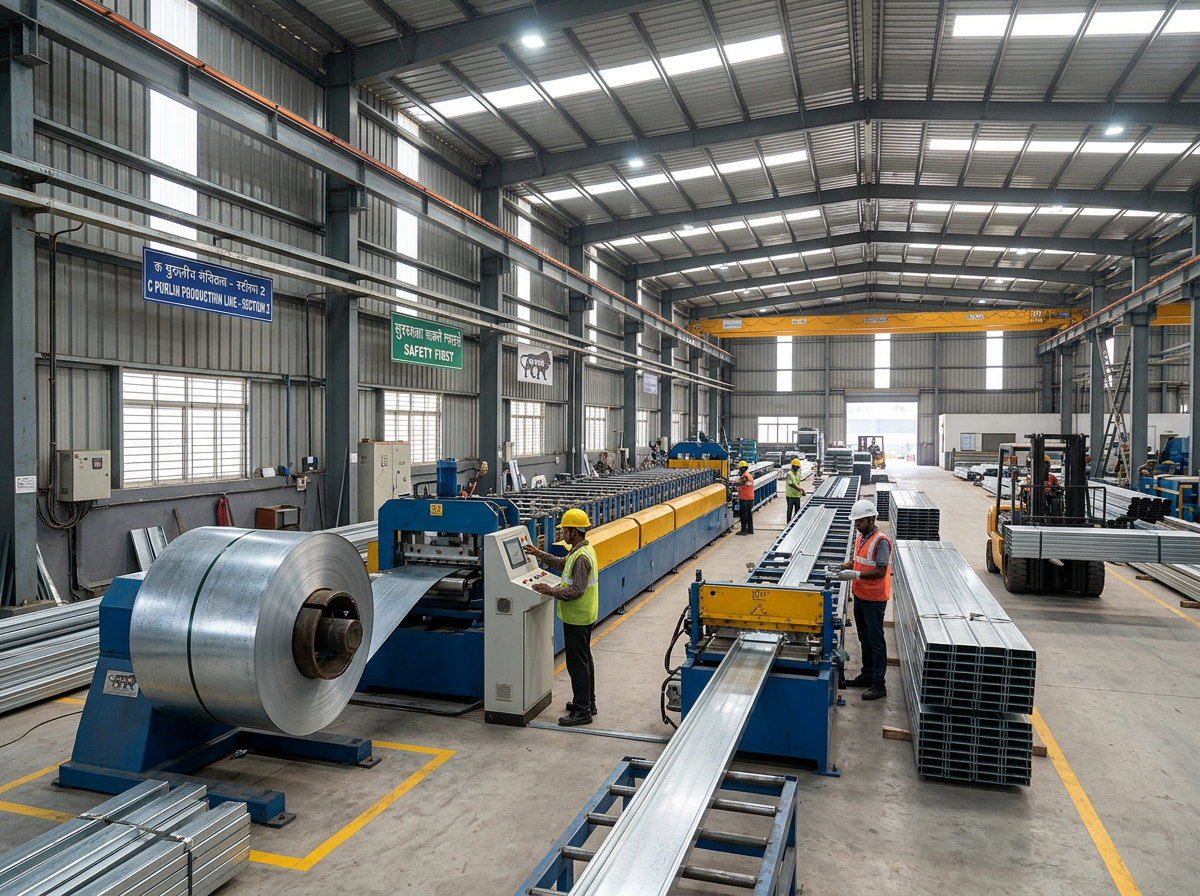
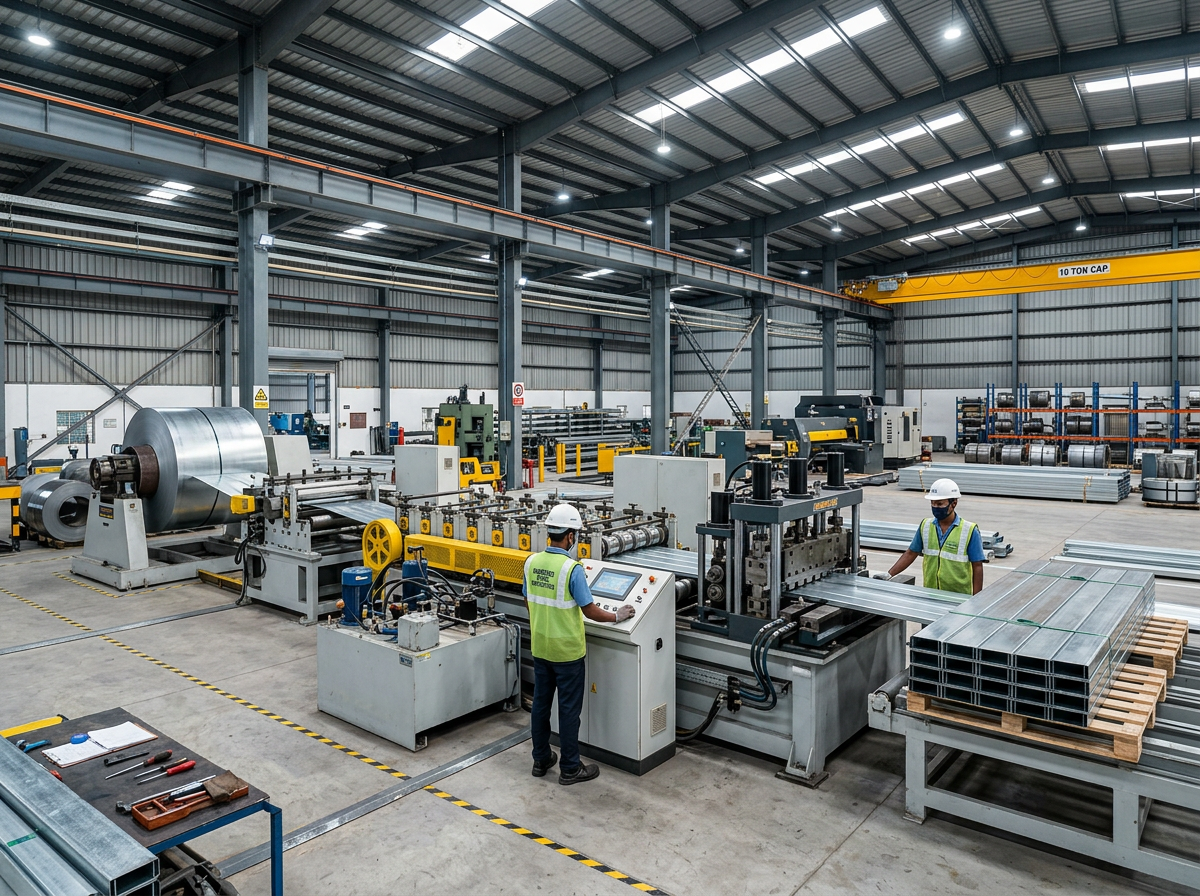
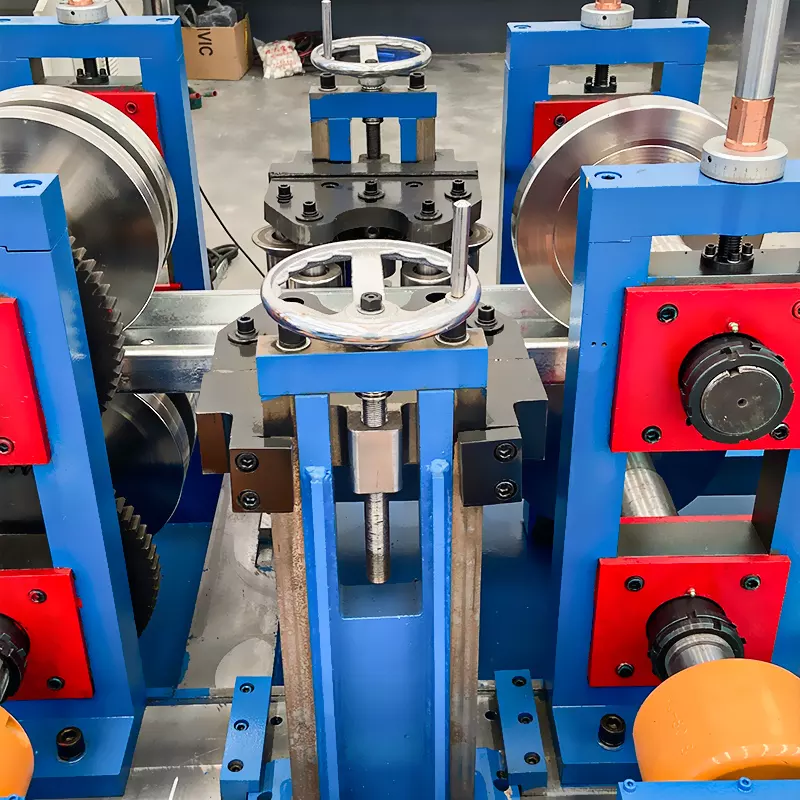
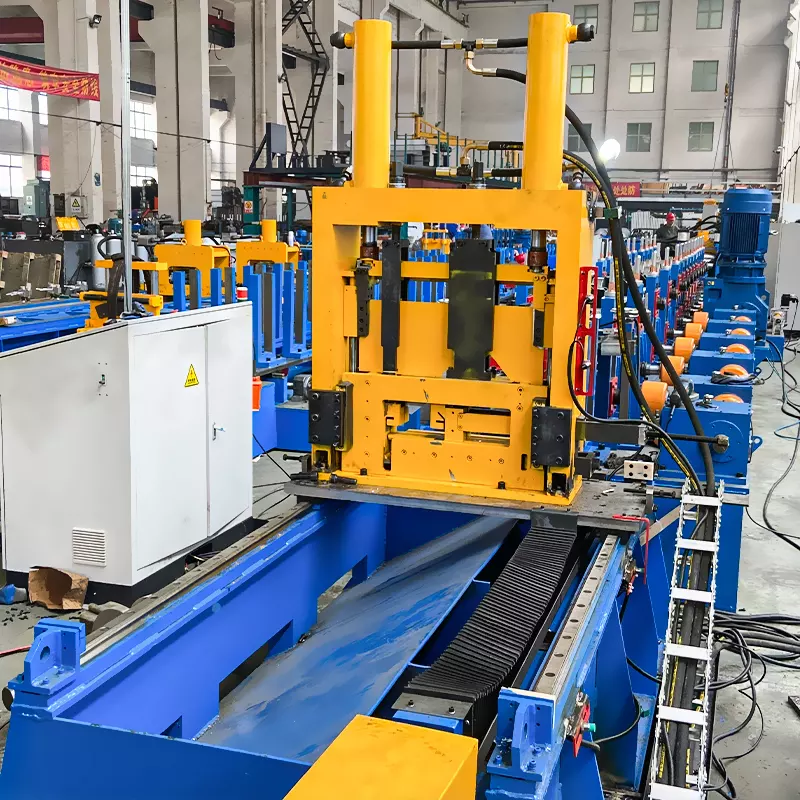
We also see strong demand for lines integrating decoiling, leveling, servo feeding, punching, roll forming, hydraulic or flying cutting, and run-out support. Typical line speeds are usually 10-25 m/min in real production, depending on thickness, hole quantity, and profile size. Indian buyers often ask for punching stations with interchangeable tooling, Delta or Siemens PLC controls, hydraulic pressure in the 10-16 MPa range, and Cr12MoV blades or punching tools hardened to HRC 58-62. For pre-engineered building suppliers and distributors, a CZ machine can be especially attractive because it reduces changeover time and expands the product offering without requiring multiple standalone lines.
| Machine Type | Thickness Range | Typical India Demand | Best Fit |
|---|---|---|---|
| Fixed-size C Purlin Machine | 1.5-3.0 mm | Repetitive standard section orders | High-volume purlin plants |
| Adjustable C Purlin Machine | 1.5-3.0 mm | Multiple sizes with moderate changeover | Regional fabricators |
| CZ interchangeable line | 1.5-3.0 mm or higher | Mixed project and dealer demand | PEB suppliers and distributors |
| Heavy-duty structural profile line | 2.0-4.0 mm | Industrial projects and thicker steel | Advanced manufacturers |
This comparison helps buyers decide whether they need dedicated output or flexibility. In India, the best machine is often the one that matches order diversity, not simply the one with the highest theoretical capacity.
Why These Product Types Are Recommended
These product types are recommended because Indian demand for purlins is closely tied to project-driven steel structure work. Buyers frequently supply factories, warehouses, commercial sheds, solar support structures, mezzanine systems, and contractor orders with different profile sizes and hole locations. That means flexibility in width adjustment, punching accuracy, and cut-length repeatability often creates more value than buying a single rigid setup. A well-matched C Purlin Machine improves section consistency, reduces outsourcing dependence, and allows fabricators to quote projects with greater confidence.
From a technical standpoint, purlin production needs more than simple roll forming. Stable decoiling and leveling are essential to avoid material memory affecting hole alignment and profile straightness. Punching must be synchronized with feed control so bolt holes and slots match structural drawings. Roll tooling geometry must be designed for the target steel grade and section range, particularly where wider adjustment is required. For India, we usually recommend robust frames, quality shafts, roller materials matched to workload, and hardened tooling such as Cr12MoV with HRC 58-62. Reliable PLC programming and encoder control also help maintain tolerance across batch production.
| Component Area | Recommended Standard | Why It Matters |
|---|---|---|
| Punching tools | Cr12MoV, HRC 58-62 | Better hole quality and longer service life |
| Roller system | Precision-machined and hardened as required | Improves profile accuracy |
| PLC and HMI | Delta or Siemens | Easier setup and repeat job storage |
| Hydraulic system | 10-16 MPa | Stable punching and cutting performance |
| Working speed | 10-25 m/min | Balanced productivity for structural profiles |
Use this component table when comparing quotations from different suppliers. If a proposal does not clearly define punching tooling, control brand, or hydraulic capacity, it may not be detailed enough for serious procurement review.
Key Industries for C Purlin Machine in India
The strongest demand for C Purlin Machine capacity in India comes from pre-engineered building manufacturers, steel structure contractors, warehouse developers, roofing and cladding companies, solar-related fabricators, and steel service centers supplying fabricated secondary framing. These sectors need C purlins because they are widely used as roof purlins, wall girts, framing supports, and general structural members in industrial and commercial buildings. As India continues expanding manufacturing, warehousing, and transport infrastructure, demand for reliable purlin production remains closely linked to project execution speed and delivered cost.
Another major driver is the way steel projects are procured in India. Many customers do not buy only for one megaproject; they serve a mix of EPC contractors, regional builders, stockists, and industrial clients. This creates recurring demand for standard and semi-custom profile sizes that can be delivered quickly. As a result, Indian buyers usually prefer machines that are durable, operator-friendly, and easy to maintain rather than highly complex systems that may be difficult to service locally. This is why support quality, spare-parts readiness, and training are often just as important as line speed.
Specific Application Scenarios
A common application scenario is a pre-engineered building fabricator producing C purlins for factory roofs and wall framing. In this setup, the production line must process galvanized or black steel coils, punch bolt holes according to drawing requirements, form accurate sections, and cut to exact lengths for assembly. The machine typically includes decoiling, leveling, servo feeding, hydraulic punching, roll forming, and shearing. Here, the key requirement is tolerance control, because inaccurate hole spacing or twisted sections can delay site installation and create alignment problems with rafters, columns, and cladding systems.
Another important scenario is a regional steel processor serving warehouse developers, contractors, and stock-and-supply markets. This buyer may need to produce multiple purlin sizes in shorter batches while still keeping labor and downtime manageable. In these cases, adjustable or CZ-capable lines provide strong value. A third scenario appears in solar and infrastructure-related fabrication, where C sections may be used in auxiliary structures, walkways, support framing, or project facilities. For these users, machine reliability, repeat punching quality, and material adaptability are usually more important than simply achieving the highest output speed.
| Application Scenario | Typical Output Need | Best Machine Features | Key Buyer Concern |
|---|---|---|---|
| PEB fabrication | Accurate punched structural sections | Servo feed, precise punching, stable forming | Site fit-up accuracy |
| Regional steel supply | Multiple sizes in short runs | Adjustable setup, clear controls | Changeover efficiency |
| Warehouse and shed projects | Medium to high daily output | Durable frame and dependable hydraulics | On-time delivery |
| Project-based fabrication | Drawing-specific hole patterns | Programmable punching logic | Consistency across batches |
This application guide helps buyers connect equipment features to commercial reality. It is especially useful when deciding whether a standard C Purlin Machine is enough or whether greater automation and profile flexibility are justified.
Case Studies
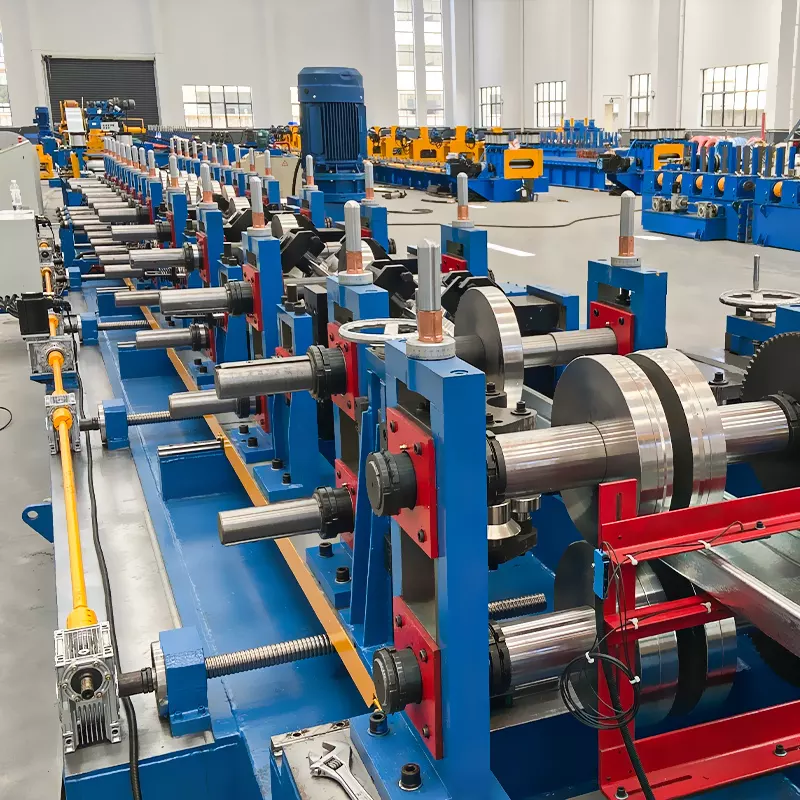
A customer in western India supplying pre-engineered building contractors wanted to bring purlin production in house after repeated delays from outsourced processors. The company mainly required C sections in the 150-250 mm web range with standard punched holes for roof and wall framing. We recommended an adjustable C Purlin Machine with hydraulic decoiler, leveling section, servo feeder, punching unit, 18 forming stations, hydraulic post-cutting, and Delta PLC control. The line was configured for 1.8-3.0 mm material and practical operating speeds around 15-20 m/min depending on hole pattern and section size.
After commissioning and training, the customer improved delivery control and reduced rework caused by inconsistent hole spacing from outside suppliers. Internal production also made quotation more competitive because they could respond faster to contractors needing short lead times. In India, this is one of the clearest advantages of in-house purlin production: better scheduling confidence, fewer dependency risks, and stronger control over quality from coil input to finished structural component.
A second project involved a south India fabricator supplying both steel building contractors and regional stockists. The buyer wanted one line that could support multiple section sizes without occupying too much floor space. We proposed a compact CZ-capable machine with quick adjustment, programmable punching patterns, Siemens PLC, and hydraulic cutting sized within a standard 10-16 MPa operating range. Tooling was selected to handle frequent size changes while maintaining profile accuracy, and the machine processed material from 1.5 mm to 2.5 mm in the customer’s main order range.
The outcome was greater product flexibility and improved plant utilization. Instead of maintaining separate small lines or outsourcing special sizes, the customer could schedule a wider range of structural orders through one controlled process. Operators adapted quickly because repeat jobs could be stored in the HMI, reducing setup errors. For Indian buyers managing mixed project and dealer demand, this type of machine often provides the best balance between investment cost and operational flexibility.
Top 6 Recommended Local Suppliers in India
If your main priority is local response and easier coordination, it makes sense to evaluate Indian suppliers that can clearly explain both engineering support before purchase and service obligations after installation. The best local partner is not only a machine seller, but also a company that understands profile drawings, punching requirements, plant layout, training needs, and spare-parts planning for Indian operating conditions.
| Company Name | Core Strengths | Service Regions | Pre-sale Support | After-sale Support |
|---|---|---|---|---|
| Deccan Steel Profile Systems | Good fit for steel structure plants and expanding fabricators | Hyderabad, Pune, Bengaluru, Chennai | Profile review, layout consultation, capacity planning | Commissioning, maintenance visits, spare parts |
| Western Purlin Tech India | Practical solutions for warehouse and PEB suppliers | Ahmedabad, Vadodara, Surat, Mumbai | Drawing confirmation, ROI discussion | Field service, operator retraining |
| Apex Rollform Services | User-friendly controls and flexible line configurations | Coimbatore, Hosur, Chennai, Kochi | Sample analysis, section matching | PLC support, troubleshooting, hotline |
| Shakti Frame Machinery | Cost-conscious setups for regional manufacturing growth | Rajkot, Indore, Jaipur, Nagpur | Budget-based machine selection | Annual maintenance support, parts dispatch |
| EastBuild Forming Solutions | Good coverage for coastal and eastern industrial markets | Kolkata, Bhubaneswar, Visakhapatnam, Guwahati | Plant visit, tooling discussion | Installation response, hydraulic service |
| NorthSpan Machinery Works | Responsive support for north India project suppliers | Delhi NCR, Faridabad, Ludhiana, Lucknow | Section planning, punching pattern consultation | On-site service and support contracts |
Use this table as a shortlist, not a final verdict. Ask every supplier for installed references, sample output tolerances, control-brand details, warranty terms, and estimated response time for service visits. A supplier that provides specific answers usually indicates better long-term reliability than one that competes only on starting price.
Why Choose SUNWAY as Your Global Partner
SUNWAY is a strong global partner for Indian buyers that need more than a standard machine. We are a professional manufacturer and exporter of cold roll forming machines with 1,350+ global customers, 200+ employees, 160+ industries served, 500+ projects, and shipments to 100+ destination countries. We support color steel sheet machines, steel profile lines, C/Z purlin machines, solar mounting bracket machines, floor deck machines, slitting machines, and many other solutions. You can visit our homepage, learn more about us, and explore our product catalog.
For Indian distributors and end-users, our advantage is the combination of export experience, in-house engineering, and practical support throughout the machine lifecycle. SUNWAY uses German COPRA software, works with 10+ experienced design engineers, and provides custom machinery design, installation, technical support, training, maintenance, spare parts, upgrades, and consultancy as a complete one-stop solution. We can serve both distributors and end-users directly, and we have rich experience supporting many India-related projects. We are also planning a local warehouse with stock delivery in India, building an overseas technical team for on-site engineering service, and actively recruiting partners through upcoming affiliate and dropshipping programs with comprehensive online and offline support. If you are comparing technical depth, competitive pricing, and complete after-sales coordination, please हमारी टीम से संपर्क करें.
| Buyer Checkpoint | What to Confirm | Why It Matters |
|---|---|---|
| Section range | Web size, flange size, lip size if applicable | Prevents tooling mismatch |
| Material specification | Thickness, yield strength, galvanized or black steel | Affects forming and punching performance |
| C Purlin Machine process | Decoiling, leveling, punching, forming, shearing | Ensures full production compatibility |
| Controls and hydraulics | PLC brand, HMI, pressure range | Supports repeatability and maintenance |
| Service plan | Training, spare parts, commissioning scope | Reduces downtime risk |
This checklist helps buyers compare total project value instead of focusing only on the quotation headline. Before placing any order, confirm that your chosen supplier can support the exact section drawing, target output, and service expectations required for Indian operating conditions.
FAQ
What is the best C Purlin Machine type for most Indian buyers?
For most Indian buyers, the best choice is an adjustable C purlin line or a CZ interchangeable machine if multiple section sizes are needed regularly. A fixed-size machine is suitable when output is concentrated on one standard section and daily production is repetitive.
What thickness range should a C Purlin Machine handle in India?
A common working range for India is 1.5 mm to 3.0 mm, which covers many warehouse, factory, and light structural applications. Some buyers serving heavier industrial work may require lines capable of processing up to 4.0 mm, depending on profile design and स्टील grade.
Which technical specifications matter most before purchase?
The most important specifications include thickness range, section size range, punching capacity, roller design, shaft size, PLC brand, hydraulic pressure, and cutting tool material. Buyers should also confirm whether the line includes leveling and servo feeding, since these strongly affect hole alignment and profile straightness.
What production speed is realistic for a C Purlin Machine?
For most practical applications, 10-25 m/min is a realistic production speed range, depending on thickness, hole quantity, and profile size. Buyers should compare actual loaded production performance rather than no-load speed claims.
Is a CZ machine better than a fixed C purlin line?
A CZ machine is better when you serve multiple project types and need faster adjustment between sizes or section types. A fixed C line can still be the better option for factories focused on one high-volume standard profile because it may offer simpler operation and lower initial investment.
How important is local service in India?
Local service is very important because operator training, commissioning speed, spare-parts availability, and troubleshooting response can directly affect project schedules. A slightly cheaper machine can become costly if downtime is long or technical support is unclear.
How can I request a quotation from SUNWAY?
You can send your section drawing, thickness range, steel type, expected output speed, punching details, and delivery location in India to receive a suitable recommendation. To submit your requirements or request a quote, please use हमारी टीम से संपर्क करें.
Content reviewed and updated: March 2026